
Puppy Training 101: Learn How to Train Your Puppy
Puppy Training Starts With Clear Routines and Early Wins

Start puppy training on the day your puppy comes home. Focus first on a predictable potty routine, calm crate familiarity, name response, gentle handling, safe socialization, and rewarding the behaviors you want to see again.
Keep practice brief and easy:
- Train for 3 to 5 minutes at a time, several times daily.
- Mark and reward the right behavior within one to two seconds.
- Prevent mistakes with supervision, a safe confinement area, and a consistent schedule.
- Use food, play, praise, and access to what your puppy wants. Avoid punishment, which can create fear and confusion.
The early weeks matter because the main socialization window narrows around 12 to 16 weeks. Your goal is not a perfect puppy. It is a puppy who learns that people, handling, new places, rest, and guidance from you are safe and worthwhile.
I am Bailey Milne-Davies, a dog trainer who has studied, shadowed, and taught alongside training professionals while building a stronger working relationship with my own dog through obedience, sport, and real-world practice. In this puppy training guide, I will help you build the same clear, relationship-based foundation from the start.
Core Foundations of Puppy Training: Where to Start
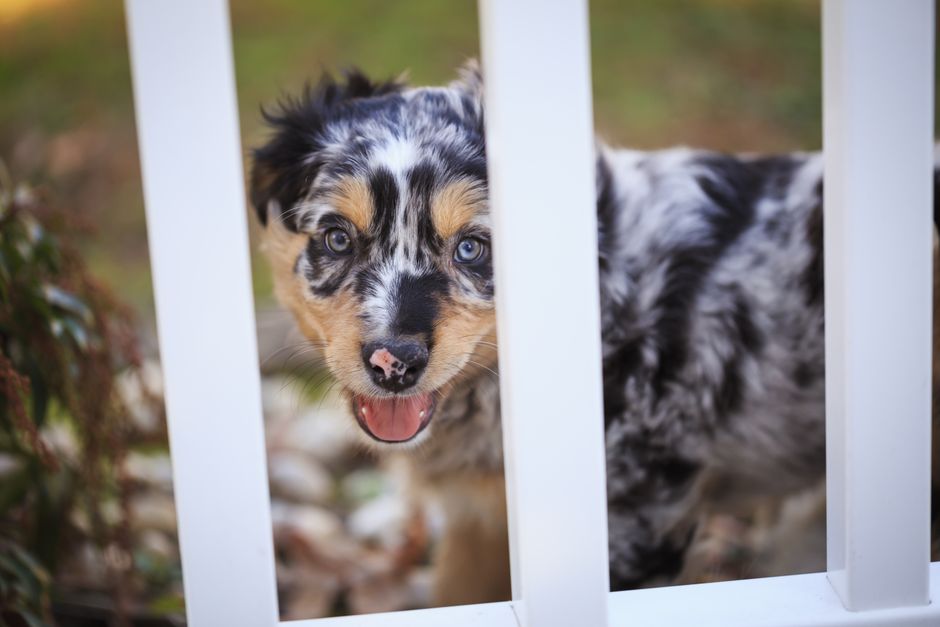
When bringing an eight-week-old puppy into your home, it is tempting to focus immediately on formal obedience cues like heel or long stays. True foundation work centers on clarity, trust, and communication. Puppies learn every single second they are awake, absorbing information about their environment, your reactions, and the consequences of their actions.
To teach effectively, we rely on clear marker systems. A marker is a distinct auditory signal, such as a sharp verbal "yes" or a mechanical clicker, that captures the exact microsecond your puppy performs a desired action. The marker bridges the gap between the behavior and the delivery of the reward.
Understanding comprehensive puppy training principles requires mastering three primary mechanics:
- Luring: Using a high-value food piece right at your puppy's nose like a magnet to guide their body into position (such as guiding their nose upward and back to cause their rear to touch the floor).
- Capturing: Waiting for your puppy to offer a natural, desirable behavior spontaneously (like offering eye contact or lying down calmly) and instantly marking and rewarding it.
- Shaping: Breaking down a complex goal into tiny, achievable steps, reinforcing successive approximations until the final behavior is achieved.
The 3-3-3 Rule for Bringing Home a Puppy
Bringing home a young dog introduces major sensory shifts, whether navigating a quiet house in San Bruno or an apartment in San Francisco. The 3-3-3 rule provides a realistic blueprint for these developmental adjustments:
- First 3 Days (Decompression): Your puppy is overwhelmed by new smells, voices, and spaces. They may sleep excessively, show hesitation when eating, or vocalize when left alone. Keep your home quiet, limit visitors, and focus entirely on gentle handling and basic containment.
- First 3 Weeks (Routine Building): By week three, your pup understands the rhythm of your home. They know when to expect meals, where the designated potty spot is, and what your daily routines look like. True personality traits and testing behaviors begin to emerge here.
- First 3 Months (Full Integration): Your puppy feels secure, recognizes your household boundaries, and forms deep relational bonds.
Applying these realistic milestones prevents handler frustration and ensures you are setting realistic training foundations without placing unfair expectations on an immature canine nervous system.
Optimizing Puppy Training Sessions for Rapid Learning
Puppy attention spans are fleeting. Expecting an eight-to-twelve-week-old puppy to focus for twenty minutes straight results in mental exhaustion, frustration, and behavioral fallout.
Keep your structured sessions between 3 to 5 minutes, repeated three to five times per day. The golden rule of puppy learning is to stop while the puppy is still eager and winning.
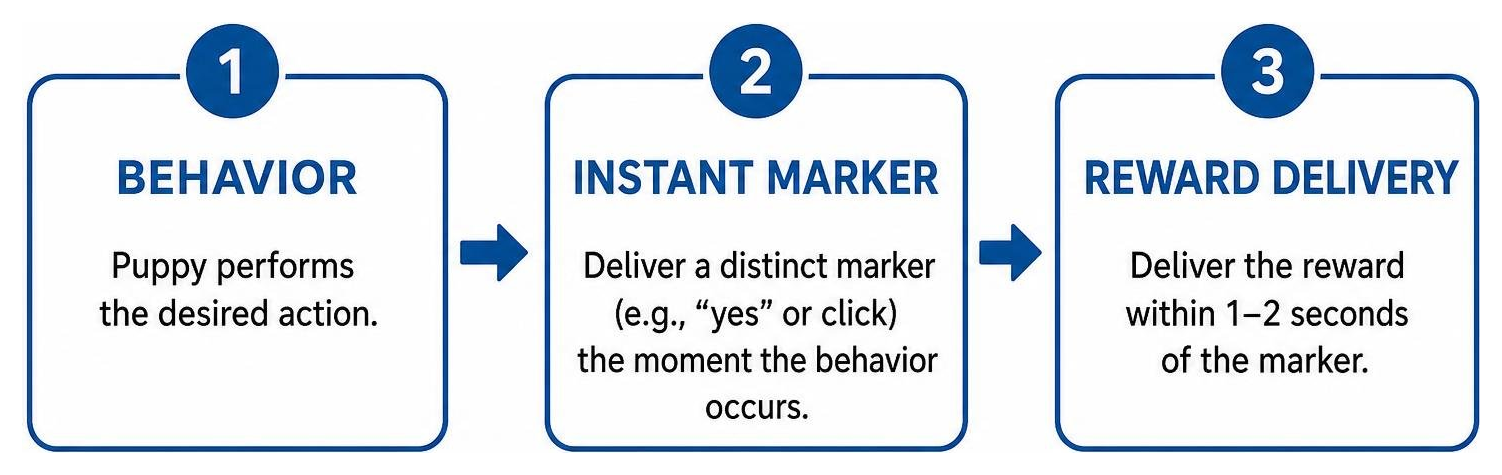
Reward delivery timing is crucial. Deliver your reward within one to two seconds of marking the behavior. If the gap is wider, you may inadvertently reward whatever behavior follows, such as pawing at your hand, breaking position, or looking away.
Maintain a clear hierarchy of rewards. Standard kibble works well in quiet indoor spaces like your kitchen in Daly City. When you transition outside to handle the sights and sounds of the Bay Area, upgrade your reinforcers to high-value items like freeze-dried liver, small cuts of roast beef, or soft string cheese cut down to the size of a pencil eraser.
Housetraining, Crate Familiarization, and Bite Inhibition
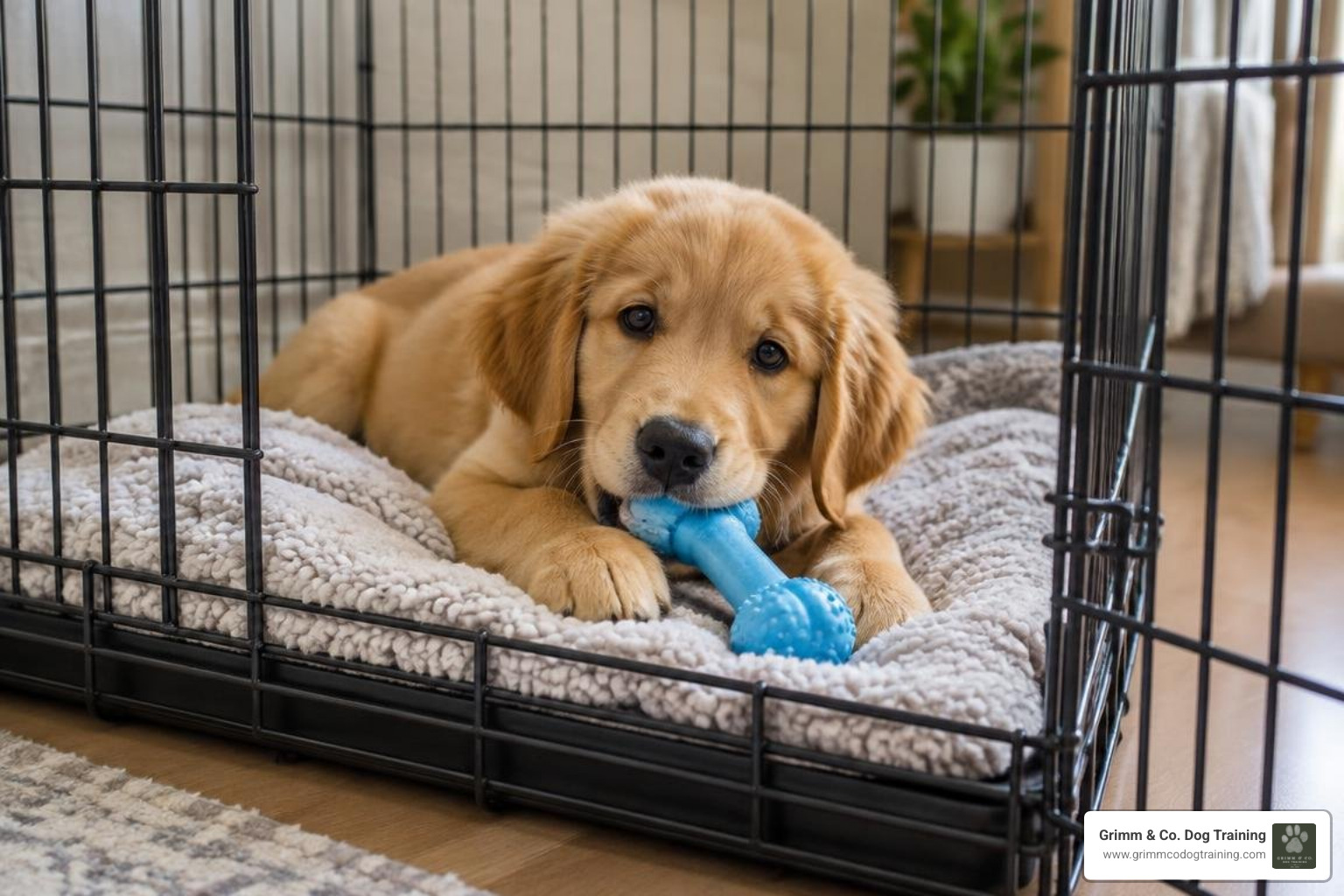
A solid house training and crate conditioning protocol prevents common behavioral issues from developing into persistent adult habits. Crate training leverages the natural denning instinct of canines, providing a secure sanctuary while accelerating the potty training process by discouraging puppies from soiling their immediate sleeping space. Mastering these routines requires consistent guidance on essential puppy behaviors from day one.
Predictable Potty Routines and Housebreaking
Young puppies have limited bladder capacity. A general benchmark for daytime holding capacity is their age in months plus one hour, though active, awake puppies often need to eliminate much more frequently.
Take your puppy out to a designated outdoor elimination spot:
- Immediately upon waking up in the morning or from daytime naps.
- Within 10 to 15 minutes after finishing a meal or drinking water.
- Directly following high-energy play, training, or chewing sessions.
- Every 45 to 60 minutes during active, unstructured indoor time.
When taking your puppy outside, keep them on a 6-foot leash to minimize distractions. Stand quietly in your designated potty area, giving them two to three minutes to sniff and eliminate. The instant they finish, mark with your verbal cue, deliver a high-value treat, and offer calm praise.
Accidents happen when owners rely on unsupervised freedom too soon. Establishing strict indoor management helps in avoiding critical early puppy raising mistakes that derail clean habits. If you catch an accident in progress, interrupt your pup neutrally without scolding, carry them directly to their outdoor potty area, and reward them if they finish there. Clean indoor accidents thoroughly with an enzymatic cleaner to eliminate biological scent markers.
Low-Stress Crate Conditioning and Alone-Time Training
A crate must be a calm refuge, never a tool for punishment. Select a crate that provides enough room for your puppy to stand up, turn around completely, and lie down comfortably with their legs outstretched. Using a crate with an adjustable divider panel allows you to expand the space as your dog grows, preventing them from using one side for sleeping and the opposite side as a bathroom.
Introduce the crate through low-pressure associations:
- Toss high-value treats and favorite toys inside, allowing the puppy to enter and exit voluntarily without closing the door.
- Feed all daily meals inside the open crate.
- Provide stuffed, frozen food puzzle toys or safe chew items inside the crate with the door latched while you sit calmly nearby.
- Gradually build duration from two minutes up to thirty minutes, only letting the puppy out when they are quiet and relaxed.
Teaching independent rest habits early prevents separation distress. Even when working from home, establish dedicated periods where your puppy rests in their crate or playpen in a separate room.
Managing Puppy Mouthing and Developing Soft Mouth Control
All puppies explore their world through their mouths. During the needle-teeth phase between 8 and 16 weeks, puppies must learn bite inhibition: the ability to control and moderate the pressure of their jaws.
When your puppy bites down with painful pressure during interaction:
- Emit a sudden, sharp, high-pitched vocalization (a yip or crisp "ouch") and instantly go limp.
- Remove your attention and hands entirely for 5 to 10 seconds.
- Re-engage smoothly and offer an appropriate chew toy or firm rubber item.
- If the puppy continues lunging or biting frenetically, they are almost certainly overtired.
Puppies need 16 to 18 hours of sleep per day. Frantic biting during the evening is rarely stubbornness; it is usually an overtired puppy needing an enforced nap in a quiet crate. Paying attention to subtle body changes and interpreting canine body language signals will help you identify when arousal is escalating before biting begins.
Early Socialization and Safe Environmental Exposure
The primary canine socialization window closes between 12 and 16 weeks of age. During this brief neurodevelopmental stage, a puppy's brain is uniquely receptive to novel stimuli, processing new environments, sounds, and objects as neutral or positive rather than threatening. Once this window closes, unfamiliar stimuli are approached with increased caution and defensive suspicion.
Socialization does not mean your puppy needs to greet every dog and person they pass. True socialization is about building confidence and environmental neutrality, teaching your puppy to remain calm, focused, and secure in varied settings.
Safe Socialization Protocols Before Final Vaccinations
New owners often face the challenge of balancing socialization with disease risk before the 16-week vaccination series is complete. The American Veterinary Society of Animal Behavior emphasizes that behavioral issues remain a significant risk for adult dogs, making safe early exposure essential.
To socialize safely in busy Bay Area spots like Emeryville, Berkeley, or San Francisco:
- Carry your puppy in a sling, pet backpack, or your arms when visiting public retail spaces, outdoor transit hubs, or downtown sidewalks.
- Take short, structured car rides to varied locations, sitting together in the cargo area or back seat to watch traffic, bicycles, and skateboards pass from a safe distance.
- Arrange structured playdates on clean, private property exclusively with healthy, fully vaccinated adult dogs known for balanced social manners.
- Avoid public dog parks, communal grass patches, and high-traffic pet store floors until your veterinarian confirms complete vaccination.
Exploring targeted local puppy socialization practices ensures your pup experiences the urban environment safely.
Applying the 7-7-7 Rule for Well-Rounded Development
The 7-7-7 rule is a practical framework to ensure your puppy experiences a wide range of positive exposures during their early weeks.
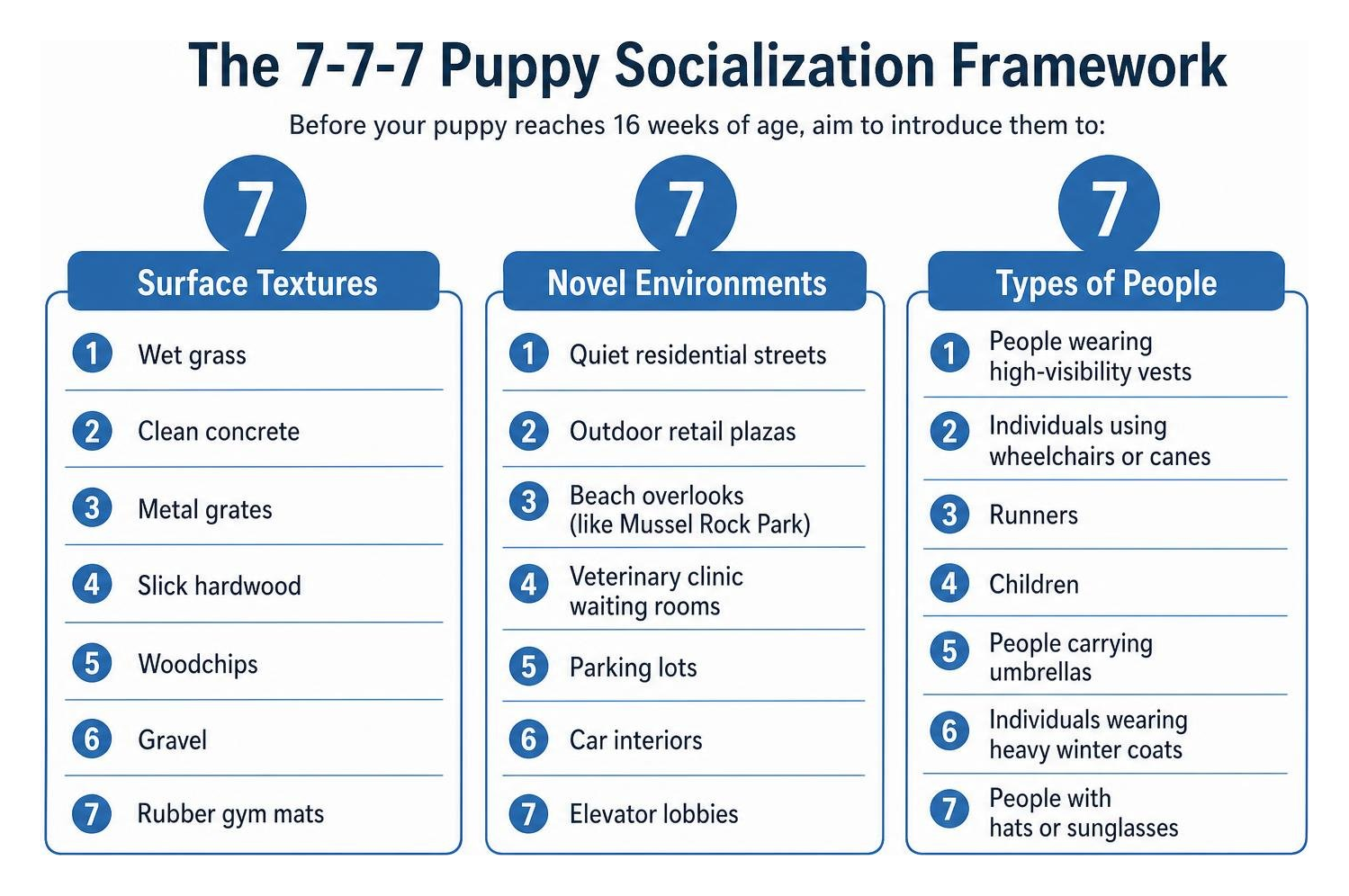
Before your puppy reaches 16 weeks of age, aim to introduce them to:
- 7 Surface Textures: Wet grass, clean concrete, metal grates, slick hardwood, woodchips, gravel, and rubber gym mats.
- 7 Novel Environments: Quiet residential streets, outdoor retail plazas, beach overlooks like Mussel Rock Park, veterinary clinic waiting rooms, parking lots, car interiors, and elevator lobbies.
- 7 Types of People: People wearing high-visibility vests, individuals using wheelchairs or canes, runners, children, people carrying umbrellas, individuals wearing heavy winter coats, and people with hats or sunglasses.
- 7 Everyday Challenges: Stepping over low obstacles, walking through open doorways, exploring cardboard boxes, walking on unstable surfaces (like a wobble board), tolerating nail clippers, experiencing gentle body exams, and hearing vacuum cleaners from a distance.
Pair every novel exposure with calm verbal praise and high-value food rewards. If your puppy hesitates, backs away, or shows tension, increase the distance from the stimulus. Never force a fearful puppy toward an intimidating object. Providing proactive exposure helps in preventing reactive vocalization around novel stimuli as your dog matures.
Structured Command Progression and Developmental Milestones
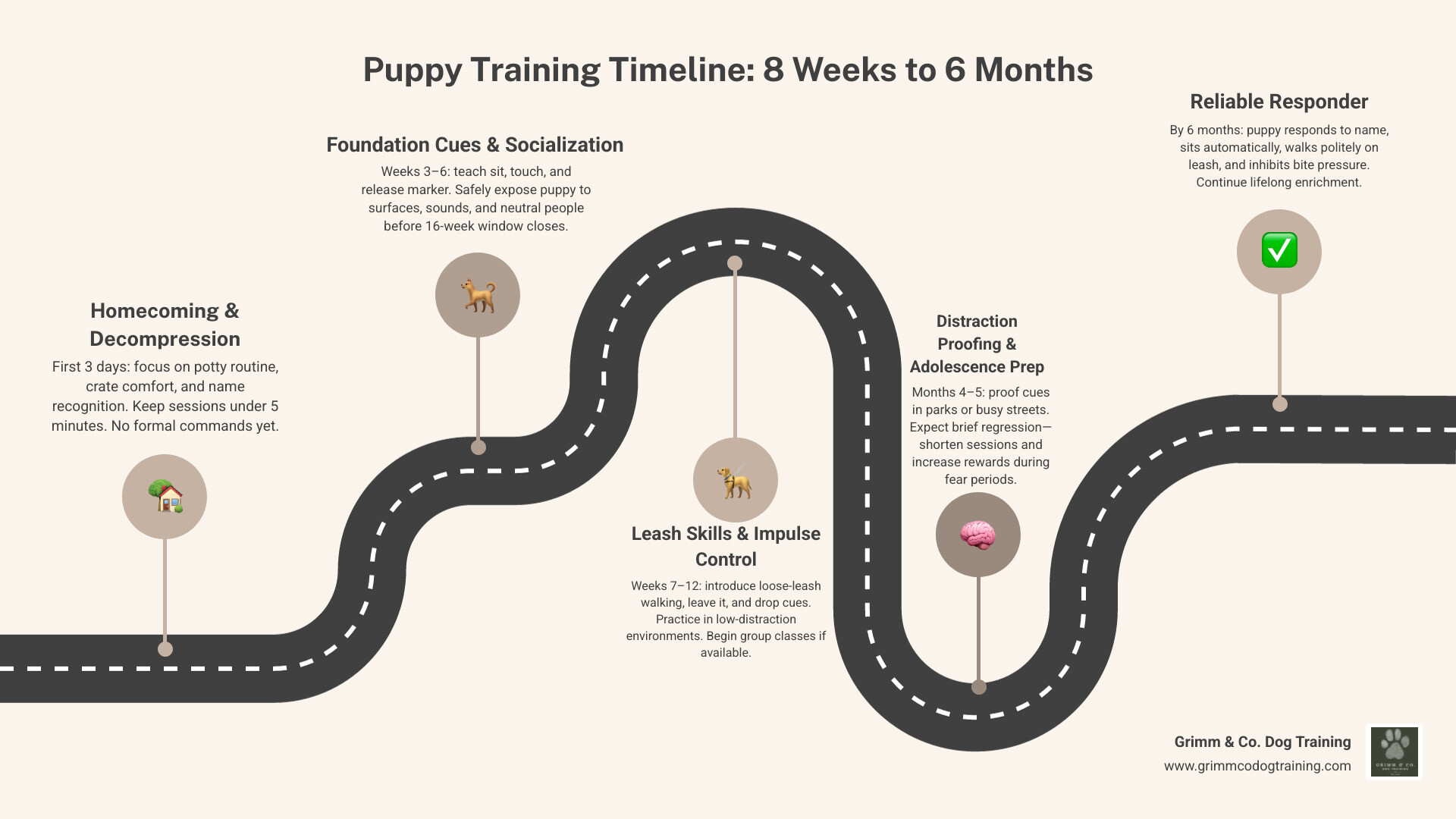
Puppy training should follow a structured progression matching physical and cognitive maturity. Rushing into complex proofing before foundational mechanics are solid leads to gaps in focus and responsiveness.
| Age Range | Primary Training Focus | Key Behavioral Exercises |
|---|---|---|
| 8 to 10 Weeks | Home adjustment, potty routines, name recognition | Crate conditioning, hand-luring mechanics, bathroom schedules, gentle handling |
| 10 to 12 Weeks | Basic obedience cues, marker mechanics | Sit, down, release cues, foundation recall, bite inhibition, gentle leash introductions |
| 12 to 16 Weeks | Impulse control, real-world socialization | Leave it, stay basics, loose-leash walking foundations, safe public exposure |
| 4 to 6 Months | Proofing obedience under distraction | Distance stays, reliable recall with distractions, polite door manners, impulse games |
| 6+ Months (Adolescence) | Routine maintenance, working focus | Generalizing obedience to new environments, structured mental hobbies (e.g., mantrailing) |
Essential Puppy Training Milestones by Age
During the 8 to 10 week period, focus entirely on home habits, name recognition, and developing a positive association with your training markers. Keep sessions short and engaging.
Between 10 and 12 weeks, begin shaping basic positions like sit and down using clean luring techniques. Introduce the leash as a neutral attachment indoors, letting the puppy trail a light line under direct supervision to prevent resistance or leash-biting habits.
From 12 to 16 weeks, move your foundation cues outdoors into controlled, low-distraction environments like a private backyard or a quiet driveway in South San Francisco. Introduce impulse-control exercises such as waiting calmly before meal bowls are placed down.
At 4 to 6 months, your puppy enters early adolescence. Physical energy increases, teething concludes, and natural independence emerges. Reviewing updated puppy obedience training strategies can help you navigate this phase without losing earlier training gains.
Core Foundational Cues: Step-by-Step Curriculum
1. The Name Game (Attention on Cue)
Say your puppy's name in a clear, upbeat tone while standing two feet away. The microsecond their head turns and their eyes meet yours, mark with "yes!" and deliver a high-value treat. Practice this across different rooms until your puppy reliably whips their head toward you whenever their name is called.
2. Sit to Down Transitions
Hold a treat at your puppy's nose, slowly moving it upward and back over their head. As their nose follows the lure, their hips lower to the floor. Mark the instant their rear touches down, reward, and release with a cheerful "break!"
From the sit, lower the treat straight down between their front paws and pull it slowly outward along the floor like an "L" shape. As their elbows touch the ground, mark and reward the down position.
3. Emergency Recall (The Come Cue)
Start indoors on a 6-foot leash. Crouch down, call your puppy's name followed by a clear "come!" in an encouraging voice, and take three brisk steps backward. As the puppy runs toward you, mark the moment they reach you, grasp their collar gently with one hand, and feed three high-value treats in rapid succession with the other.
Never call your puppy to you to perform unpleasant tasks (such as baths, ear cleanings, or crate lockups), as this creates hesitation during recall.
4. Loose-Leash Walking Foundations
Attach your leash to a standard flat collar or comfortable back-clip harness. Stand still with high-value treats held at your seam line. Whenever your puppy turns toward you and creates slack in the leash, mark, reward at your hip, and take two steps forward.
If the puppy lunges forward or hits the end of the line, immediately stop like an anchor. Wait for them to release the pressure and glance back at you, then mark, reward, and continue walking.
5. The "Leave It" and "Drop" Protocol
Hold a piece of low-value kibble in a firmly closed fist. Present the fist to your puppy. They will likely sniff, lick, and paw at your fingers.
Remain still and silent. The second your puppy pulls their nose back even half an inch, mark and deliver a high-value piece of meat from your opposite hand.
They quickly learn that ignoring the item in front of them yields something far better. Transition this concept to dropped items on the floor, adding your verbal "leave it" cue once the mechanic is fluid.
For toys, trade the item in their mouth for an identical secondary toy or high-value treat, using the cue "drop." If you need structured guidance through these foundational stages, consider exploring structured obedience classes.
Frequently Asked Questions About Raising a Puppy
What are the very first commands a puppy should learn?
The most valuable early lessons focus on functional communication rather than complex tricks. Teach name recognition (paying immediate attention when called), hand targeting (following your hand to guide movement), a clean sit-to-stay foundation, and a release marker (such as "free" or "break"). These behaviors give you the control needed to navigate vet visits, door manners, and daily household routines smoothly.
How should I handle sudden behavioral regression during adolescence?
Between 5 and 12 months of age, hormonal shifts and brain restructuring often cause temporary behavioral setbacks. A puppy who previously had reliable recall may suddenly ignore cues, or display newfound wariness toward familiar objects during a secondary fear period.
When regression happens, avoid frustration:
- Temporarily lower your expectations and reduce environmental distractions.
- Shorten your training sessions back down to focused 2-to-3-minute bursts.
- Increase the value and frequency of your food rewards.
- Reinstitute active indoor management and keep your long line attached during outdoor outings.
Consistency during this adolescent transition will solidify your adult dog's training.
When is it necessary to enroll in professional obedience training?
While routine training can be managed at home, professional intervention is recommended if your puppy exhibits early signs of resource guarding (growling or stiffening over food or toys), extreme environmental fear, persistent reactivity toward other dogs, or uncontrolled biting that does not respond to standard redirection.
A skilled trainer provides objective structural feedback, safe, controlled socialization environments, and customized handling techniques that prevent early behavioral challenges from becoming permanent adult issues.
Building a Clear, Lifelong Partnership
Raising a balanced, confident puppy takes patience, clear communication, and consistent daily habits. By implementing predictable house training schedules, gentle crate routines, thoughtful socialization, and marker-based training, you establish a solid foundation for your dog's future.
At Grimm & Co. Dog Training, we work with dog owners across Daly City, San Francisco, and the greater Peninsula, helping you build a clear, dependable working relationship with your companion. Whether you need private puppy foundation lessons, structured pack walks, or group classes, our training programs emphasize real-world focus and reliable communication.
For handlers seeking a rewarding outdoor activity, we also offer specialized mantrailing. Mantrailing taps into your puppy's natural scenting drive, providing an engaging weekend activity that builds sharp focus, mental stamina, and handler teamwork across our unique Northern California landscapes. To get started, explore personalized puppy training programs and set your puppy up for a lifetime of success.