
No More Chewed Shoes: Finding the Perfect Puppy Obedience Training Near You
Why Prevention Is the Only Real Option for Puppy Development

Puppy obedience training classes near me is one of the most searched phrases by new dog owners in the South Bay, and for good reason. The window you have to shape your puppy's behavior is narrow, and what happens inside it matters more than almost anything else you will do as an owner.
Here is a quick summary of what to look for when finding a puppy obedience class near you:
- Age range: Most classes accept puppies between 9 weeks and 6 months old
- Class format: Group classes, private lessons, and hybrid options are all available
- Core skills taught: Sit, down, stay, recall, loose leash walking, and impulse control
- Typical cost: Roughly $160 to $250 for a multi-week group course
- Class length: Usually 5 to 8 weeks, with sessions of 45 to 60 minutes each
- Health requirements: Most programs require proof of DHPP and bordetella vaccinations before your puppy can attend
- What to bring: High value treats, a standard leash, and your puppy's vaccination records
The puppy in front of you right now is not a problem to manage. It is a dog in progress. The chewed shoes, the jumping, the pulling toward every stranger on the sidewalk, these are not personality flaws. They are the entirely predictable result of a developing brain with no framework yet for how the world works. Your job, and the job of a good training program, is to provide that framework before the absence of one becomes the problem.
I'm Bailey Milne-Davies, and my own entry point into serious dog training came not from a textbook but from a dog named Grimm who had too much freedom, too little structure, and a very clear opinion about where he was going on any given walk. That experience, combined with formal study at Tarheel Canine and years of work alongside skilled trainers, shapes how I think about puppy obedience training classes near me and what actually makes them worth your time.
Why Early Intervention Is the Only Strategy That Works
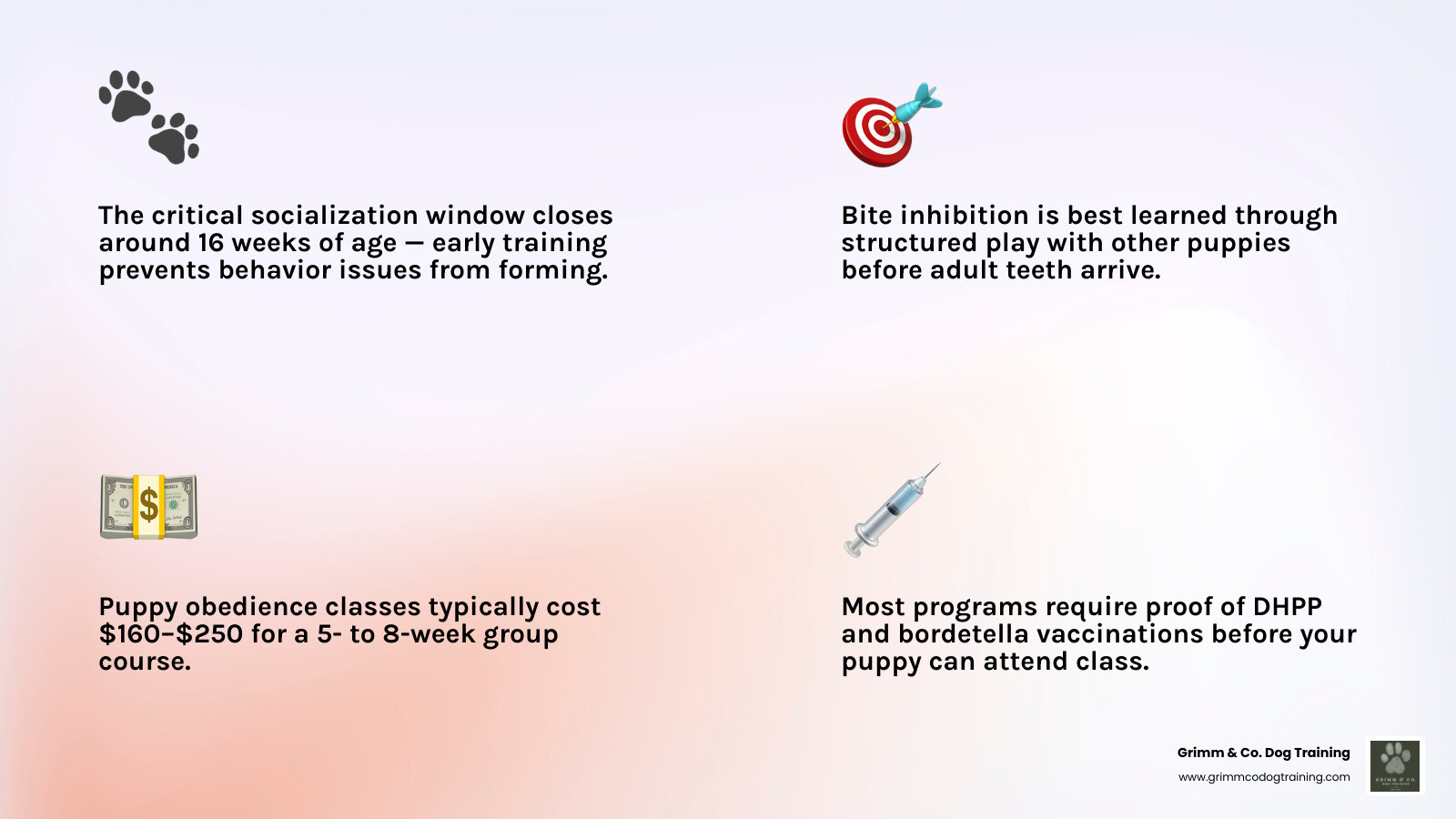
Waiting for your puppy to grow out of unwanted behaviors is a strategy designed for failure. The critical socialization window closes rapidly, typically around sixteen weeks of age. During this brief developmental phase, your puppy forms foundational associations about what is safe, what is threatening, and how to interact with the environment. If you miss this window, you are no longer preventing behavior issues; you are actively rehabilitating them.
One of the most vital skills a puppy learns during early group interactions is bite inhibition. Puppies naturally explore the world with their mouths, but they must learn the limits of their jaw pressure before their adult teeth arrive. Through structured play and immediate feedback from their peers, they learn that biting too hard brings an abrupt end to the fun. This social feedback is incredibly difficult to replicate in a home environment without other dogs.
Our philosophy focuses heavily on relationship building rather than simple obedience. A dog that obeys out of fear or mechanical repetition is not a reliable companion in a busy urban environment. By establishing clear communication and mutual respect early on, you prevent the common behavior challenges that lead to frustration later in life. Investing in professional Puppy Training during these formative months ensures you build a cooperative partnership that lasts a lifetime.
What to Demand from Puppy Obedience Training Classes Near Me
When evaluating local options, you must look beyond convenience and price. The market is saturated with trainers, but the quality of instruction varies wildly. You should demand a program that utilizes relationship based methods. Avoid classes that rely on heavy corrections for young puppies, as well as those that offer unstructured, chaotic free play where fearful puppies are bullied and assertive puppies learn to overbear others.
Class size is another critical factor. A room crowded with twelve puppies and their distracted owners is a recipe for sensory overload. Look for small group sizes where the instructor can provide individual attention and tailor feedback to your specific dog. The training environment should be clean, secure, and designed to minimize unnecessary stress while still providing enough distraction to proof the behaviors you are teaching.

A professional trainer should possess verifiable credentials and a deep understanding of canine development. They should be able to explain the mechanics behind their training decisions, rather than relying on outdated dominance theories. When you evaluate our Training Approach, you will find a structured, thoughtful methodology designed to build focus, calm state of mind, and reliable manners in real world situations.
The Elements of a Sophisticated Puppy Curriculum
A sophisticated puppy class does not just teach your dog to sit on cue in a quiet room. It prepares your dog to navigate the complexities of your actual lifestyle. The curriculum should balance formal obedience commands with practical life skills, impulse control, and cooperative husbandry handling.
Loose leash walking is a prime example of a behavior that requires early, consistent instruction. A puppy that learns to pull to get where they want to go will grow into an adult dog that drags you down the street. Teaching your puppy to yield to leash pressure and choose to walk near you is far easier than trying to correct a deeply ingrained pulling habit in a mature, powerful dog.
| Training Category | Basic Obedience Focus | Advanced Lifestyle Focus |
|---|---|---|
| Leash Manners | Walking on a loose lead in a quiet training room | Navigating crowded sidewalks near high traffic areas |
| Impulse Control | Waiting briefly for a food bowl or treat | Ignoring dropped food on a busy restaurant patio |
| Socialization | Neutrality around other dogs and handlers | Settling quietly under a table while other dogs walk past |
| Husbandry | Tolerating basic paw touches and collar holds | Cooperating calmly during veterinary exams and grooming |
Core Behaviors Taught in Puppy Obedience Training Classes Near Me
The foundational behaviors taught in a premium puppy class serve as the building blocks for all future training. We do not view these behaviors as mere tricks. They are functional tools for safety and daily management.
- Sit and Down: These positions are the foundation of a reliable settle. We teach puppies to sit for attention rather than jumping on guests.
- Stay: This behavior teaches your puppy to remain in place until released, building valuable impulse control and mental endurance.
- Recall: Coming when called is a non negotiable safety skill. A reliable recall ensures you can get your dog out of potentially dangerous situations quickly.
- Attention and Focus: Teaching your puppy to look at you on cue, even when the environment is highly stimulating, is the key to managing reactivity.
By enrolling in structured Group Classes, you learn how to teach these behaviors systematically, ensuring your puppy understands them even when surrounded by distractions.
Real World Proofing in Puppy Obedience Training Classes Near Me
It is easy for a puppy to perform commands in the quiet comfort of your living room. The real test of a training program is whether those behaviors hold up when you take your dog out in public. Real world proofing is the process of gradually introducing distractions, distance, and duration to your puppy's existing skills.
For residents of the South Bay, this proofing is essential. If you want to enjoy a quiet afternoon on a dog friendly patio in Redwood City or walk through the bustling farmers market in Los Gatos, your dog must know how to settle quietly despite high stimulation. Our Dog Obedience Training Classes focus on preparing you for these exact scenarios, teaching you how to advocate for your dog and maintain their focus in challenging environments.
What to Expect Regarding Logistics and Health Requirements
Before your puppy can set foot in a training facility, you must navigate several logistical and health requirements. These protocols are not arbitrary; they are designed to protect the health of all participants. Because puppies do not possess fully developed immune systems, reputable training programs enforce strict vaccination standards.
Most facilities require proof of at least two rounds of the DHPP vaccine, which protects against distemper, hepatitis, parvovirus, and parainfluenza. A bordetella vaccine is also standard to prevent canine cough. Once your puppy reaches sixteen weeks of age, proof of a rabies vaccination is mandatory. Some advanced programs will also accept valid antibody titer tests as an alternative to standard re-vaccination records.

In terms of financial investment, you can expect to pay anywhere from $160 for a basic five week community program to upwards of $250 for an intensive eight week course that includes professional evaluations like the AKC STAR Puppy exam. For those seeking a comprehensive approach to early development, our Puppy Passes offer a streamlined way to access both group classes and targeted private instruction.
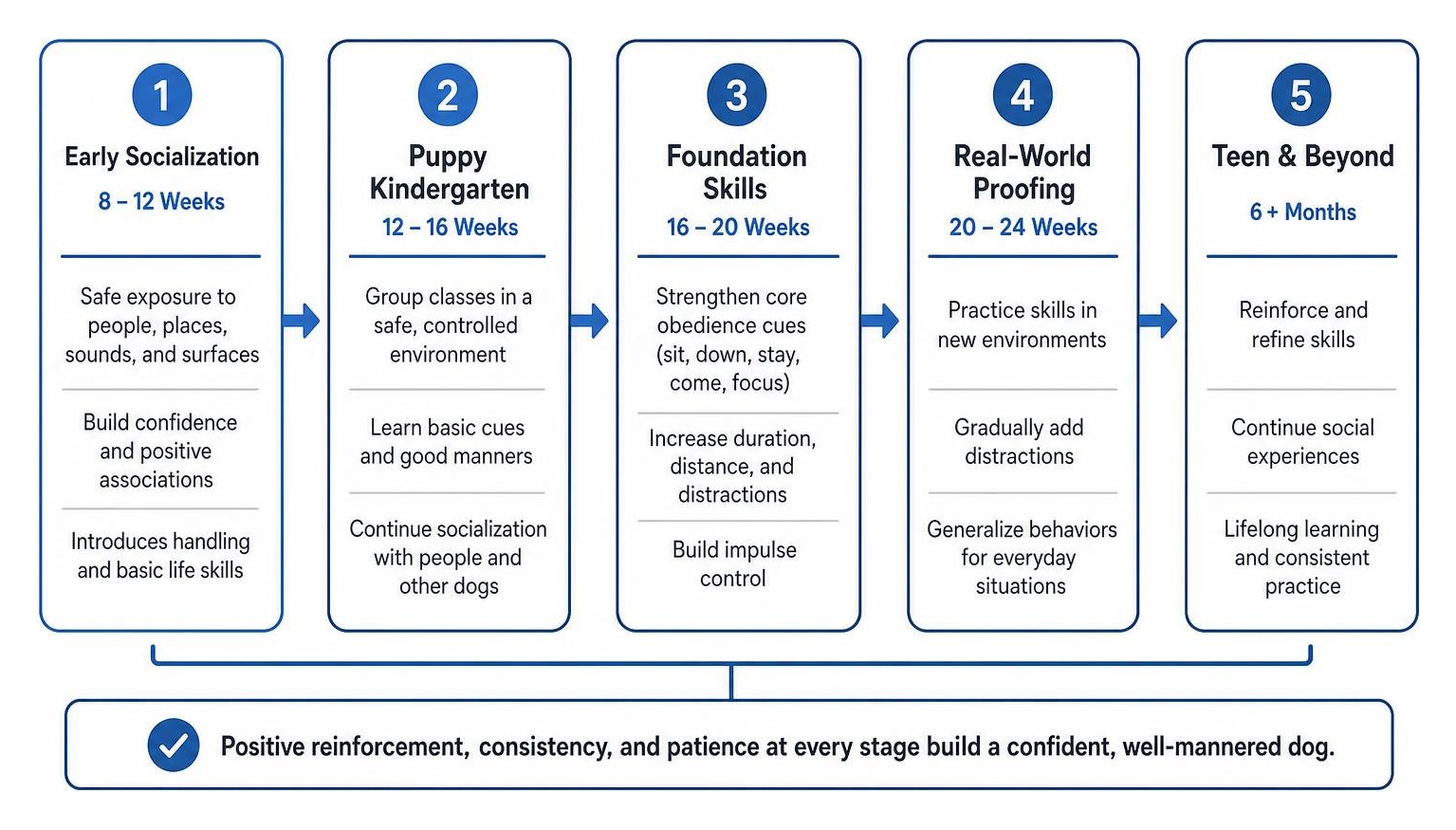
To help you visualize the timeline and requirements, here is a breakdown of the standard progression for early puppy instruction:
For additional context on course structures and pricing models in the broader training industry, you can review standard curriculums like the Basic Obedience Level I course, a typical community based Puppy Kindergarten program, or a structured Puppy Obedience Class syllabus.
Common Questions on Early Development and Training
Navigating the early months of dog ownership can feel overwhelming. Here are some of the most common questions we receive regarding puppy development and class preparation.
At what age should a puppy begin formal instruction
A puppy can and should begin formal training as early as nine weeks of age. While they will not have completed their full vaccination series at this point, the risk of behavioral issues resulting from poor socialization far outweighs the medical risks of attending a clean, controlled indoor training environment. Waiting until your puppy is fully vaccinated at six months old means missing the most critical learning window of their life.
The logistics of raising and training siblings simultaneously
We strongly advise against raising littermates or two puppies of similar ages at the same time. Doing so often leads to littermate syndrome, a condition where the puppies bond so to each other that they fail to develop individual confidence or a strong bond with their human handlers. If you do choose to raise siblings, they must be crated, exercised, trained, and socialized separately to ensure they learn to navigate the world as independent, confident individuals.
Essential preparation for the first day of class
Preparation is key to a successful first session. You should bring a large supply of high value treats, such as small pieces of freeze dried meat or cheese, cut into portions no larger than a pea. Avoid feeding your puppy a large meal right before class; a slightly hungry puppy is far more motivated to learn. Ensure you have a standard six foot flat leash, a comfortable collar or harness, and a copy of your puppy's up to date vaccination records.
Setting the Standard for Your Dog's Future
The choices you make during your puppy's first six months will echo throughout their entire life. You can spend that time reacting to behavioral issues as they arise, or you can proactively build a foundation of clear communication, focus, and mutual respect.
At Grimm and Co. Dog Training, we specialize in relationship based training that prepares your dog for the realities of life in the San Francisco Bay Area. Whether you are navigating the busy streets of Daly City or looking to enjoy a quiet weekend in San Francisco, we provide the structure and support you need to raise a well mannered companion.
If you are ready to invest in a premium training experience that respects your intelligence and delivers real results, explore our upcoming Group Classes and take the first step toward a lifetime of cooperative partnership.