
The Friendly Yapper: Training Your Puppy to Ignore Other Dogs
Your Puppy Barks at Other Dogs. Here Is What Is Actually Happening.

When a puppy barks at other dogs, it rarely means what owners fear it means. It is not aggression, nor is it dominance or a sign of owner failure. It is communication from an animal that has not yet learned the vocabulary to say what it means quietly. Understanding the root cause of this behavior is the first step toward resolving it.
The behavior typically stems from one of several distinct emotional states. Excitement and frustration often manifest as forward lunging and whining, common in puppies over three months old. Fear or insecurity presents as backing away with a tucked tail, a defensive strategy to create distance. Leash frustration occurs when a puppy is perfectly social off leash but reactive when restrained. Finally, a lack of social skills or general overstimulation can cause a young dog to bark incessantly, unable to settle in high traffic environments.
Walking a dog through the dense, high stimulation neighborhoods of the South Bay makes this problem feel urgent fast. Other dogs appear around every corner on every trail and every cafe patio, demanding immediate control. The urgency, however, should be about getting the training right rather than simply suppressing the noise.
I am Bailey Milne Davies, and my own dog Grimm taught me how a social, energetic dog can slide into frustration and reactivity when the foundations are not in place. That experience, combined with professional training and ongoing work with dogs navigating the specific demands of urban Bay Area life, is what this guide is built on. If your puppy barks at other dogs and you want to understand why before you try to fix it, you are in the right place.
Deciphering the Vocalizations of a Developing Canine
To resolve vocal reactivity, we must first understand that barking is one of the primary tools of canine vocal communication. Puppies do not possess a complex repertoire of social strategies, so they default to vocalizations to express their internal emotional states. When your companion projects their voice across a crowded park in Redwood City, they are offering a direct window into their nervous system. Understanding this language requires looking past the noise to evaluate the underlying physiology of the animal.
According to the Why Do Dogs Bark at Each Other? : American Kennel Club , barking serves multiple communicative functions including playfulness, territorial defense, attention seeking, and fear. For a young dog, these categories are not always distinct, and a puppy can easily slide from one state into another within seconds. To help you decode these moments, we have detailed the nuances of puppy communication in our guide on What Your Puppy Is Trying to Tell You. By analyzing the physical posture accompanying the vocalization, we can determine whether the puppy is seeking connection, asking for space, or simply overwhelmed by the environment.
These behaviors generally fall into three distinct categories of intention. Playful engagement is characterized by loose, bouncy movements, a classic play bow, and wide tail wags, accompanied by high pitched, repetitive yips. Fearful avoidance presents with weight shifted back, a tucked tail, lip licking, and a sharp, rapid, descending pitch designed to increase distance. Frustrated greeting, on the other hand, involves a stiff forward lean, a high tail, and persistent, harsh barking as the puppy strains against the leash in a desperate attempt to access the other dog.
Distinguishing Between Frustrated Greetings and Fear
The distinction between excitement and fear is the most critical diagnostic step in resolving leash reactivity. Many owners misinterpret a frustrated greeting as aggression because the display is loud and intense. Frustrated greeting occurs when a highly social puppy, accustomed to unstructured play, is restrained by a leash. The physical barrier of the leash prevents natural greeting rituals, causing intense frustration that manifests as frantic barking and lunging.
Conversely, fear based barking is designed to achieve the exact opposite result. When a puppy experiences a developmental fear period, which commonly occurs around the age of four to five months, unfamiliar dogs can appear highly threatening. This triggers a fight or flight response. Because the leash restricts their ability to flee, the puppy selects the only other available option, which is to bark aggressively to force the approaching dog to go away. As outlined in the analysis of Why Does My Puppy Bark At Other Dogs? [And How To Respond] , under socialized puppies often default to this defensive strategy because they lack the confidence to process novel stimuli calmly.
Reading the Subtle Physical Cues of Arousal and Stress
Relying solely on the sound of the bark is a mistake, as a high pitched invitation can quickly mask rising stress levels. True canine body language is written in the subtle details of muscle tension and micro movements. A playful puppy displays a loose posture, often offering a classic play bow where the front legs are lowered while the hindquarters remain raised. Their movements are fluid, and their tail wags in a relaxed, circular motion that involves the entire rear half of their body.
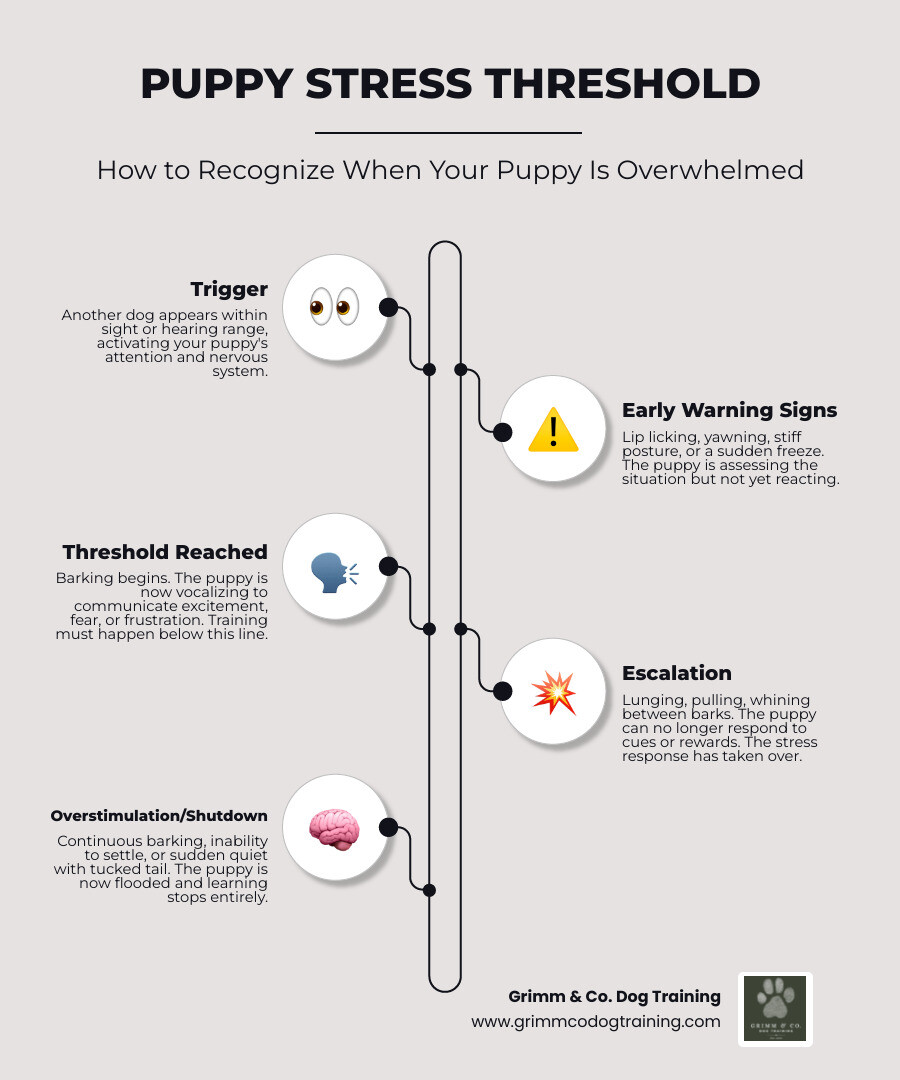
When over stimulation or fear takes over, the physical presentation changes dramatically. The body stiffens, the tail rises to a rigid vertical position or tucks tightly between the hind legs, and the puppy may display lip licking, yawning, or a whale eye where the whites of the eyes are visible. These are clear indicators of escalating stress. If these early signs are ignored, the puppy will cross their emotional threshold, rendering them temporarily incapable of learning or processing training cues.
The Generational Divide in Canine Communication
Puppies do not enter the world with fully formed social graces, and their interactions with adult dogs often reveal significant developmental gaps. Young dogs communicate with a high degree of physical enthusiasm, which can easily overwhelm or irritate older animals. Senior dogs, much like older humans, often have physical limitations such as arthritis or sensory decline that reduce their tolerance for chaotic energy. This mismatch in energy and communication styles is a frequent source of tension during neighborhood walks in Daly City.
According to research on Why Does My Puppy Bark at Older Dogs? , this vocal behavior is often driven by a lack of social manners and basic boundary testing. Puppies are essentially social novices who have not yet learned to read the quiet, subtle boundary setting signals that mature dogs employ. When an older dog turns their head away or stiffens their body, they are politely asking for space. A puppy often misses these quiet cues and continues to bark, attempting to force an interaction that the adult dog is actively avoiding.
The Social Mismatch Between Puppies and Mature Dogs
The tendency for a puppy to bark at older dogs while ignoring peers of their own age stems from a social mismatch. Other puppies share the same high energy, unstructured play style, making their interactions predictable and easy to navigate. Mature dogs, however, present a completely different set of behavioral expectations. They are calmer, more direct, and highly protective of their personal space.
When a puppy encounters an adult dog, they often experience a mix of curiosity and insecurity. The puppy may bark to test the boundaries of the older dog, trying to determine if the adult is a play partner or a potential threat. If the puppy has not had sufficient exposure to balanced, calm adult mentors, they will default to vocalizations as a defensive mechanism to manage their own discomfort in the presence of a larger, more confident animal.
Understanding Normal Adult Corrections and Boundaries
It is common for owners to feel alarmed when an older dog growls or snaps at a vocal puppy, but these corrections are often a normal and necessary part of canine socialization. Well adjusted adult moderators use controlled corrections to teach puppies appropriate social limits. A quick, dry growl or a sharp air snap is the canine equivalent of a firm verbal reprimand. These corrections are rarely intended to cause physical harm; rather, they are designed to teach the puppy that pushy, vocal behavior will not be tolerated.
However, we must never rely entirely on other dogs to educate our puppies. We must actively monitor these interactions and look for warning signs that indicate the older dog is becoming dangerously stressed. If the mature dog displays a rigid body, bared teeth, or a low, sustained growl that does not resolve when the puppy backs away, we must intervene immediately. Separating the dogs before the situation escalates preserves the safety of both animals and prevents the puppy from learning that other dogs are highly dangerous.
When Your Puppy Barks at Other Dogs: Systematic Training Protocols
Resolving vocal reactivity requires a structured, relationship based training approach that focuses on building focus and changing the puppy's underlying emotional response. We do not support methods that simply suppress the bark through punishment, as this does not address the root cause of the behavior and can lead to severe behavioral fallout. Instead, we focus on proactive management and teaching alternative behaviors that set the dog up for success.
To build a solid foundation, we recommend reviewing our principles on Setting Your Dog Up for Success. By structuring your training sessions deliberately, you can prevent your puppy from entering situations where they are destined to fail. For owners dealing with more intense reactions, our resources under the Dog Reactivity Tag offer deeper insights into managing reactive patterns in high distraction urban environments.
Distance Management and the Look at Me Cue
The foundation of reactivity training is distance management. Every puppy has a working threshold, which is the precise distance at which they can observe another dog without reacting. For some puppies, this threshold may be fifty feet; for others, it might be the width of a standard street in San Jose. Our goal is to identify this threshold and work strictly within the zone where the puppy remains calm and receptive to learning.
Within this safe distance, we teach the look at me focus cue. This behavior shifts the puppy's attention away from the environmental trigger and back to the handler. To train this, you will mark the moment your puppy looks at you with a clicker or a precise verbal marker, then deliver a high value reward, such as roast chicken or freeze dried liver. By systematically practicing this cue in low distraction areas before transitioning to busier parks, you build a reliable history of reinforcement that competes successfully with the presence of other dogs.
Desensitization and Counter Conditioning Protocols
Desensitization and counter conditioning work together to change the puppy's emotional association with other dogs. Systematic desensitization involves exposing the puppy to the trigger at an intensity so low that it does not elicit a stress response. Over time, we gradually decrease the distance between the puppy and the other dog, ensuring the puppy remains relaxed at each step of the process.
Counter conditioning pairs the sight of the other dog with a positive experience. The moment another dog enters the puppy's field of vision, we begin delivering high value rewards. When the other dog leaves, the rewards stop. This teaches the puppy that the presence of other dogs predicts highly valuable resources, transforming their emotional state from frustration or fear to calm anticipation. Managing this process carefully prevents trigger stacking, which occurs when multiple stressors accumulate over a short period, pushing the puppy over their threshold. For a realistic look at how this progress unfolds over time, we recommend reading our personal accounts of Living with a Reactive Dog.
Structuring Safe Introductions and Avoiding Common Pitfalls
Introducing a vocal puppy to unfamiliar dogs requires a highly controlled environment and a clear plan. Random, face to face meetings on tight leashes are a recipe for failure, as they artificially force dogs into a confrontational posture. When leashes are held tight, they transmit the handler's tension directly to the dog, exacerbating barrier reactivity and increasing the likelihood of a vocal outburst.
Understanding that reactivity can fluctuate based on environmental factors is crucial. As we discuss in Your Dog's Reactivity Isn't Getting Worse, seasonal changes and increased foot traffic can expose underlying vulnerabilities in your dog's training. Navigating these challenges requires patience and a commitment to long term progress, a topic we explore deeply in Lessons from Grimm: Living with a Reactive Dog.
Parallel Walking and Controlled Exposure
The safest and most effective method for introducing dogs is parallel walking. This technique involves walking two dogs in the same direction on neutral ground, maintaining a safe distance between them. Because the dogs are moving forward together rather than confronting each other head on, the pressure of the interaction is significantly reduced. This allows them to acclimate to each other's scent and movement patterns without the pressure of direct contact.
As the dogs show signs of relaxation, such as loose body language and casual sniffing of the environment, the distance between the walkers can be gradually decreased. Keep initial interactions brief and positive, ending the session before either dog becomes over stimulated. At home, utilize management tools such as baby gates and playpens to give both animals dedicated space to decompress, preventing the puppy from pestering older residents.
Common Training Errors That Reinforce Reactivity
Many well meaning owners make critical errors that unintentionally worsen their puppy's vocal behavior. The most common mistake is shouting at the puppy to be quiet. To a highly aroused young dog, your shouting sounds exactly like barking, which serves to validate and reinforce their vocal outburst. Another frequent error is grabbing the puppy by the collar to drag them away, which can cause collar sensitivity and teach the puppy to associate the presence of other dogs with physical discomfort.
Forcing greetings is equally damaging, as it deprives the puppy of choice and can easily push a fearful dog into defensive aggression. Similarly, taking an under socialized or highly reactive puppy to a dog park in the hope that they will work it out is a dangerous strategy. Dog parks are highly unpredictable environments that frequently overwhelm young dogs, cementing negative associations that can take months of intensive training to resolve. Finally, relying on bark control tools, such as ultrasonic devices or static collars, is highly counterproductive; these tools increase anxiety and fail to address the underlying emotional state of the animal.
Frequently Asked Questions About Puppy Reactivity
Navigating the nuances of puppy development can be challenging, especially when vocal behaviors begin to interfere with daily life. Below are some of the most common questions we encounter from dedicated owners in the South Bay community. For a broader selection of topics related to managing reactive behaviors, you can explore our resources under the Reactivity Tag.
When to Seek Professional Behavioral Guidance
If your puppy's vocalizations are accompanied by extreme physical rigidity, persistent snarling, snapped lunges, or an inability to decompress even when the trigger is far away, it is time to seek professional guidance. A certified trainer can perform a comprehensive behavioral assessment to determine whether the behavior is rooted in severe fear or developing aggression.
In cases where behavior changes are sudden or unusually intense, consulting a veterinary behaviorist is highly recommended to rule out underlying medical issues, such as pain or neurological discomfort. For personalized, professional support in the Bay Area, you can connect with our team of skilled Puppy Trainers or explore our structured Dog Training Classes designed to build focus in real world settings.
Leash Reactivity in Very Young Puppies
Yes, it is entirely normal for a twelve week old puppy to bark when restrained on a leash. At this developmental stage, puppies are navigating their critical socialization window, which closes around sixteen weeks of age. The leash is an artificial constraint that prevents them from exploring their environment and greeting other dogs in a natural, species typical manner.
This barrier frustration can easily manifest as vocal protests. Rather than allowing this behavior to become a habit, owners should focus on building positive associations and teaching basic focus skills during this crucial period. Participating in our curated Group Classes provides a structured, safe environment where young puppies can learn to exist calmly around peers without the pressure of forced interactions.
Managing Demand Barking During Play
Demand barking during play is the canine equivalent of a child shouting in excitement on a playground. While some vocalization is normal, persistent barking designed to bully or pester another dog into playing must be redirected. As discussed in Puppy Barking When Playing With Other Dogs: Tips from a Dog Trainer. , we must proactively interrupt play sessions before the puppy becomes over stimulated.
Instead of waiting for the play to degenerate into obnoxious barking, step in when you notice arousal levels rising. Call your puppy away using a reliable recall cue, ask for a simple behavior like a sit, reward them with a treat, and then release them back to play once they have calmed down. This teaches the puppy that self control is the key to continuing the fun, preventing them from developing a habit of demand barking.
Establishing Long Term Focus
Training your puppy to ignore other dogs is not about eliminating their natural social instincts; it is about teaching them that you are the most valuable and reliable resource in their environment. By choosing a relationship based approach that prioritizes clear communication, appropriate boundaries, and systematic desensitization, you can transform stressful walks into calm, productive experiences.
Whether you are navigating the busy sidewalks of Daly City or enjoying a quiet trail in the South Bay, our team at Grimm and Co. Dog Training provides the structured guidance required to resolve these behaviors. To begin addressing your puppy's reactivity with a customized training plan, visit our Puppy Training Landing Page and schedule an initial consultation.