
Ready for the Wild? How to Get Your Dog Ready for Off-Leash Walking
Off-Leash Control Starts Long Before You Unclip the Leash
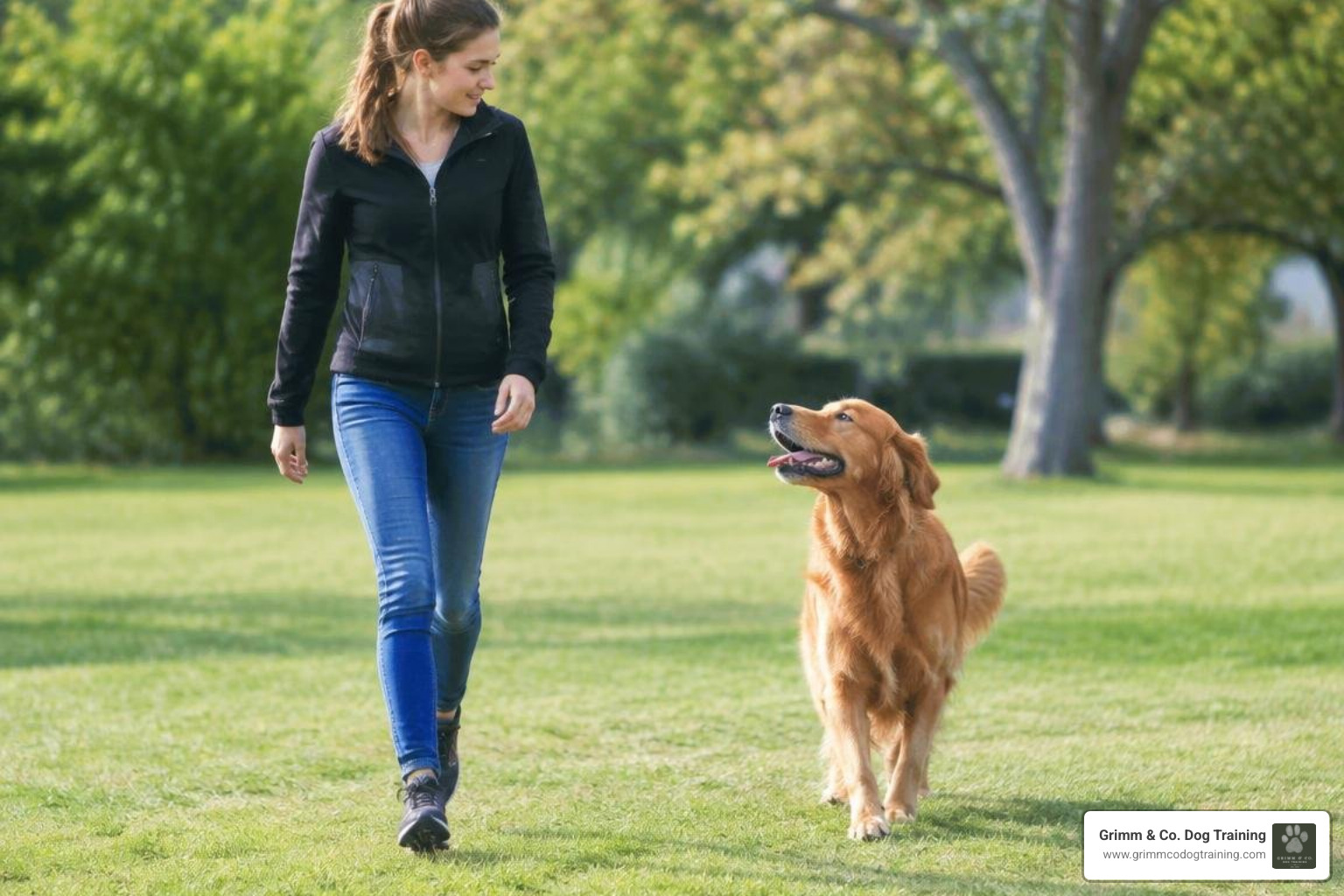
Dog training for off leash control begins with skills your dog can perform reliably on a leash and long line. Before allowing true freedom, build a fast recall, strong name response, leave-it, stay, and an emergency stop. Then practice those skills in gradually harder places, from indoors to a fenced yard to low-distraction outdoor spaces.
A dog is ready to go off leash only when they choose to check in, respond promptly around distractions, and can be safely managed within the rules of the location. Reliable off-leash behavior is not one command. It is a set of habits built through repetition, rewards, clear boundaries, and thoughtful risk assessment.
For many Bay Area adventures, a long line is the safest bridge between a standard six-foot leash and complete freedom. It gives your dog room to explore while you continue building recall, impulse control, and the "invisible leash" of voluntary attention.
I am Bailey Milne-Davies, a dog trainer and scientist who has trained extensively with my own dog, Grimm, in obedience, neutrality, scent-based sports, and outdoor activities. Through dog training for off leash control, I help owners build the practical communication and trust dogs need for safe freedom in the real world.
Safety First: Essential Safety Precautions and Legal Risk Assessments
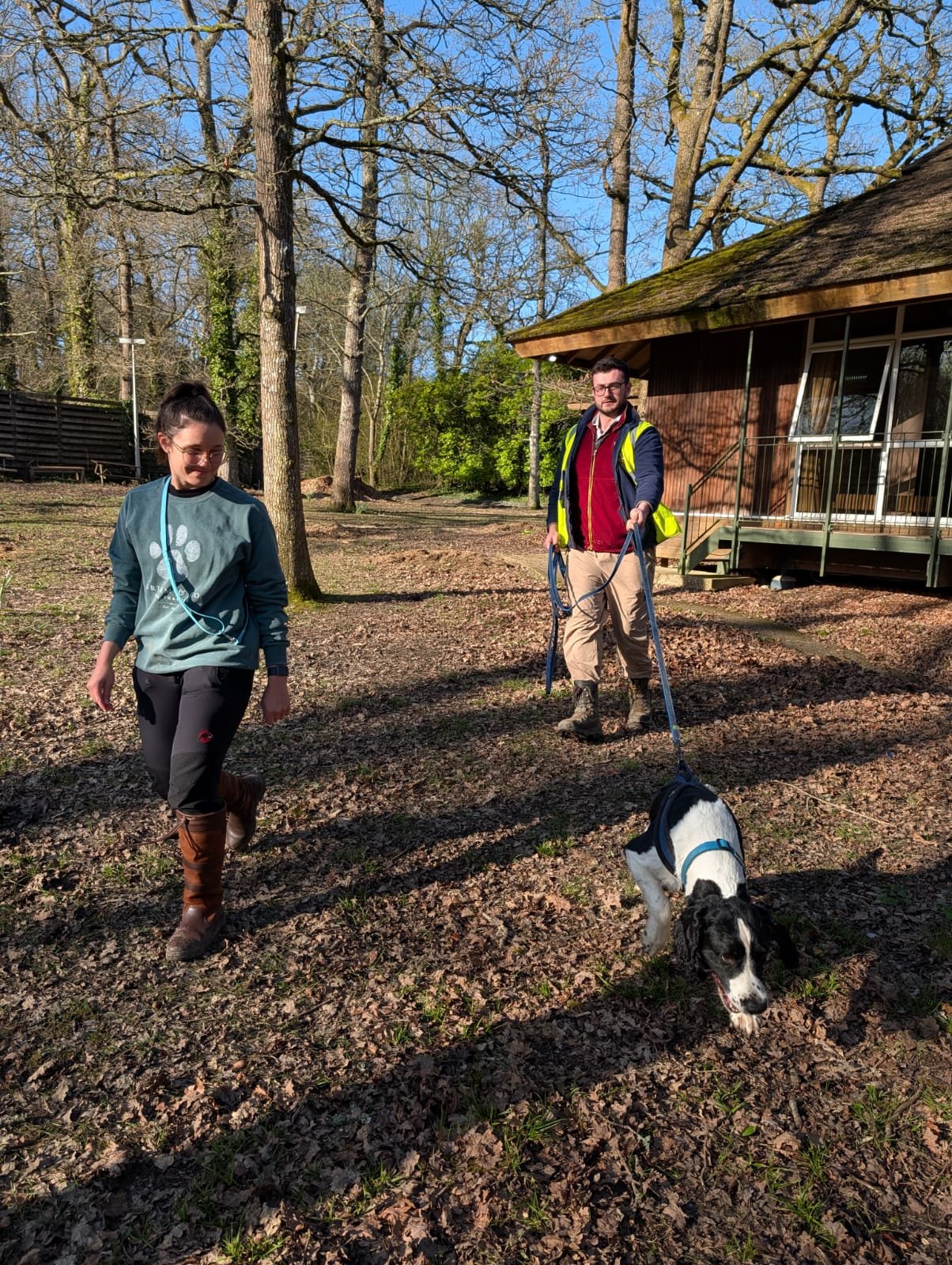
Before considering unclipped freedom on local trails or open spaces, an honest risk assessment is essential. True off-leash reliability is not simply a matter of technical responsiveness. It requires an active management strategy that accounts for environmental hazards, legal regulations, and your dog's immediate safety profile.
Direct physical and digital identification forms your initial baseline. Your dog must carry an up-to-date microchip registered with accurate contact details, paired with a fitted collar displaying visible identification tags. For outdoor adventures through coastal scrub or wooded open spaces, adding a cellular or satellite GPS tracking collar provides a vital layer of real-time monitoring should unexpected wildlife bolt your dog out of sight.
Environmental hazards across Northern California demand keen handler awareness:
- Terrain and Wildlife Encounters: Coastal cliffs, dense coyote brush, foxtails, ticks, and steep drop-offs around spots like Mussel Rock Park or coastal trails present genuine physical risks. Encounters with deer, raccoons, or off-leash wildlife require instant stopping power.
- Traffic and Blind Intersections: Shared multi-use pathways often have fast-moving cyclists, horseback riders, and service vehicles. Proximity to roadways requires non-negotiable physical containment.
- Local Leash Regulations: Municipal codes vary substantially across Daly City, San Francisco, and the broader Peninsula. Many regional parks require six-foot leashes to protect sensitive habitats and prevent dog-on-dog conflicts. Respecting these laws keeps trails open for all handlers while avoiding costly citations.
A safe handler constantly scans the horizon 50 yards ahead. If the environment presents blind corners, uncontrolled off-leash dogs, or high wildlife density, keeping your dog connected to a secure line is the mark of an experienced, responsible owner.
The Core Pillars of Dog Training for Off Leash Control
Achieving reliable off-leash stability requires balanced communication, emotional regulation, and rock-solid foundational responses. When off-leash freedom is granted, the physical tether disappears. You must replace that nylon strap with an established cognitive and relational bond.
| Core Pillar | Purpose in Off-Leash Control | Practical Application |
|---|---|---|
| Impulse Control | Prevents impulsive bolting toward triggers | Holding a steady sit or down while distractions move past |
| Marker Cues | Bridges the exact moment of compliance with reward | Crisp verbal markers (such as "Yes") delivered precisely |
| High-Value Reinforcement | Maintains handler value above environmental reinforcers | Fresh meats, single-ingredient rewards, or high-drive toy play |
| Emergency Stop Cue | Freezes forward motion instantly at a distance | Immediate drop to a down or standing freeze on verbal command |
| Leave-It Protocol | Diverts attention away from hazardous items or wildlife | Disengaging from food scraps, dead animals, or critters |
Building these skills starts with structured foundational obedience for dogs. Your dog must view working with you as an active partnership where listening yields direct value, clear feedback, and access to fun outdoor adventures.
Essential Foundational Dog Training for Off Leash Control
Before testing distance, your dog must exhibit fluent responses to core baseline commands on a standard leash. If a dog struggles to hold a stay or yield to a leave-it cue at arm's length, those behaviors will deteriorate when open space is introduced.
- Crisp Name Response and Focus: Your dog must pivot their head toward you immediately upon hearing their name, breaking eye contact with the environment.
- Stationary Stays (Sit-Stay and Down-Stay): A dependable stay teaches emotional patience. Your dog learns that they cannot break position until released, which is vital when trail runners or horses pass.
- Solid Leave-It and Drop-It Commands: These cues stop a dog from lunging toward food wrappers, animal carcasses, or poison oak.
- Emergency Stop (Whistle or Verbal Drop): An advanced safety protocol taught in advanced dog obedience training, commanding your dog to drop flat into a down or freeze in place 30 yards away from you.

Building an Unshakeable Distraction-Proof Recall Cue
Your recall cue is the single most critical safety behavior in your entire training repertoire. Because a failed recall in the wild can carry severe consequences, the cue must remain protected and strictly maintained.
To protect your recall cue:
- Pick a Clean, Dedicated Word: Avoid using a generic "come" if it has already been diluted through casual household repetition. Select a fresh cue such as "Here," a distinct whistle blast, or a unique verbal marker.
- Avoid Poisoning the Cue: Never call your dog to you to perform actions they dislike, such as bathing, clipping nails, or immediately leaving a park every single time. Call them, reward generously, and release them back to explore.
- Adhere to the Single-Call Rule: Never repeat your recall cue multiple times if your dog fails to respond. Repeating the word teaches your dog that the first cue is optional background noise. Call once, utilize your long line to enforce follow-through calmly, and reset.
- Utilize Premium Reinforcement: Recall must be paired with top-tier rewards. Single-ingredient proteins like freeze-dried liver, roast beef, or interactive tug games should be reserved almost exclusively for fast returns.
For broader perspectives on standard progression frameworks, reviewing resources such as Off-Leash Training for Dogs: The Complete Guide (2026) can offer helpful insights into how handlers pace their distance goals.
Radius Training and Natural Check-Ins
Off-leash control should not require you to issue constant verbal instructions. Constant micromanagement creates handler fatigue and teaches the dog to ignore you until you raise your voice. Instead, the goal is radius training, teaching your dog to manage an invisible boundary around you voluntarily.
Radius training builds the habit of auto check-ins. Whenever your dog naturally turns, looks back, or pauses to orient toward you while moving ahead, immediately mark and reward that choice.
Practice sudden changes of direction. If your dog drifts 20 feet ahead, quietly make a 180-degree turn and walk the other way. When your dog notices the distance growing, turns, and sprints to catch up, praise and reward them beside your leg. This drill teaches your dog that staying oriented around you is their active responsibility.
The Long Line Bridge: Transitioning from Leash to Complete Freedom
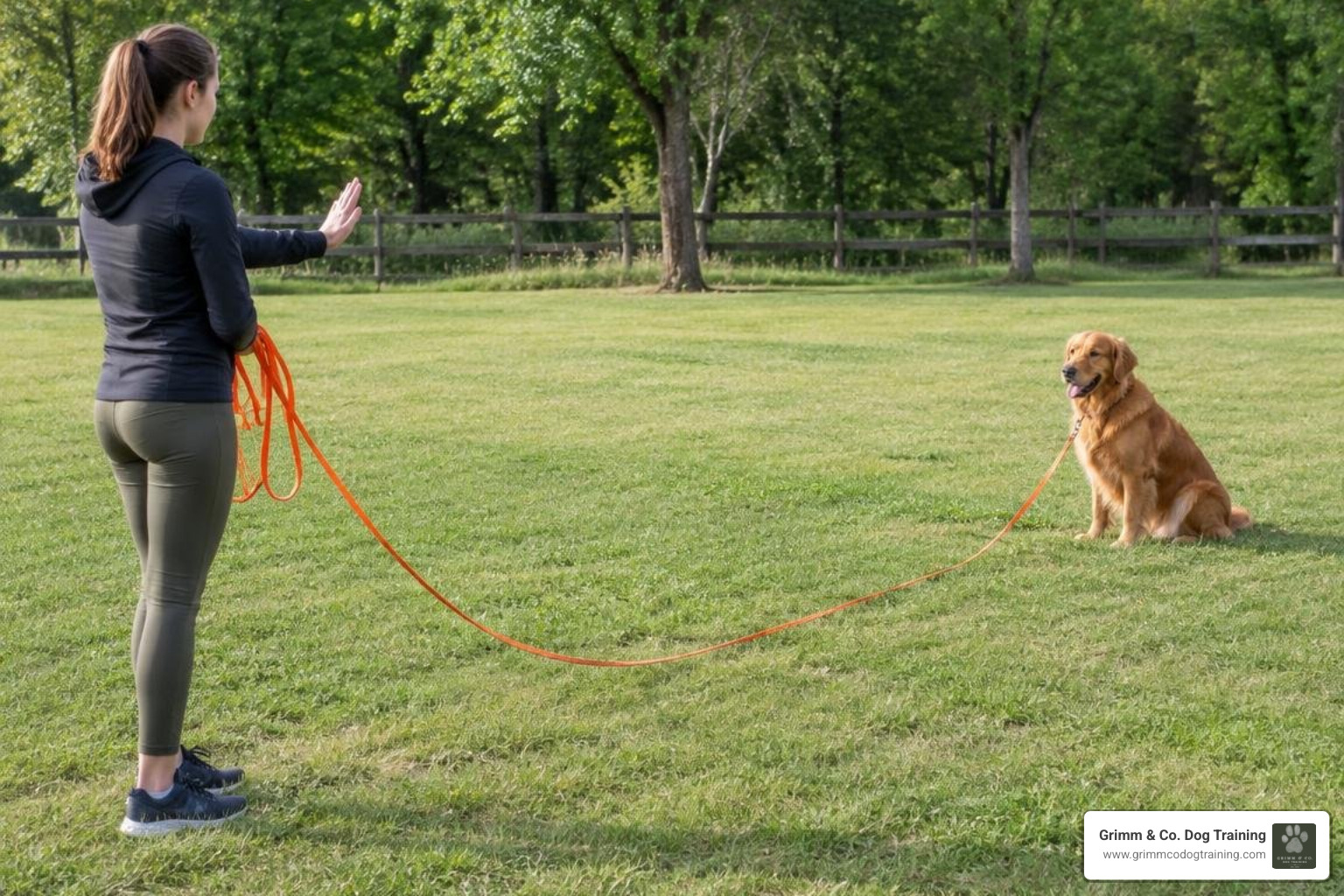
The biggest pitfall handlers face is unclipping the standard six-foot leash too early. When a dog discovers they are untethered before their impulse control is fully conditioned, self-reinforcing behaviors like chasing birds or ignoring cues take root quickly. The long line serves as the indispensable bridge between physical restraint and reliable mental control.
Biothane long lines (typically 15 to 30 or 50 feet) are the gold standard for outdoor handling. Unlike cotton or nylon webbing, biothane does not absorb water, resist burrs, or snag aggressively on brush, making it easy to handle along open ground.
Mastering line handling mechanics is critical:
- Maintain gentle slack on the line; do not keep tight tension, which builds frustration or environmental opposition reflex.
- Step on the line near your feet to halt forward momentum rather than grabbing the line with bare hands to avoid friction burns.
- Transition through structured group dog training classes where you can test long line responses around neutral, controlled dogs before venturing into wilder terrain.
Structuring Step-by-Step Dog Training for Off Leash Control
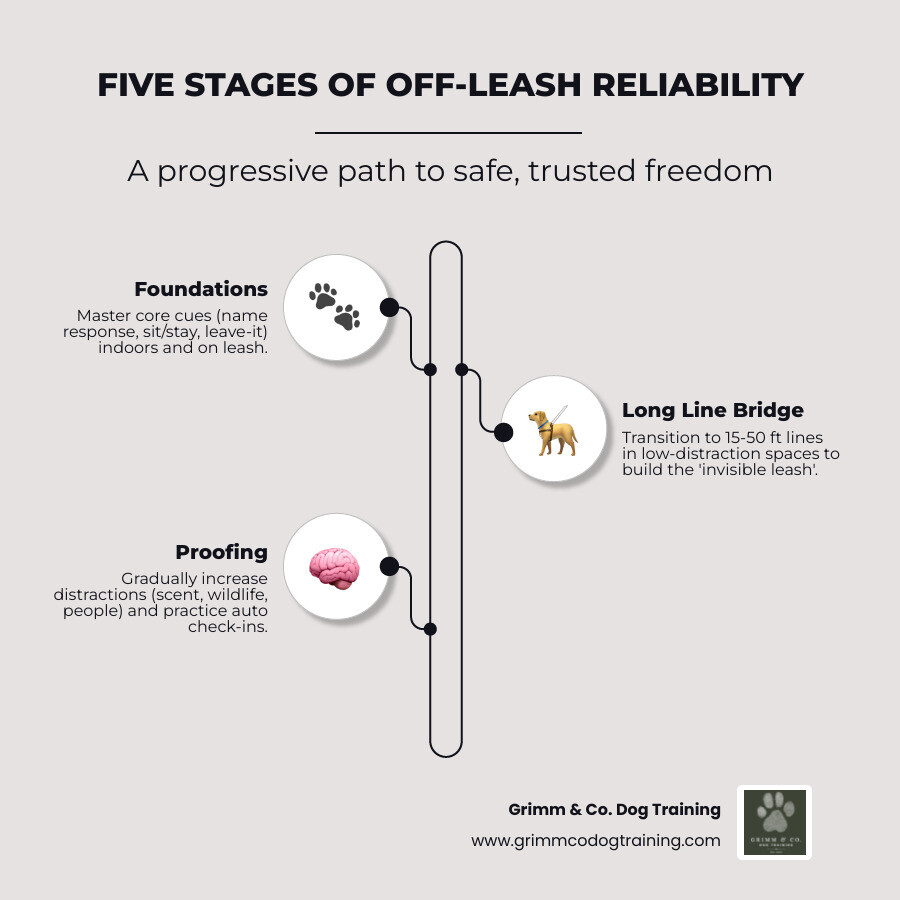
Moving toward off-leash freedom requires progressive staging. You should only advance to a harder environment when your dog achieves a consistent 90 percent success rate at their current level.
By allowing your dog to drag a lightweight line during Stage 4, you retain the ability to step on the trailing line if an unexpected stimulus appears, preserving safety while evaluating genuine off-leash compliance.
Proofing Across Distraction Hierarchies and Environments
Dogs do not generalize verbal concepts automatically. A recall that functions flawlessly in a Daly City backyard may fall apart when tested against Pacific coastal winds, unfamiliar scents, or passing dogs. Proofing requires systematically climbing a distraction ladder:
- Low Distraction: Quiet residential yards, empty athletic courts, or indoor facilities.
- Moderate Distraction: Open grassy fields with distant pedestrian movement or mild scent trails.
- High Distraction: Multi-use recreational paths with bicycles, passing leashed dogs, and jogging groups.
- Extreme Distraction: Coastal zones with nesting birds, active dog play groups, or scurrying wildlife.
If your dog struggles at a new level of difficulty, do not scold them. Simply decrease the environmental pressure, increase the value of your rewards, and revisit structured reps. For personalized help structuring these criteria, handlers often leverage structured private dog training to systematically proof specific behavioral triggers.
Training Games, Breed Tendencies, and Handling Training Setbacks
Engagement is a living dynamic that must be refreshed continuously. Incorporating structured training games transforms off-leash responsiveness from a chore into an exciting, cooperative game. Furthermore, understanding your dog's inherent breed drives ensures you work with their natural motivations rather than fighting against them.
For dogs with strong hunting, herding, or athletic drives, pairing obedience with canine sports and outdoor engagement channels their natural focus and sharpens overall responsiveness.
High-Engagement Games: Recall Parties and Scent Work
Integrating playful engagement games during trail walks builds enthusiasm and rapid compliance:
- The Recall Party: When your dog comes running on cue, do not hand over a single small kibble. Throw an energetic "party" by dropping multiple high-value treats in succession, running backward to encourage chase drive toward you, and celebrating their return.
- Two-Person Recall Ping-Pong: Position two handlers 30 yards apart in an open field. Take turns calling the dog back and forth, rewarding each successful arrival with enthusiastic praise and food rewards.
- "Find Me" Hide-and-Seek: While your dog is safely checking out an interesting scent on a long line, step behind a wide tree trunk or boulder. Call your dog once. When they locate you, reward them enthusiastically. This teaches dogs that losing track of you requires active effort on their part.
- Mantrailing and Scent Work: Dogs possess exceptional olfactory capabilities. At Grimm & Co. Dog Training, we specialize in mantrailing, an engaging discipline where pet dogs learn to find specific "missing" people using their nose. This provides immense mental fulfillment, builds handler focus, and teaches reliable distance teamwork across varied outdoor terrain.
Managing Prey Drive, Breed Instincts, and Setbacks
Genetic drives heavily influence how a dog processes open environments. Recognizing these tendencies allows you to tailor your off-leash expectations appropriately:
- Sighthounds and Terriers: Driven by high visual acuity and fast prey instincts. These breeds often require extended long line conditioning and extensive impulse-control proofing around moving targets.
- Working and Herding Breeds: Generally possess high handler focus, but their motion sensitivity can lead them to chase cyclists or wildlife if boundary criteria are unclear.
- Independent Hounds and Northern Breeds: Bred to work at a distance from humans following scent trails or independent drives. They require immense engagement work, variable reinforcement schedules, and dedicated scent outlets like mantrailing.
Setbacks are a normal part of training, particularly when adolescent dogs (around 6 to 14 months) begin testing their boundaries. If your dog begins ignoring cues, calmly pick up the long line, step back one stage in your distraction hierarchy, and rebuild the foundation.
Frequently Asked Questions About Off-Leash Dog Training
At what age should you start off-leash training with a puppy?
You can start teaching foundational off-leash skills as early as 8 to 12 weeks of age. Young puppies naturally possess a strong instinct to follow their handler. Capitalize on this natural window by practicing follow-me games and rewarding enthusiastic check-ins inside the home and in secure, sanitized yards.
As puppies enter adolescence between 5 and 9 months, their exploratory drive expands and independence grows. This is the stage to clip on a 20-to-30-foot long line to ensure consistency and prevent self-rewarding habits from developing during boundary testing phases.
What should you do if your dog completely ignores a recall cue in public?
If your dog ignores your recall cue, avoid chasing them. Running toward a dog often initiates an interactive game of keep-away or causes them to bolt farther away.
Instead, remain calm and use proactive strategies:
- Turn your body sideways or walk in the opposite direction while clapping your hands or making high-pitched, engaging noises.
- Drop low to the ground and pretend to investigate something fascinating in the grass. Dogs are curious and will frequently return to inspect what you are doing.
- If your dog is dragging a long line, calmly close the distance and step firmly on the line to secure control.
- Never punish your dog when they finally return to you. If you reprimand them upon arrival, they will associate returning to you with conflict. Reward the return, clip the leash on, and reassess your proofing criteria.
Can high-prey-drive or independent breeds ever be trusted off-leash?
Many high-drive and independent dogs can achieve dependable off-leash skills, but it requires structured impulse control, dedicated proofing, and realistic management.
For some individuals with extreme predatory drive, complete off-leash freedom in open, unfenced wildlife corridors may carry too high a risk. These dogs can still enjoy rich outdoor exploration using 50-foot biothane long lines, private enclosed rental spaces, or structured scent activities like mantrailing that safely satisfy their genetic needs.
Building Lasting Trust on the Trail
Off-leash control is not about physical restraint. It is about fostering clear communication, reliable habits, and mutual trust between you and your dog. When your dog reliably chooses you over the surrounding environment, trail adventures become a relaxing, rewarding experience for both ends of the line.
Achieving this level of freedom takes patience, step-by-step proofing, and thoughtful safety habits. Whether you are addressing stubborn recall hurdles or looking for an engaging weekend outdoor sport like mantrailing to channel your dog's instincts, our team is here to help. Explore our comprehensive dog training services to start building real-world off-leash control today.