
Advanced Dog Obedience Classes and How to Ace Them
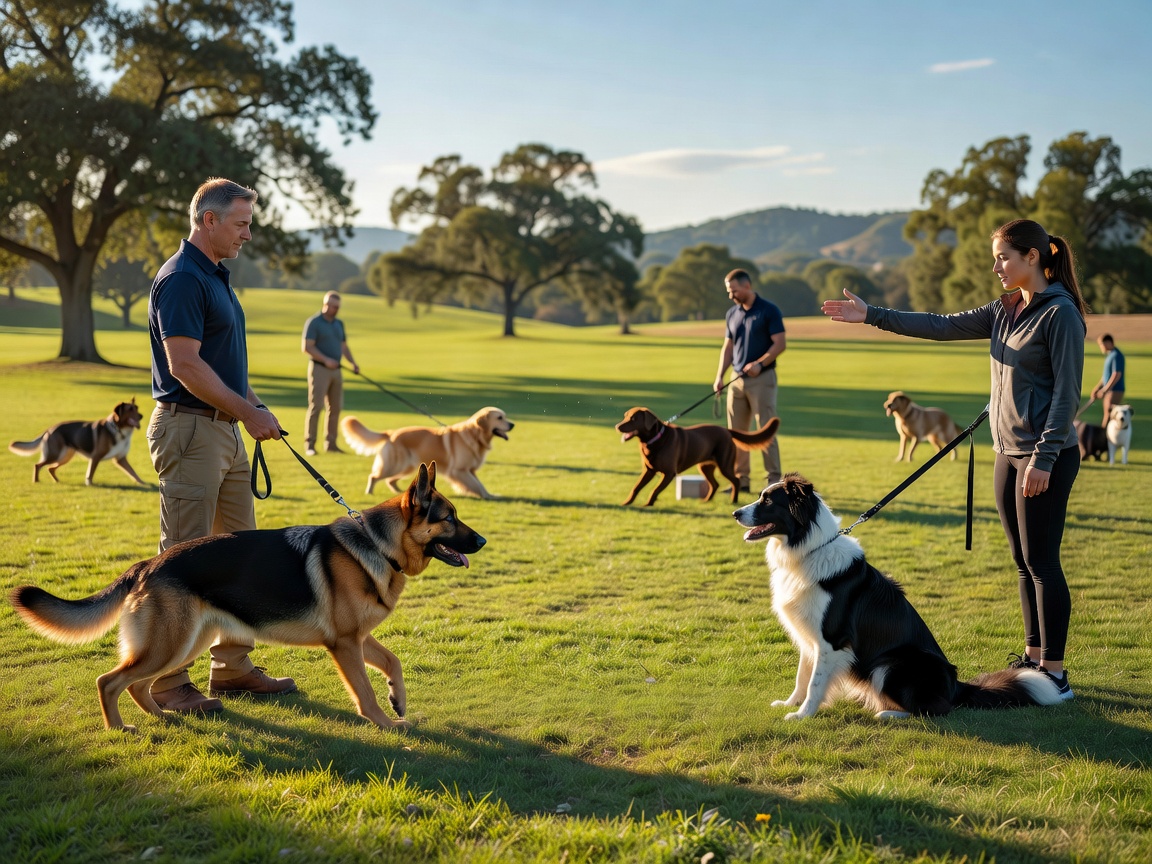
What Sets Advanced Dog Obedience Classes Apart from Basic Manners?
Basic obedience classes focus on acquisition. During that initial phase, dogs learn what specific words mean in quiet, low-distraction environments. Handlers spend their time teaching foundational mechanics: how to sit, lie down, offer eye contact, and walk on a loose lead without dragging the handler down the block.
Advanced obedience represents a deliberate criterion shift. The focus moves away from simple comprehension toward stimulus control, precision, fluency, and distraction resistance. stimulus control means that your dog performs the exact behavior requested, offers it promptly on a single cue, does not offer competing behaviors, and does not perform that behavior without being cued.
When advancing past foundational canine obedience classes, the criteria for success change across three dimensions:
- Distance: The dog executes complex behaviors while working ten, thirty, or fifty feet away from the handler.
- Duration: The dog maintains positions through extended intervals without shifting weight, creeping forward, or breaking focus.
- Distraction: The dog ignores high-value environmental competing motivators, such as passing dogs along the Embarcadero, dropped food on a café patio, sudden loud sounds, or moving wildlife.
| Skill Dimension | Basic Manners Foundation | Advanced Obedience Criterion |
|---|---|---|
| Heeling / Walking | Loose leash by handler's side with mild pulling allowed | Focused heeling with shoulder alignment, sharp pivots, and immediate automatic sits at halts |
| Stay & Duration | 30 to 60 seconds within 6 feet of handler in a quiet room | 3 to 5+ minutes with handler out of sight, novel distractions dropping nearby |
| Recall | Coming when called on a 10-foot line in a fenced yard | Rapid emergency recall away from running dogs, dropped food, or high arousal triggers |
| Cues & Signals | Verbal prompts paired with obvious physical hand lures | Distinct verbal cues or subtle, isolated hand signals executed at distance |
| Reinforcement | Continuous primary rewards (treat in hand for every repetition) | Variable schedules, secondary bridge markers, and indirect/planted reinforcement |
Foundational Prerequisites and Readiness Indicators
Entering an advanced curriculum requires a reliable baseline. Advanced classes are not designed to teach a dog what "down" means; they teach a dog to execute a down instantly while sprinting or when the handler is twenty yards away.
To determine readiness, instructors assess specific operational prerequisites:
- Marker Literacy: The dog understands clear terminal and continuation bridge markers (such as a clicker or distinct marker words like "Yes" and "Good").
- Impulse Control: The dog can remain stationary in a sit or down while the handler drops treats, steps away, or opens a door.
- Loose-Leash Fluency: The dog walks comfortably on a flat collar, slip lead, or properly fitted training tool without constant physical management.
- Handler Engagement: The dog readily checks in and re-engages after environmental interruptions.
Evaluating these foundational baselines helps owners understand why dog training classes might be the right fit for you and whether group progression or targeted private work represents the best next step.
Essential Skills Taught in Advanced Dog Obedience Classes
Advanced courses systematically layer complexity onto basic cues. Handlers learn how to isolate verbal cues from body language, eliminating accidental physical prompts like head dips, shoulder shifts, or leaning.
Key skills covered include:
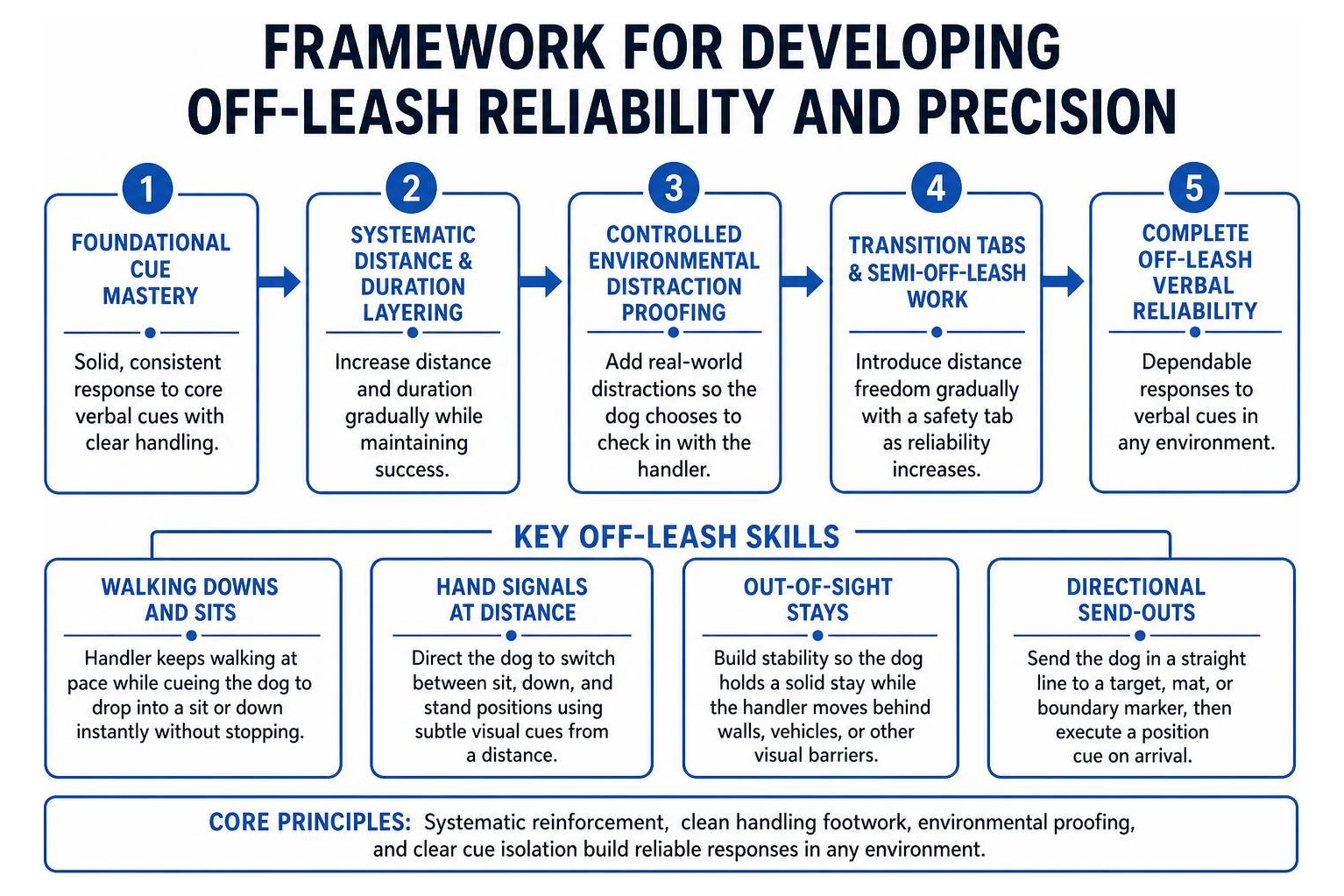
- Walking Downs and Sits: The handler continues walking forward at pace while cueing the dog to drop into a sit or down instantly without pausing their stride.
- Hand Signals at Distance: Directing the dog to switch between sit, down, and stand positions purely through subtle visual cues from across a park or training field.
- Out-of-Sight Stays: Building psychological stability so the dog holds a solid stay while the handler walks behind walls, vehicles, or visual barriers.
- Directional Send-Outs: Teaching the dog to run in a straight line away from the handler toward a designated target, mat, or boundary marker, then execute a position cue on arrival.
Core Curriculum: Mastering Off-Leash Reliability and Precision
Reliability off-leash is not an accident of temperament. It is the result of systematic reinforcement mechanics, clean handling footwork, and environmental proofing. In professional dog obedience training classes, dogs learn that external distractions are environmental cues to check in with the handler rather than opportunities to self-reinforce.
Distance Control, Out-of-Sight Stays, and Reliable Recall
True off-leash control demands an emergency recall that functions across high arousal states. Advanced programs use whistle commands and distinct emergency cues alongside standard recalls.
Building an out-of-sight stay requires careful progression:
- Duration Stabilization: Establish a baseline 3-minute stay with the handler standing five paces away in a low-distraction room.
- Visual Flashes: The handler steps behind an open door or partition for two seconds, steps back into view, returns, and rewards.
- Variable Absence: The duration out of sight increases incrementally (15 seconds, 45 seconds, 2 minutes) while varying the handler's return path.
- Distraction Layering: Novel sounds (clattering bowls, squeakers, bouncing balls) are introduced while the handler remains out of sight.
Terminal markers release the dog directly to a high-value reward station or the handler's hand, ensuring the dog waits for formal permission rather than anticipating release.
Complex Heeling Mechanics and Handler Footwork
Precision heeling transforms a standard walk into an athletic partnership. Advanced courses break heeling down into discrete mechanical components: handler footwork and canine spatial awareness.
Handlers learn specific footwork patterns:
- Left and Right 90-Degree Turns: Executing clean square turns without stepping into the dog's path or swinging wide.
- Left and Right 180-Degree About-Turns: Pivoting cleanly over the left shoulder (German about-turn) or spinning smoothly into the turn while maintaining the dog's head position.
- Pace Changes: Seamless transitions between normal pace, fast sprint, and slow motion, with the dog matching handler cadence instantly.
To keep the dog's body parallel to the handler during turns, classes use platform work and abbreviated perches. Perch work teaches rear-end awareness: the dog places its front paws on an elevated pivot disk and rotates its hindquarters independently around the object. This mechanical foundation prevents the dog from swinging its hips outward or lagging during tight left turns on city sidewalks or in competition rings.
Expanding Horizons: Sports, Working Titles, and Real-World Applications
A structured dog training program provides practical benefits beyond personal satisfaction. It bridges the gap between companion animal manners and specialized canine sports, competitive titles, and community access certifications.
How Advanced Dog Obedience Classes Prepare Teams for Dog Sports and Titles
For handlers interested in performance events, advanced coursework introduces the precise criteria required by titling organizations:
- AKC Traditional Obedience: Prepares dogs for Novice (CD), Open (CDX), and Utility (UD) titles, incorporating formal dumbbell retrieves, drop on recall, directed jumping, and scent discrimination exercises.
- AKC Rally Obedience: Focuses on navigating complex courses featuring rapid sign stations, side steps, spiral heel patterns, and moving down-stays.
- Scent Work and Tracking: Builds handler communication, leash management, and environmental neutrality necessary for dogs to follow target odors through complex air currents.
- Canine Good Citizen (CGC, CGCA, CGCU): Prepares teams to pass practical evaluations testing supervised separation, navigating crowds, and maintaining focus around strange dogs.
Therapy Dog Desensitization and Public Access Etiquette
Therapy dog work requires emotional stability and physical neutrality around unusual stimuli. Advanced obedience courses proof dogs against real-world healthcare and community environments by introducing:
- Medical Equipment Desensitization: Conditioning calm responses to rolling wheelchairs, clattering walkers, crutches, and medical carts.
- Tactile and Sound Conditioning: Exposing dogs to sudden clapping, dropped metal clipboards, and heavy handling from unfamiliar adults.
- Neutral Greetings: Ensuring the dog remains completely calm when strangers approach enthusiastically, refusing to jump, lean, or solicit attention without handler permission.
Setting Up for Success: Equipment, Structure, and Cost Expectations
Achieving reliable performance requires appropriate tools and structured instruction. Our relationship-centered training approach focuses on handler clarity, mutual trust, and practical communication.

Essential Gear: Tabs, Long Lines, and Reinforcement Delivery
Advanced classes move away from standard everyday pet gear to facilitate clean transitions toward off-leash work:
- Transition Tabs: Short 6- to 12-inch leashes attached to the collar. A tab gives the handler an immediate physical handle if intervention is needed without dragging a heavy leash line on the ground.
- Biothane Long Lines: 15- to 30-foot lines used for long-distance send-outs, out-of-sight stays, and emergency recall proofing across open outdoor spaces.
- Target Platforms and Place Boards: Low, non-slip platforms used to teach boundary stays, directional send-outs, and precise heeling position.
- Reinforcement Pouches and Indirect Placement Containers: Specialized treat bags and remote reward boxes that allow handlers to deliver rewards away from their body, teaching the dog to work for distant reinforcement rather than staring at the handler's hands.
Class Formats, Investment, and Evaluation Protocols
Structured advanced coursework is typically delivered through dedicated group cohorts or flexible multi-session packages.
- Class Sizes: High-quality advanced classes generally cap enrollment at 6 to 8 dogs. Smaller rosters ensure safety during off-leash work and allow individual coaching on handler mechanics.
- Tuition Rates: High-level group courses typically range from $250 to $700 depending on syllabus length, facility type, and whether private evaluation sessions are included. Online specialty modules often run between $100 and $200 for technical theory and video review.
- Course Duration: Courses generally span 6 to 15 weeks, with weekly 60-minute practical classes supplemented by structured daily homework routines.
Before enrolling in specialized dog training classes, reputable academies require an entry screening or prerequisite completion to confirm that every participating dog possesses the baseline impulse control required for group safety.
Frequently Asked Questions About Advanced Obedience
How do I know if my dog is ready to move past intermediate training?
Your dog is ready when they consistently perform foundational cues on a single verbal or visual signal in moderately distracting environments. If your dog still requires physical food lures in your hand to sit, pulls hard on the leash toward other dogs, or breaks a 60-second stay when someone walks by, they need additional intermediate proofing before joining advanced group work.
What is the typical duration and price range for advanced coursework?
In-person advanced classes run between 6 and 15 weeks. Comprehensive multi-session packages that combine weekly group classes with private coaching sessions generally range from $400 to $700. Individual 6-week specialty tracks average $200 to $350.
Can advanced classes fix existing behavioral reactivity or aggression?
No. Advanced obedience classes are designed to build skills, precision, and stimulus control, not rehabilitate acute fear, reactivity, or aggression. Placing a reactive dog in an off-leash advanced group creates an unsafe learning environment. Dogs with underlying reactivity should first complete structured private behavior modification to develop emotional regulation before stepping into an advanced group.
Building Real-World Partnership with Grimm & Co.
Advanced training is about building clear, effortless communication with your dog across any environment. Whether you are navigating busy Bay Area sidewalks, hiking coastal trails, or preparing for performance rings, true off-leash reliability gives your dog greater freedom and safety.
At Grimm & Co. Dog Training, we help owners transform foundational obedience into rock-solid teamwork. Explore our advanced group classes to take your training to the highest level and build a reliable, lasting partnership with your dog.