
The Ultimate Guide to Canine Obedience Classes
Why Canine Obedience Classes Build Better Everyday Behavior

Canine obedience classes are structured lessons that teach dogs and handlers how to communicate clearly, practice useful skills, and stay calm around everyday distractions. Most programs progress from puppy socialization and household manners to reliable leash walking, recall, impulse control, and advanced work such as Canine Good Citizen preparation or competitive obedience.
| Class level | Best for | Typical focus |
|---|---|---|
| Puppy foundations | Young puppies during early socialization | Confidence, handling, attention, potty and crate routines, polite play |
| Beginner manners | Puppies or adult dogs new to training | Sit, down, stay, come, loose-leash walking, leave-it, polite greetings |
| Intermediate obedience | Dogs with reliable basics | Distractions, distance, duration, place cues, stronger recall |
| Advanced or title prep | Dogs ready for precision work | Public manners, CGC skills, off-leash control, rally or AKC obedience exercises |
The right class is not simply about teaching commands. It helps you build a repeatable system for calm behavior at home, on walks, and around other dogs and people. For a new puppy, that may mean preventing rehearsals of jumping and pulling. For a reactive or inconsistent adult dog, it may mean choosing a format with enough structure, space, and individual support to work below their stress threshold.
I am Bailey Milne-Davies, and my work with my own dog, Grimm, led me from basic training challenges into ongoing obedience, neutrality work, tricks, and dog sports. Through classes, seminars, trainer education, volunteering, and co-teaching, I have seen how well-matched canine obedience classes can turn unclear expectations into a stronger working relationship.
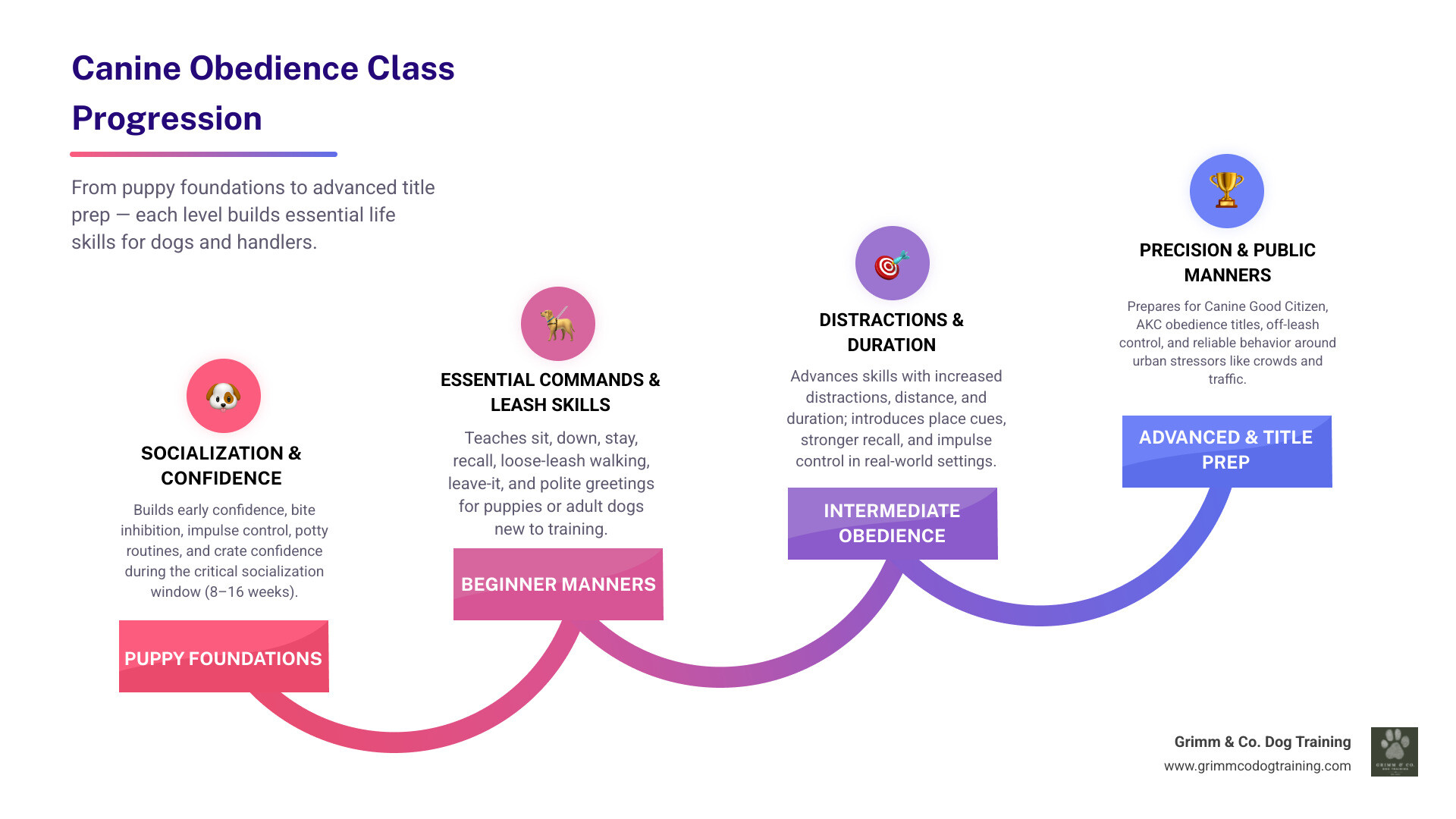
Progressive Skill Levels in Canine Obedience Classes
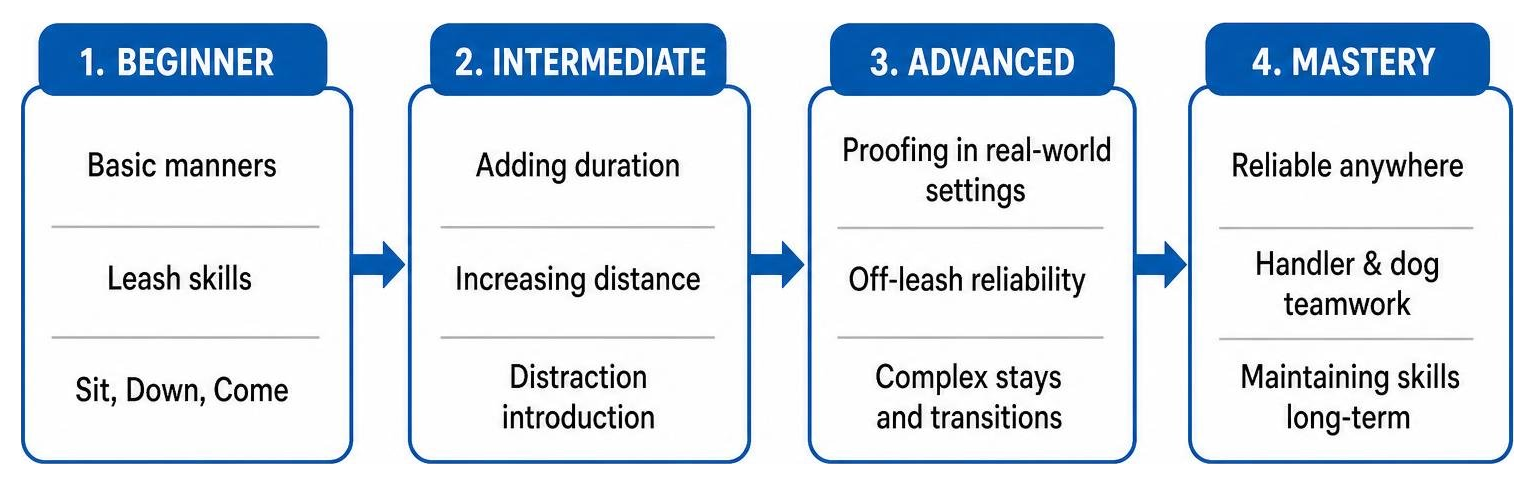
Navigating the landscape of dog training options requires understanding how skills build on one another. Progression is not just about age. It depends on emotional maturity, focus, and environmental stability. In dense environments like San Francisco, Daly City, and across the Peninsula, a dog needs clear communication and structural support to handle urban stressors such as passing commuters, crowded sidewalks, and active wildlife along coastal trails.
When enrolling in structured Dog Obedience Training Classes, dogs move through developmental benchmarks that mirror their physical and cognitive growth.
Early Puppy Socialization and Foundational Manners
The critical socialization window for puppies closes around 16 weeks of age. Early puppy kindergarten courses are engineered specifically to leverage this early developmental stage. The primary focus of a quality puppy curriculum goes beyond basic mechanical positions like sit or down. It prioritizes building confidence, body awareness, bite inhibition, and handler focus amidst novel stimuli.
In our local Bay Area context, early exposure must be carefully managed. High-density urban areas present unique challenges for young dogs. Proper puppy classes teach puppies to view external environmental triggers with calm neutrality rather than over-aroused excitement or fear. Key foundational elements include:
- Impulse Control and Nipping Management: Guiding mouthy puppies to direct their energy toward appropriate outlets while establishing clear boundaries regarding human skin and clothing.
- Crate and Potty Routines: Developing predictable household structures that prevent separation anxiety and fast-track housebreaking.
- Handling and Grooming Prep: Desensitizing puppies to touch on their paws, ears, and tail, preparing them for stress-free veterinary examinations and professional grooming sessions.
- Proactive Socialization: Exposing young dogs to various surface textures, unexpected sounds, and controlled dog-to-dog interactions without permitting chaotic, unregulated play.
Dog owners seeking Puppy Obedience Classes Near Me can implement proven Puppy Obedience Training Tips 2026 early on to establish house rules that prevent nuisance behaviors from becoming ingrained habits.
Essential Skills Taught in Beginner Canine Obedience Classes
Beginner obedience classes serve as the bedrock for all future training, catered to puppies over five months old as well as newly adopted adult dogs. This stage introduces foundational mechanical exercises, translating simple hand signals and verbal markers into reliable daily habits.
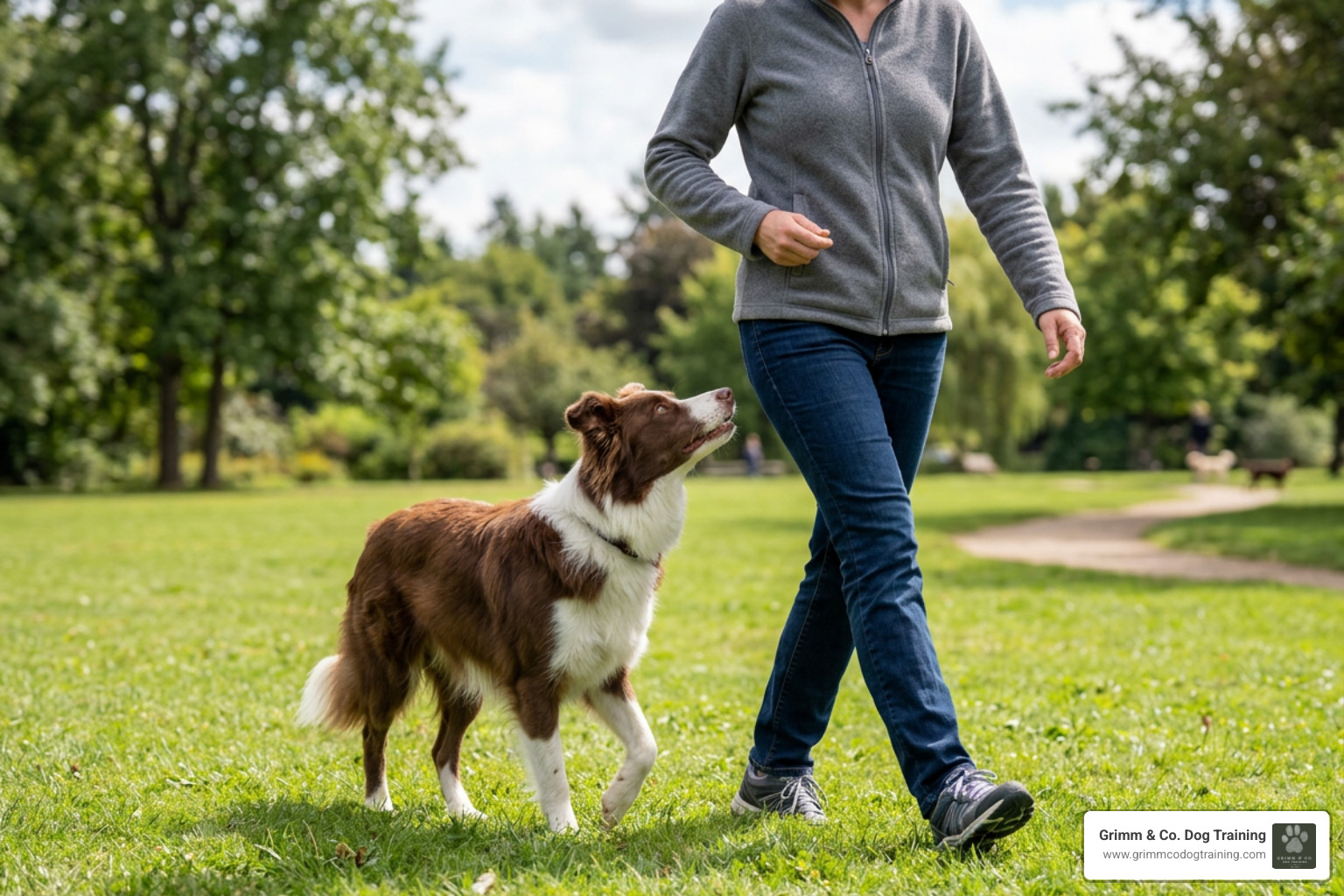
In a beginner program, handlers learn proper leash mechanics and timing. The core curriculum routinely covers:
- Loose-Leash Walking: Training the dog to walk smoothly alongside the handler without applying pressure to the collar or harness, a mandatory skill for navigating busy spots like Embarcadero or local San Mateo downtown districts.
- Reliable Recall (Come): Building an immediate response to the handler's call, laying the groundwork for safe off-leash or long-line freedom.
- Sit-Stay and Down-Stay: Teaching dogs to hold positions until released, establishing self-control around competing environmental rewards.
- Leave-It and Drop-It Cues: Essential safety commands that stop a dog from picking up toxic street debris or foreign objects.
- Place Cue: Directing the dog to a designated bed or mat to remain calm during family meals or when visitors arrive at the home.
- Automatic Sit and Polite Greetings: Teaching dogs to automatically sit when the handler stops walking and preventing jumping when greeting strangers.
For owners residing in urban hubs, enrolling in dedicated Dog Manners Training Daly City helps bridge classroom drills with real-world utility on busy city streets.
Advanced Control, AKC Titles, and Real-World Proofing
Once a dog demonstrates fluency with basic commands in a low-distraction setting, advanced obedience classes introduce real-world proofing. Proofing involves systematically increasing three variables: distance, duration, and distraction.
Advanced courses refine precision and push skills toward off-leash reliability. Handlers practice distance commands where dogs execute sits or downs 30 feet away, emergency drop-on-recall exercises designed to halt a dog mid-run if a hazard appears, and scent discrimination tasks.
Many handlers choose to evaluate their progress through formal recognized certifications administered by the American Kennel Club (AKC):
- AKC S.T.A.R. Puppy: Evaluates basic socialization, leash handling, and foundational care for puppies under one year old.
- Canine Good Citizen (CGC): A ten-step standard testing practical skills including polite greeting of strangers, walking through crowds, reaction to distraction, and supervised separation. Earning a CGC title is frequently required for therapy dog work, service dog foundations, and residential lease approvals in Bay Area apartment complexes.
- Advanced CGC (AKC Community Canine) & Urban CGC: Evaluates obedience in real environments, such as public plazas, outdoor dining areas, and elevators.
- Competitive Obedience & Rally Titles: Tracks precision performance across Novice, Open, and Utility competition tiers, incorporating complex jumps, retrieves, hand-signal sequences, and scent discrimination exercises. Owners can review detailed competition requirements directly through the Obedience Classes – American Kennel Club resources.
Essential Gear, Vaccination Standards, and Class Prerequisites
Success in group or private canine obedience classes depends on handler preparation, suitable equipment, and strict adherence to health protocols. Arriving fully prepared ensures a safe, productive environment for all participants.
Training Equipment Essentials and Prohibited Gear
Using the appropriate gear allows for clear communication between handler and dog while maintaining physical control. Instructors evaluate equipment based on safety, clarity, and handler comfort.
| Category | Recommended Gear | Restrictive / Discouraged Gear |
|---|---|---|
| Leashes | Standard 4 to 6-foot non-retractable leather, nylon, or Biothane leash | Retractable flexi-leashes, extra-long chain leashes |
| Collars & Harnesses | Standard flat buckle collar, martingale collar, or well-fitted Y-harness | Broken hardware, ill-fitting step-in harnesses that restrict shoulder motion |
| Rewards & Tools | Treat pouch with high-value bite-sized treats, place mat or towel | Loose treats stored in deep pockets, loud squeaker toys that disrupt class |
| Handler Attire | Non-skid closed-toe athletic shoes, functional training vest | Flip-flops, high heels, open-toed sandals |
Retractable leashes are universally prohibited in group class settings because they maintain constant friction, teach pulling, and pose entanglement hazards. While basic group classes typically favor flat collars or martingales, custom equipment setups can be evaluated in specialized sessions depending on the dog's drive, size, and physical needs.
Understanding Why Dog Training Classes Might Be the Right Fit for You helps owners align their tools and goals before their initial class session.
Health Requirements, Vaccination Records, and Age Criteria
To protect all attending dogs, professional facilities enforce explicit medical and health guidelines. Prior to stepping into a indoor facility or outdoor training field, handlers must submit verified veterinary records.
Standard health prerequisites include:
- Core Vaccinations: Documented administration of DHPP (Distemper, Hepatitis, Parvovirus, Parainfluenza) and Rabies vaccines by a licensed veterinarian.
- Bordetella Vaccination: Protects against infectious tracheobronchitis (kennel cough), mandatory for indoor group environments.
- Antibody Titer Tests: Many facilities accept veterinary-certified titer tests demonstrating adequate immune response as a safe alternative to booster vaccines.
- Flea and Parasite Prevention: Proof of active monthly broad-spectrum parasite control.
- Age Thresholds: Young puppies can typically join puppy socialization classes at 10 to 12 weeks of age provided they have completed at least two rounds of DHPP. General adult obedience classes usually set a minimum age threshold of 5 months.
- Sick Dog Policy: Dogs displaying active symptoms such as coughing, runny nose, vomiting, diarrhea, or dogs in heat must not attend group sessions until cleared by a veterinarian.
Training Formats, Provider Policies, and Investment Breakdown
Selecting the correct training path involves weighing the trade-offs between group classes, individual lessons, and specialized workshops. Each format serves distinct training goals depending on your dog's current behavior and your lifestyle demands.
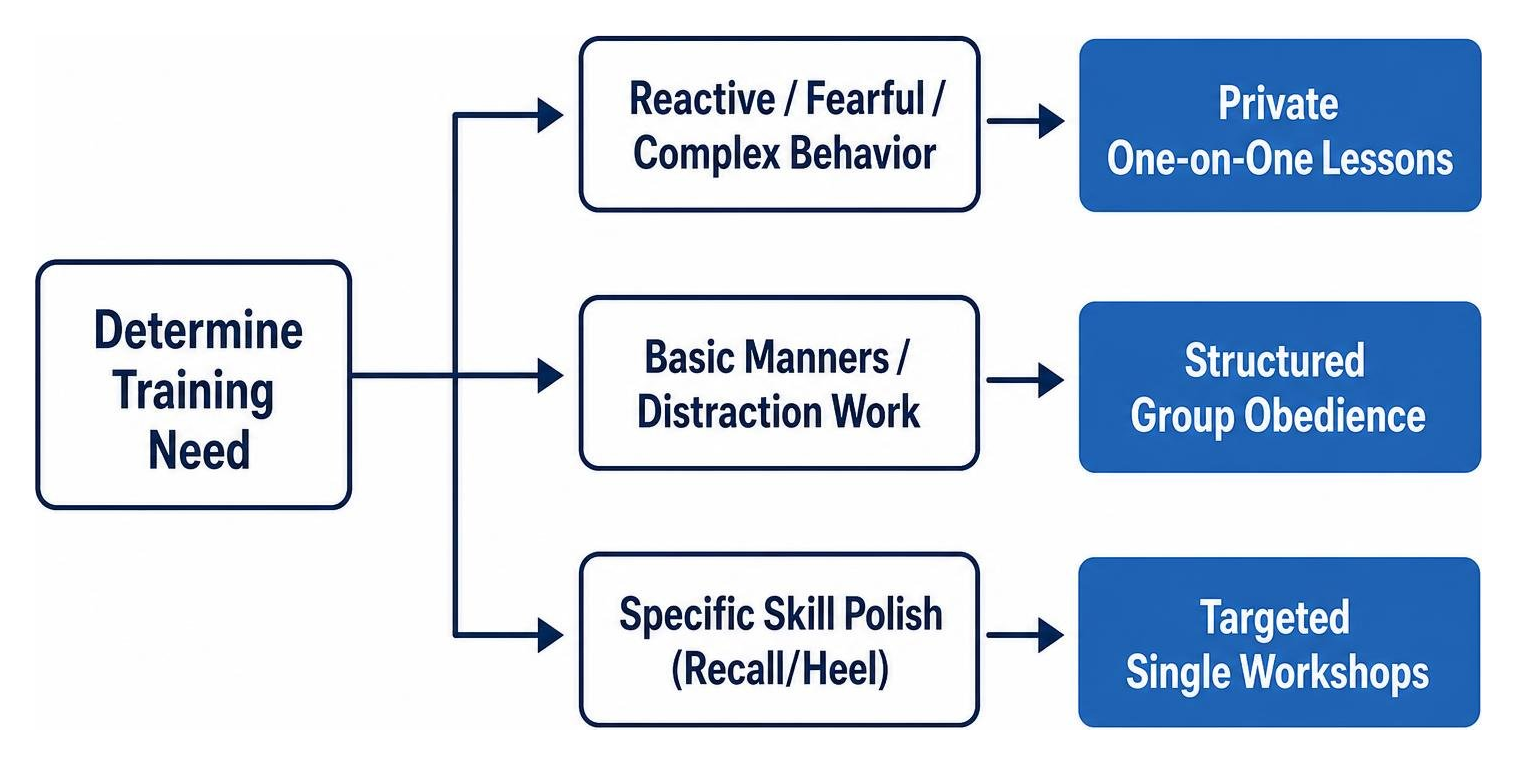
Selecting Private Lessons vs. Group Canine Obedience Classes
Both private instruction and group training programs offer distinct advantages. Analyzing your dog's temperament and environmental tolerance will help you select the appropriate entry point.
| Training Variable | Group Obedience Classes | Private One-on-One Lessons |
|---|---|---|
| Primary Environment | Dedicated training center or outdoor park with peer distraction | In-home, shelter facility, or tailored real-world location |
| Class Size | Typically 4 to 8 dog-and-handler teams | Dedicated 1-on-1 handler, dog, and trainer focus |
| Distraction Level | High: constant exposure to other dogs, people, and novel sounds | Controlled: structured low-distraction setting scaled to dog capacity |
| Best Used For | Social proofing, neutrality training, budget-conscious owners | Behavioral modification, leash reactivity, severe fear, flexible schedules |
| Customization | Standardized curriculum across set multi-week modules | Fully tailored to individual household dynamics and specific goals |
For dogs experiencing heightened frustration or leash reactivity when seeing other dogs, starting directly in a group setting can cause sensory overload. In these scenarios, initial private instruction builds foundational focus before transitioning the dog into structured Group Classes. Handlers seeking tailored assistance can explore our comprehensive Dog Training Services to identify the optimal starting route.
Cost Structures, Class Durations, and Attendance Policies
Training investments vary across the San Francisco Bay Area based on provider credentials, location overhead, facility type, and course length.
Generally, multi-week group obedience sessions range from $100 to $350 for 6 to 8-week courses, running 45 to 60 minutes per weekly session. Private instruction ranges from $60 for a 30-minute shelter consult to $150–$250+ per hour for personalized in-home sessions.
When choosing a provider, evaluate their operational policies:
- Make-Up Policies: Because group class schedules run sequentially, providers handle missed classes differently. Some facilities allow missed sessions to be made up during alternate scheduled blocks, while others offer digital homework guides or private catch-up add-ons.
- Family Participation: Having all adult family members and mature children attend class ensures consistent application of handling mechanics, verbal cues, and household rules.
- Refund and Retake Guarantees: Review registration cancellation deadlines carefully. Many facilities offer discounted package rates when bundling foundation, intermediate, and advanced courses together.
Practicing skills in high-distraction public environments, such as exploring Mussel Rock Park and Beach - Dog-Friendly in Daly City, provides handlers with real-world settings to generalize classroom skills once basic fluency is established.
Frequently Asked Questions
How early can puppies begin formal obedience training classes?
Puppies can safely begin formal puppy socialization and foundation classes as early as 10 to 12 weeks of age. Early entry requires proof of at least two rounds of DHPP vaccinations administered at least 48 hours prior to the first class session. Starting early takes advantage of the critical developmental window, laying strong foundations for bite inhibition, potty routines, and handler focus before unwanted habits take hold.
How do instructors manage dogs that show leash reactivity during group classes?
Professional instructors manage leash reactivity by controlling environmental spacing and limiting line-of-sight triggers. Class sizes are typically limited, and visual barriers, such as tall privacy screens or exercise pens, are used to create safe working thresholds for sensitive dogs. Handlers should inform the instructor prior to the first class so appropriate spatial arrangements can be set up in advance. If a dog's reactivity exceeds what can be safely managed in a group setting, the instructor may recommend transitioning to private lessons first to build baseline impulse control.
What happens if a dog misses a scheduled weekly class session?
If you miss a scheduled class, notify your instructor as early as possible. Most providers offer structured make-up options, such as providing detailed homework packets, offering access to instructional video reviews, or allowing you to audit an alternate group time slot without your dog. Because obedience skills build progressively week over week, reviewing missed material at home ensures your dog remains on track with the rest of the class.
Elevating Your Relationship Through Structured Training
Enrolling in canine obedience classes is one of the most effective investments you can make in your dog's long-term well-being and safety. Structured training does far more than teach mechanical position cues; it establishes a shared language, builds mutual respect, and provides your dog with the mental stimulation required to thrive in modern environments.
At Grimm & Co. Dog Training, our relationship-based methodology emphasizes clear communication, structured support, and real-world utility tailored to the unique demands of Bay Area urban life. Whether you are bringing home a young puppy in San Francisco, working through leash manners in Daly City, or looking to polish off-leash control along the Peninsula, our personalized training options provide the guidance you need.
Explore our full range of training options by reviewing our comprehensive Training Classes Dog program guide, or discover how our multi-step Dog Training Program can support your journey. Ready to take the next step toward a calmer, more confident dog? Explore Grimm & Co. Group Classes today to find the perfect fit for your household.