
Dog Scentwork Training 101: Harness Your Pup's Natural Power
Dog Scentwork Training Turns Your Dog's Nose Into a Superpower

Dog scentwork training is a structured sport where your dog uses their nose to locate a specific hidden scent and communicate the find to you. It is modeled directly after the work of professional detection dogs, and it is one of the most mentally demanding and rewarding activities you can do with your dog.
Here is what you need to know at a glance:
- What it is: A canine sport where dogs search for hidden essential oils (or the handler's scent) across different environments
- Who it is for: Any dog, any breed, any age over 6 months, including mixed breeds
- Core target odors: Birch, Anise, Clove, and Cypress (AKC); Birch, Anise, and Clove (NACSW)
- Search environments: Containers, Interiors, Exteriors, and Vehicles
- Key benefit: Deep mental fatigue, genuine confidence building, and a stronger handler-dog relationship
- How to start: Imprint on a single odor (typically Birch), build a reliable indication behavior, then progress through search elements at your dog's pace
Dogs have a sense of smell that is between 10,000 and 100,000 times more acute than ours. Scentwork is not teaching them a new skill. It is giving them a structured outlet for something they are already doing constantly, and it channels that drive into focused, purposeful work.
For dogs with reactivity, high arousal, or frustration-based behaviors, this matters more than it might seem. A dog that is genuinely mentally tired is a different dog to live with. A dog that has learned to solve problems independently, in a self-rewarding loop of scent and reward, builds real confidence rather than the performed calm that some training produces.
I'm Bailey Milne-Davies, and alongside my own dog Grimm, I have trained extensively in rat sports including Barn Hunt, Trailing and Locating, and Urban Locating, all of which share the same foundational odor drive and independent problem-solving mechanics that make dog scentwork training so effective. That background, combined with my science training, shapes how I approach this guide: methodically, with precision, and without skipping the steps that actually matter.
The Foundational Mechanics of Dog Scentwork Training
Why Dog Scentwork Training Outperforms Traditional Enrichment
Canine enrichment is often reduced to food puzzles and slow feeder bowls. While these tools have their place, they do not engage the canine brain at the same neurological level as targeted scent work. A dog possesses an olfactory cortex that occupies a significantly larger proportion of its brain than ours does. When a dog actively searches for a specific molecule, they are engaging in intense cognitive problem solving that naturally induces deep mental fatigue. This process helps lower arousal levels and builds profound confidence in anxious or reactive dogs.
By allowing your dog to take the lead in a structured search, you shift the traditional obedience dynamic. You are no longer directing every movement; instead, you are learning to read the subtle behavioral changes that indicate your dog has entered a scent cone. This cooperative structure builds a unique bond of trust and mutual respect between you and your dog. To understand how sports like this fit into a broader behavioral plan, you can read our guide on Dog Training Through Sports: Boosting Engagement, Bonding, and Enrichment, which explores how structured activities provide meaningful Work for Dogs.
Structuring Your Dog Scentwork Training Sessions for Maximum Focus
High quality scent work sessions are defined by brevity and precision. A beginner dog should not be asked to search for more than five minutes at a time. Olfactory fatigue occurs rapidly, especially in warm climates or high stimulation environments. To keep your dog motivated and prevent frustration, we utilize the sixty six thirty three training rule. This means sixty six percent of your training sessions should focus on repeating known, highly successful skills, while only thirty three percent should introduce new challenges or environmental stressors.
This ratio ensures that your dog remains highly driven and confident in their abilities. If your dog is struggling with boredom or excess energy during the warmer months, incorporating these short, structured sessions can make a dramatic difference. For more ideas on managing your dog's mental health during the summer, see our resource on Your Dog Is Bored? Here Is What You Can Do About It This Summer.
The Essential Gear and Chemistry of Target Odors
Selecting the Right Harness and Long Line
The right equipment is critical for allowing your dog to move naturally and search without physical restriction. We recommend using a fully adjustable, non restrictive harness such as the Balance Harness, which allows complete freedom of movement in the shoulders. Your leash should be a BioThane long line, typically ranging from ten to thirty three feet in length depending on the search environment.
A BioThane line is highly durable, waterproof, and easy to clean. Crucially, you should choose a long line that is handle less. A handle less line functions safely as a drag line, preventing the leash from getting caught or snagged on obstacles, vegetation, or furniture while your dog is working independently.
Scent Kits and DIY Search Vessels
To begin training, you will need to establish a clear distinction between hot equipment, which is contaminated with the target odor, and neutral equipment, which remains completely scent free. Your search vessels can be simple, budget friendly items like metal tins with slider lids, small plastic containers with holes drilled in them, or even clean cardboard boxes.
Never use breakable materials like glass, ceramics, or china for active search vessels due to safety concerns if a dog paws or steps on them. All hot vessels must be marked clearly on the bottom and stored in separate airtight containers away from your neutral gear to prevent cross contamination. For a detailed breakdown of basic equipment setup, you can refer to A Beginners Guide to Scentwork .
Understanding and Storing Target Oils Safely
Competitive scent work utilizes high purity essential oils. The standard target odors are Birch, Anise, Clove, and Cypress. Because these oils are highly concentrated, they must be handled with extreme care. Always wear nitrile gloves when preparing your scent aids to prevent transferring the oil to your hands, door handles, or neutral training equipment.
To prepare scent aids, place two to three drops of essential oil inside a clean glass jar, rotate the jar to coat the interior, add twenty five cotton bud tips, and seal the lid. Allow the jar to cure for twenty four to forty eight hours before use so the scent can distribute evenly. Store your cured jars in a cool, dark place, and dispose of used cotton buds in an outdoor trash bin to keep your home environment neutral. You can find more details on the official standards for these odors through the AKC Scent Work – American Kennel Club platform.
Imprinting and Building Odor Obedience
Classical Conditioning and the Imprinting Phase
Odor imprinting is the process of teaching your dog that the target scent has immense value. We use classical conditioning to pair the smell of the essential oil directly with a high value primary reward, such as freeze dried meat or a lickable treat pouch. To start, hold a scented tin in one hand and keep your other hand loaded with treats behind your back.
Present the tin to your dog. The moment their nose moves toward the vessel to investigate, deliver a treat directly at the source. We use an open, guiding hand gesture, often called the weather presenter hand, instead of pointing directly. This prevents the dog from relying on your visual cues and forces them to use their nose.
Developing a Reliable Indication Behavior
An indication is the specific behavior your dog uses to tell you they have located the source of the scent. While some handlers prefer a sit indication, we highly recommend training a freeze indication, where the dog holds their nose pointing directly at the scent source. This is a passive alert that keeps the dog focused on the hide without scratching or biting at the environment.
You can train this by using a metal colander or a modified plastic container with a small hole. Place the scent aid beneath the colander, and when your dog puts their nose to the hole, immediately drop treats through the opening. This teaches the dog that the reward comes directly from the scent source itself, rather than from your hands or pockets, building strong odor obedience.
Mastering the Four Core Search Elements
Navigating Containers and Interior Environments
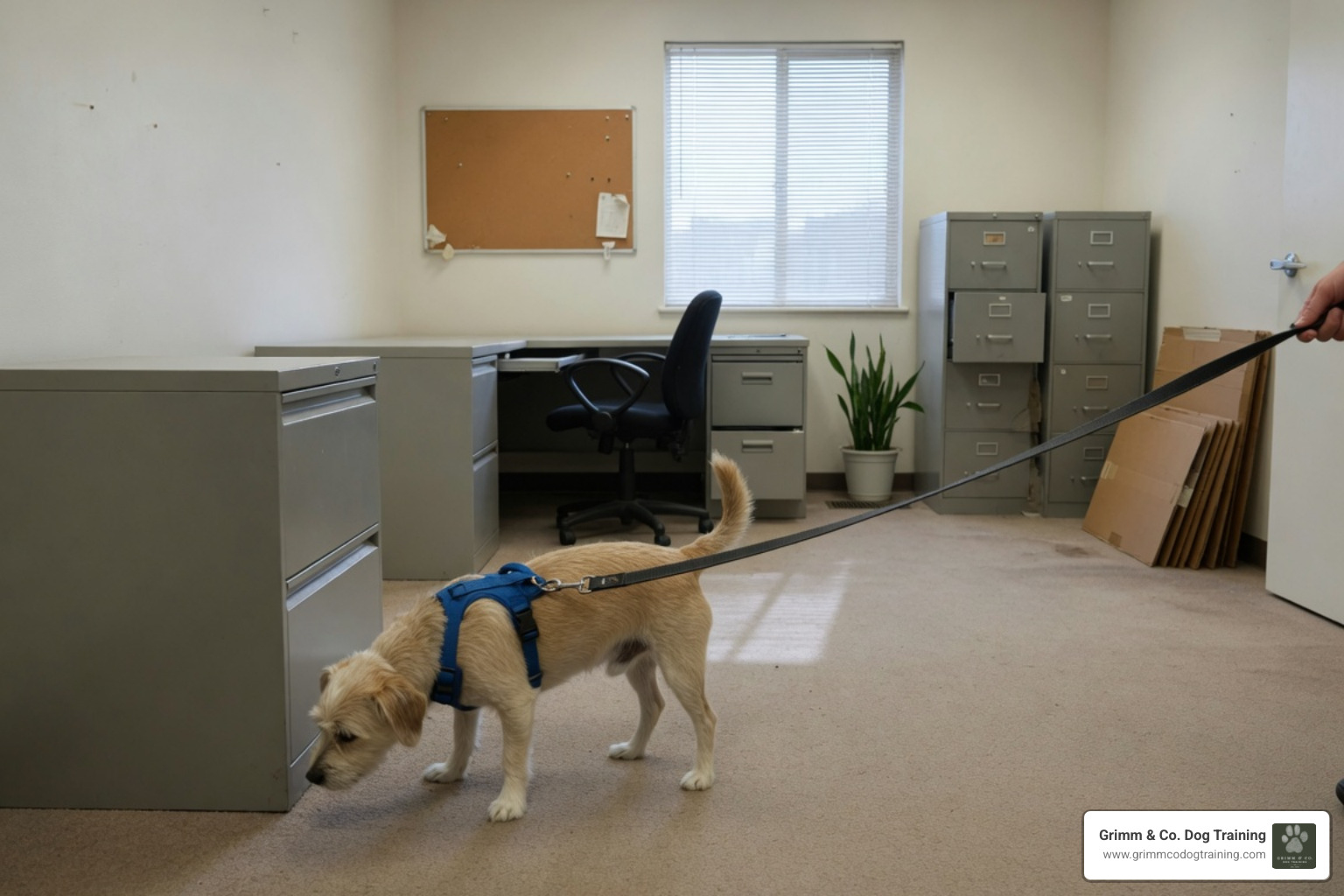
Container searches and interior searches are the perfect entry points for beginner dogs. Containers are typically cardboard boxes, luggage, or plastic bins arranged in a pattern. Interior searches take place inside rooms, presenting challenges like furniture, varying floor surfaces, and complex airflow.
| Search Parameter | Container Searches | Interior Searches |
|---|---|---|
| Typical Layout | Linear or grid patterns of boxes | Open rooms with furniture and obstacles |
| Primary Challenge | Distinguishing hot containers from neutral ones | Managing pooling odor and draft currents |
| Handler Focus | Maintaining leash tension and pacing | Reading environmental airflow and dog body language |
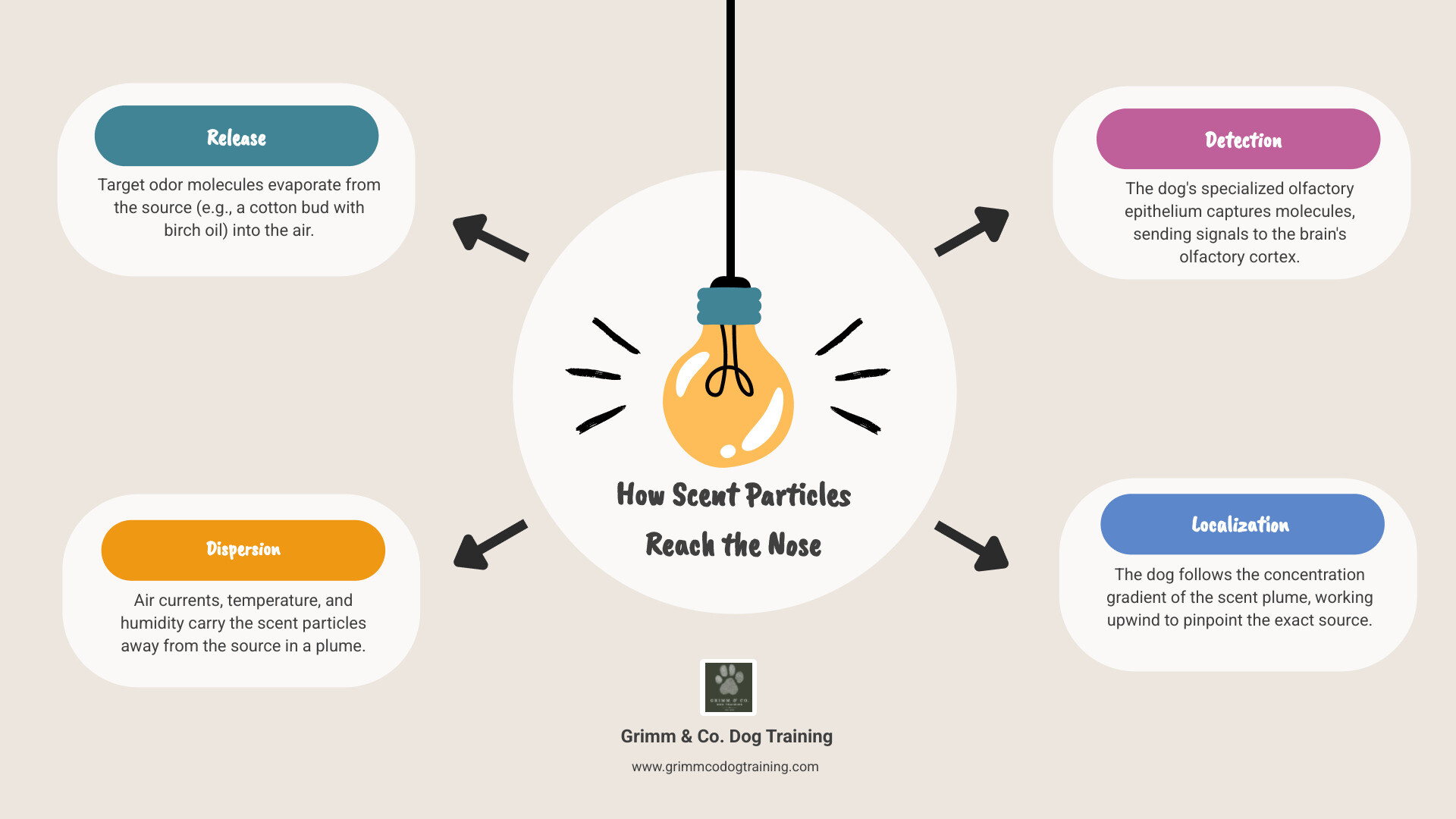
In interior spaces, scent does not travel in a straight line. Scent molecules behave like liquid, drifting with drafts, pooling in corners, and eddying around furniture. Understanding how these factors influence scent diffusion is key to helping your dog navigate complex indoor layouts.
Conquering Exterior Areas and Vehicles
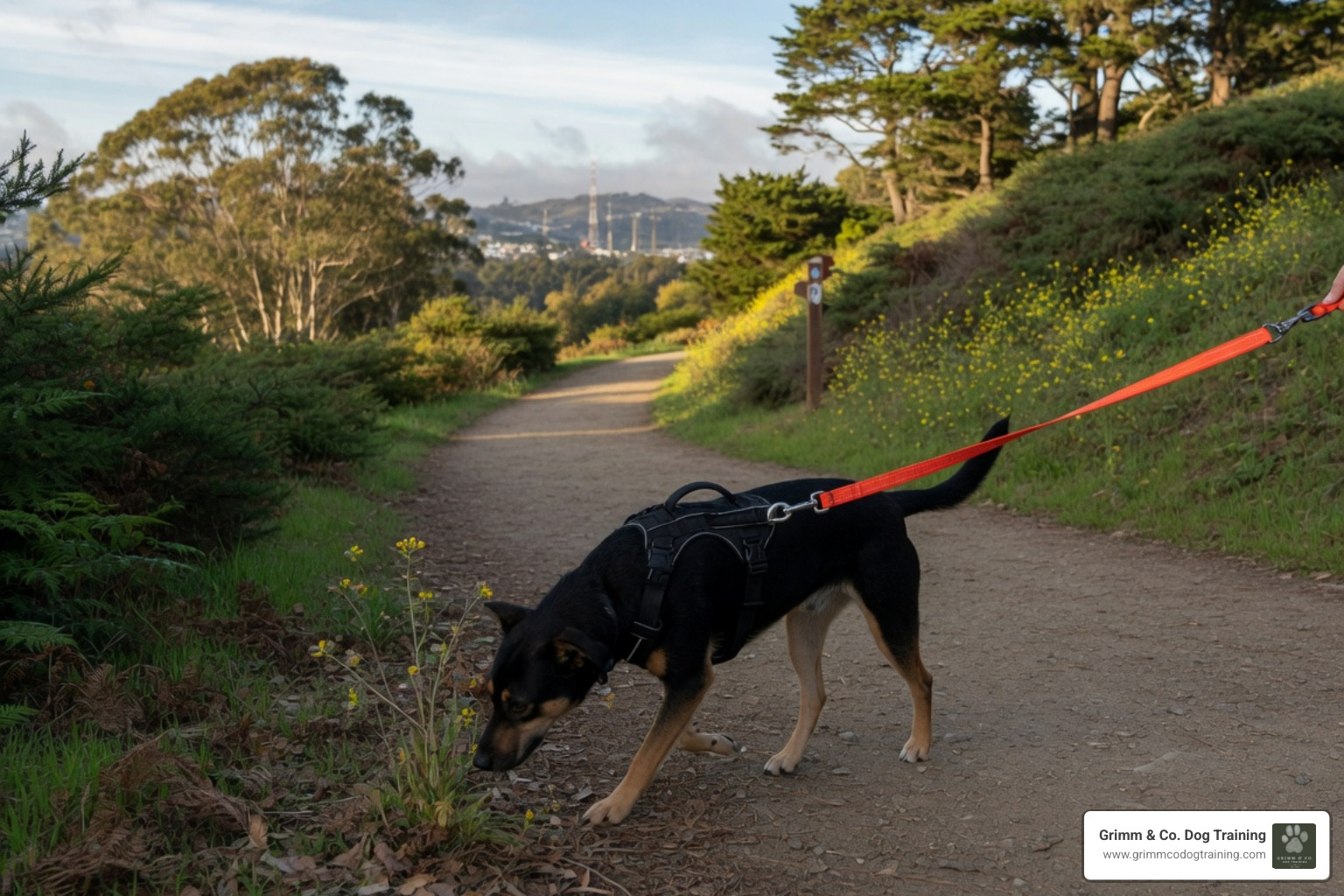
Exterior searches and vehicle searches introduce unpredictable outdoor variables. When working outside, you must contend with wind currents, temperature fluctuations, and natural distractions like animal tracks or food debris. Scent thermals rise as the ground warms in the sun and fall as the temperature drops in the evening.
Vehicle searches require the dog to search the exterior of parked cars, trucks, or trailers. Scent is often hidden on wheel wells, license plates, or door seams. The metal surfaces of vehicles heat up rapidly, causing scent to rise and drift away from the physical hide. Handlers must learn to manage their long lines carefully to avoid catching the leash on tires or side mirrors.
Progressing from Novice to Master Level Searches
As your dog gains confidence, you can systematically increase the difficulty of your training setups. Progression involves increasing the search area size, adding multiple hides, introducing non food distractions, and utilizing inaccessible hides where the scent source is tucked deep inside an object.
At the master level, searches often feature an unknown hide count, meaning the handler does not know how many hides are in the area and must rely entirely on the dog's behavior to decide when the area is clear. This level of work requires a deep, intuitive partnership. To see how these advanced problem solving skills compare to other working canine disciplines, you can read about the work of a Search and Rescue Dog.
Navigating the Competitive Arena
Comparing AKC and NACSW Scent Work Programs
If you decide to enter the competitive arena, it is important to understand the structural differences between the major trialing organizations. The American Kennel Club program features the Odor Search Division and the Handler Discrimination Division, testing dogs across five difficulty levels from Novice to the elite Detective Class. The AKC uses four target odors: Birch, Anise, Clove, and Cypress.
The National Association of Canine Scent Work focuses heavily on mimicking real life detection scenarios. Before you can compete in an NACSW trial, your dog must pass an Odor Recognition Test to prove they can identify Birch, Anise, and Clove. For a comprehensive look at their specific trial guidelines, safety protocols, and scoring systems, you can study the NACSW Rule Book .
What Bay Area Handlers Should Know Before Trialing
For handlers in Daly City, San Francisco, and the wider Bay Area, the most relevant competition pathways are U.S. organizations such as AKC and NACSW, along with local training clubs that host odor recognition tests, trials, practice searches, and workshops. The practical preparation matters more than memorizing a distant rulebook: your dog needs to work calmly around parking lots, school campuses, warehouse spaces, community centers, windy exterior areas, and vehicle searches with heavy urban odor contamination.
Before entering a trial, confirm the specific rule set for the organization hosting the event. Pay close attention to required target odors, age and registration requirements, crate or car waiting expectations, whether searches are on leash, and how the organization defines faults, alerts, finishes, and disqualifications. If your dog trains in dense Bay Area environments, practice neutralizing your own handling habits as much as the dog’s odor skills. Crowding the dog, staring at likely hide locations, tightening the line near source, or rushing the search can all create confusion in a trial environment.
Preparing for Your First Scent Work Trial
Preparing for your first trial involves both mental and physical preparation. You will need to obtain a Premium List from the hosting club, which contains all the entry forms, location details, and the contact information for the trial secretary. Dogs must meet the minimum age requirements, which is six months of age for AKC trials.
On trial day, establish a consistent start line routine to help your dog transition into search mode. This might include a specific harness fitting, a brief focus exercise, and a clear search cue. Because trials can be long, you must acclimate your dog to resting quietly in your vehicle between runs, as most venues do not offer indoor crating options.
Troubleshooting Complex Environmental Challenges and Sourcing Resources
Managing Distractions and Blank Areas
One of the most common challenges in advanced training is teaching your dog to ignore non food distractions, such as toys, unusual surfaces, or human scent, while searching for the target odor. We address this by building high value histories of reinforcement at the target scent, making the target odor far more lucrative than any environmental distraction.
Blank areas, which are search zones that contain absolutely no hides, are also introduced in higher levels. The handler must navigate the area and confidently call a finish without their dog falsely alerting. This requires you to recognize when your dog is simply exploring the environment versus actively tracing a scent cone, helping you avoid handler bias. To learn more about our philosophy on reading canine behavior, visit our Training Approach page.
Resolving Inaccessible Hides and Pooling Odor
An inaccessible hide is a scent source placed where the dog can smell the odor but cannot physically touch the vessel, such as high up on a wall or deep inside a cabinet. Dogs will naturally try to pinpoint the exact source, but they must learn to alert at the closest accessible point.
Pooling odor occurs when scent collects in draft free pockets, such as under a desk or in a corner, far away from the physical hide. If your dog alerts on pooled odor, do not correct them. Instead, encourage them to keep searching to find where the scent is strongest, helping them solve the puzzle of converging odors and wind eddies.
Classes and Literature for Advanced Skill Building
Developing your skills as a handler requires continuous education. Reading specialized literature, studying a scentwork glossary, and participating in progressive classes will help you refine your leash handling and environmental analysis.
If you are looking for structured, professional coaching to take your training to the next level, you can explore the curriculum options offered through Classes – Scratch and Sniff Scentwork .
Frequently Asked Questions about Scent Work
What is the difference between AKC and NACSW scent work?
The AKC program uses four target odors, including Cypress, and features a Handler Discrimination division where dogs search for their owner's scent. The NACSW uses three target odors, requires an Odor Recognition Test before trialing, and focuses heavily on natural, rugged, real world search environments with strict double blind designs.
Why should I use a long line without a handle for scent work?
A long line without a handle is designed to be dropped and dragged safely on the ground. This prevents the leash from snagging on furniture, brush, or vehicle tires, allowing your dog to search independently and cover large areas without physical interruption or safety hazards.
Can mixed breed dogs compete in official scent work trials?
Yes. Mixed breed dogs are fully welcome to compete in both AKC and NACSW trials. For AKC trials, mixed breeds can participate by registering through the Canine Partners program, provided the dog is at least six months of age.
Put Your Dog’s Nose to Work in Real Life
At Grimm and Co. Dog Training, we believe that the strongest relationships are built on mutual understanding, clear communication, and activities that respect your dog's biological needs. Whether you are living in Daly City, San Francisco, or elsewhere in the South Bay Area, scent work is an exceptional way to provide your dog with meaningful mental exercise.
If you are ready to build a deeper bond, challenge your dog's mind, and explore the power of canine scenting, we invite you to check out our Services page. For those interested in taking scenting to the ultimate level of outdoor teamwork, explore our specialized program in Mantrailing to get started on your next adventure.