
Is Your Dog a Born Detective? Try Mantrailing Sport
Your Dog's Nose Knows More Than You Think

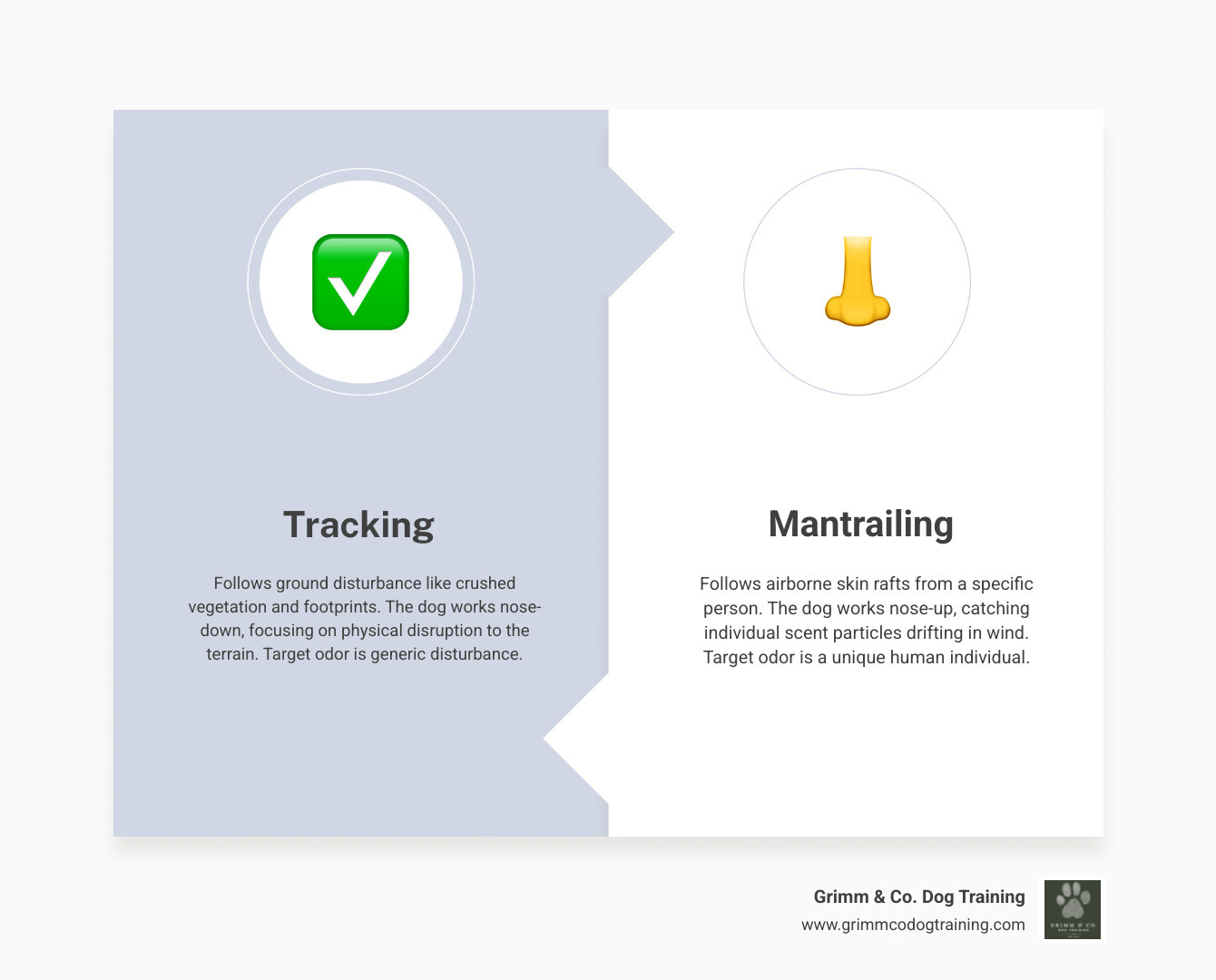
The mantrailing dog sport is a scent based activity where your dog learns to locate a specific person by following their unique scent trail, starting from an object that person has touched. Unlike classic tracking which demands a nose down focus on ground disturbances, mantrailing allows the dog to follow airborne scent rafts left by a specific individual. The sport is highly inclusive, welcoming any breed and age, including dogs managing reactivity, anxiety, or physical limitations. To begin, you only require a dedicated trailing harness, a fifteen to twenty foot long line, a scent article, and a patient helper to act as the runner. Through this work, dogs build deep confidence, handler focus, physical endurance, and profound mental enrichment.
A dog's nose is up to one hundred thousand times more powerful than a human's. Mantrailing does not teach your dog to use that ability. It simply gives that biological machinery a job worth doing.
For Bay Area dog owners navigating busy schedules and high stimulation environments, this sport translates directly into a dog that is calmer, more focused, and genuinely tired in the right way. This is not the frantic state of zoomies at 11pm. It is the deep satisfaction of having solved a complex environmental problem.
I am Bailey Milne Davies, and alongside my dog Grimm I have trained across multiple scent sports. This includes rat sports like Trailing and Locating and Urban Locating, which share core mechanics with the mantrailing dog sport. That hands on experience shapes everything you will find in this guide.
Scent Is a Language We Are Only Beginning to Translate
To understand the mechanics of the mantrailing dog sport we must first look at the canine olfactory system. While a human possesses roughly six million olfactory receptors, an average dog has over one hundred million. Bloodhounds represent the absolute pinnacle of this evolutionary design, boasting over two hundred million scent receptors. This biological machinery allows dogs to perceive the world in a resolution we cannot comprehend, detecting individual scent molecules diluted to one part in trillions.
When a person walks through an environment, they do not merely leave footprints. They leave a continuous trail of biological data. This process is the foundation of Mantrailing, or person tracking | K9 DogHealth which utilizes the dog's natural hunting instincts to solve complex environmental puzzles. Rather than teaching a dog a brand new skill, we are simply learning to read their communication as they follow a trail.
The movement of scent is dynamic, governed by physics rather than simple linear paths. Wind currents, temperature gradients, and relative humidity all dictate how scent behaves. In the cool, damp mornings of the San Francisco Bay Area, scent clings to damp foliage and settles into low lying areas. As the midday sun warms the pavement in Daly City or Redwood City, rising thermal currents can loft these scent molecules high into the air, carrying them yards away from the physical path the person walked.
The Distinct Mechanics of Trailing, Tracking, and Nosework
Many dog owners confuse trailing with other scent disciplines, but the differences are distinct and affect how your dog works. Classic tracking, often seen in competitive utility trials, requires the dog to follow precise ground disturbances and crushed vegetation. The tracking dog works slowly with its nose glued to the dirt, following the exact footsteps of a path.
Scent detection or nosework involves searching for a specific target odor, such as birch or anise essential oils, hidden within a defined search area. The dog is not looking for a person, but rather searching for a stationary source of a synthetic or botanical smell.
Mantrailing is a holistic, flexible activity. The dog is looking for a specific individual, using a scent article to identify the target. The dog is free to use both air scenting and ground scenting techniques, changing their approach as environmental conditions dictate.
| Feature | Classic Tracking | Scent Detection / Nosework | Mantrailing |
|---|---|---|---|
| Primary Scent Source | Ground disturbance and crushed earth | Refined essential oils or target odors | Human skin rafts and individual scent |
| Head Position | Constantly low, following footsteps | Variable, searching vertical and horizontal spaces | High or low, adapting to wind and terrain |
| Target at End | Dropped articles or glove | Stationary scent box or hidden vial | A living helper holding a high value reward |
| Urban Usability | Very low, requires dirt or grass | High, works indoors and outdoors | High, easily traverses asphalt and concrete |
The Physics of Skin Rafts and Scent Cones in Motion
Every human constantly sheds microscopic biological material. We shed roughly forty thousand dead skin cells, also known as skin rafts, every single minute. These rafts are accompanied by sweat, oils, and individual bacteria that create a highly personalized scent profile. As these skin rafts drift off our bodies, they are carried by wind currents, forming a three dimensional shape known as a scent cone.
Understanding how these scent cones interact with the environment is crucial for any handler. In a dense redwood forest in the hills above Woodside, the canopy traps scent, creating stable, long lasting trails. In a highly urbanized setting like downtown San Francisco or a busy shopping center in San Jose, the scent behaves differently. Wind shears off buildings, creating drafts that can trap scent in doorways or blow it across multi lane streets.
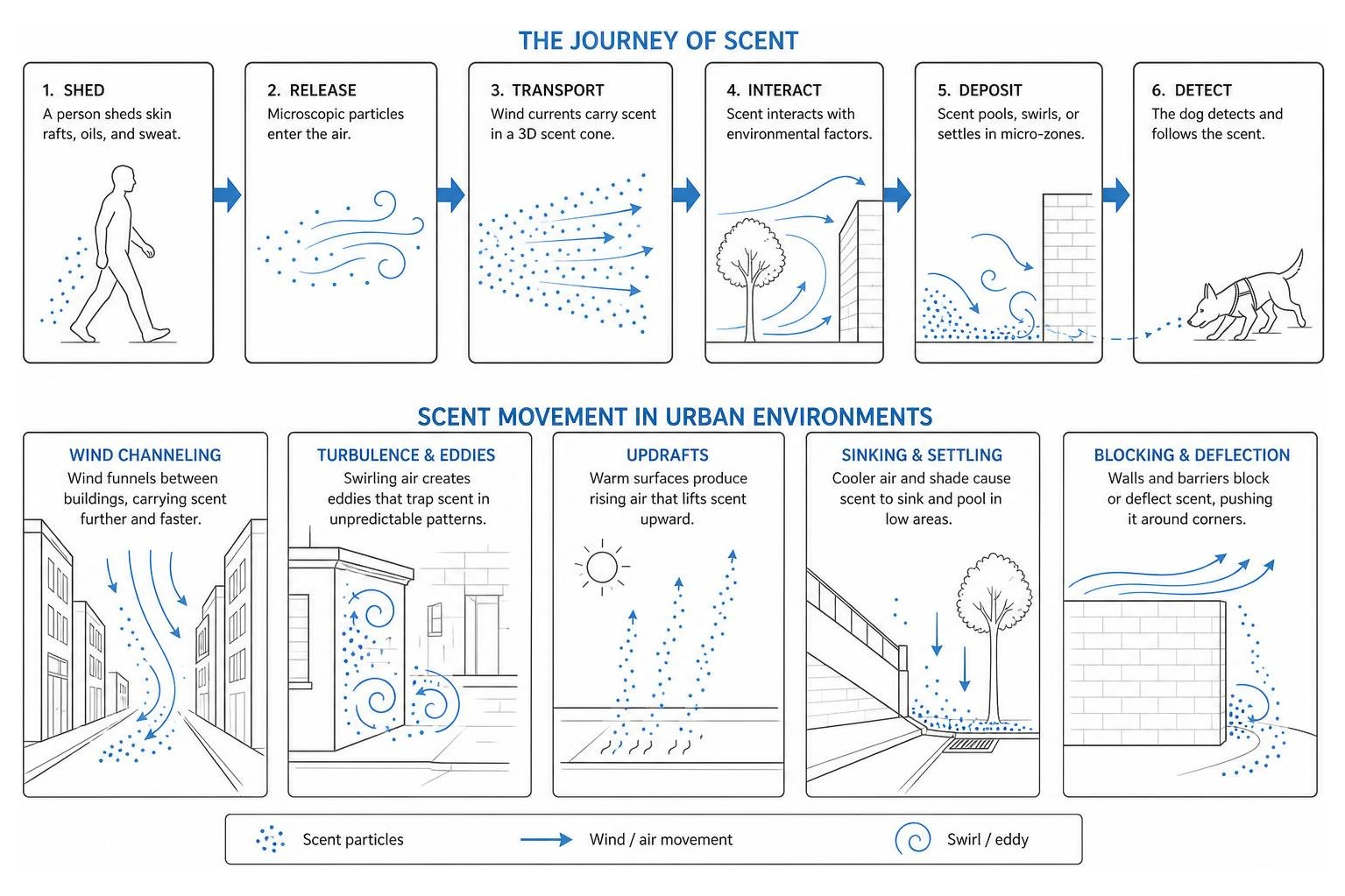
By studying the science of scent distribution, we learn to trust the dog's nose over our own eyes. When you see your dog head high, pulling toward a brick wall, they are not distracted. They are working the edge of a scent cone that has pooled against the masonry. You can read more about these fascinating dynamics in Discovering the Joy of Mantrailing: A Guide for Dog Owners which details how dogs navigate complex environmental scent puzzles.
Mantrailing as the Ultimate Cognitive Outlet for High Drive Dogs
Most modern dog sports focus heavily on physical exertion or precise obedience. While agility and flyball have their place, they can sometimes overstimulate high drive dogs, leaving them physically fit but mentally wired. Mantrailing acts as a profound cognitive outlet because it requires intense concentration. A twenty minute trail can tire a dog more thoroughly than a two hour run along the Pacific coast because their brain is working at maximum capacity to filter out background noise and focus on a single, aging scent stream.
This sport is a low impact activity, making it exceptionally inclusive. Because the dog sets the pace and works on a long line, it is safe for young dogs whose growth plates have not yet closed, as well as senior dogs or three legged dogs who need mental stimulation without high impact jumping. It is a true team sport built on relationship based training, which we discuss extensively in our dog training through sports blog.
Building Internal Confidence Through Autonomous Problem Solving
One of the most remarkable aspects of this sport is its therapeutic value for dogs with behavioral challenges. Dogs experiencing social anxiety, fear of strangers, or reactivity to other dogs thrive in mantrailing. The structure of the sport is inherently safe because only one dog works at a time. There are no loose dogs, no forced social interactions, and no pressure to perform in close proximity to triggers.
When a socially anxious dog starts trailing, we set up the scenario so they are searching for a highly familiar person, such as their owner or a trusted family member. As the dog successfully solves these simple puzzles, their focus shifts from environmental threats to the joy of the hunt. This autonomous problem solving builds deep, internal confidence. The dog learns that they can navigate strange environments, ignore sudden noises, and find their target independently. Over time, we can gradually transition them to trailing unfamiliar helpers, systematically dismantling their fear of strangers through positive association. You can explore how this fits into our broader behavioral programs on our dog training services page.
Cultivating the Handler Bond Through Shared Autonomy
In traditional obedience, the handler is the director, telling the dog exactly when to sit, heal, and turn. In mantrailing, the roles are completely reversed. The handler is entirely blind to where the trail goes, meaning you must learn to read your dog's subtle body language to understand when they are actively on the scent or when they have lost the trail.
This dynamic creates a profound level of teamwork. You are no longer managing your dog; you are supporting them. You must learn to observe the tension in the long line, the angle of your dog's head, the speed of their tail wag, and the positioning of their ears. When you learn to trust your dog's nose, you build a relationship based on mutual respect and shared autonomy. This philosophy is central to our training approach page, emphasizing that true cooperation comes from understanding, not control.
The Essential Equipment and Groundwork for Initial Trails

Getting started in this sport does not require a massive investment in specialized gear, but the equipment you do use must be selected with care to ensure safety and clarity for the dog. The right gear acts as a contextual cue, letting your dog know exactly when it is time to work and when they are off duty. If you want to see this gear in action, you can check out our upcoming schedules on our dog training classes page.
Selecting the Proper Gear for Clear Contextual Cues
The most critical piece of equipment is a dedicated trailing harness. This harness must be distinct from your daily walking harness or collar. It should be designed to allow your dog to pull comfortably without restricting their shoulders or putting pressure on their trachea. When the trailing harness goes on, it serves as a physical trigger, letting the dog know they are allowed, and indeed expected, to pull into the leash and follow their nose.
You will also need a long line, typically fifteen to twenty feet in length. Leather, biothane, or lightweight cotton web lines work best because they do not tangle easily and are easy to manage as you walk behind your dog. Never use a retractable leash, as they do not allow for the subtle line handling and feedback required in this sport.
Finally, you will need sterile containers, such as clean glass jars or zip top bags, to store your scent articles. A scent article can be any item touched by the runner, such as a glove, a hat, or a clean gauze pad that has been rubbed against their neck. The reward at the end of the trail must be extraordinarily high value, such as fresh wet food, sardines, or a highly coveted toy, delivered directly by the hidden helper to build maximum motivation.
Structuring Initial Intensity Trails for Maximum Motivation
We begin training by playing simple runaway games to tap into the dog's natural drive to chase and find. In these initial sessions, the runner, who is often a familiar person, will excite the dog with a high value reward, then run a short distance, perhaps twenty five feet away, while the dog watches. The runner then ducks behind a tree or a wall, completely out of sight.
The handler then presents the scent article to the dog, gives their start cue, and lets the dog pursue the runner. The moment the dog reaches the helper, they are immediately showered with praise and fed their high value reward directly from the helper's hands. There is no complex indication behavior required. The dog does not need to sit or bark; the simple act of finding the person is the victory.
We gradually increase the difficulty by hiding the runner out of sight before the dog even enters the area, transitioning the dog from visual chasing to pure scent work. If you are ready to take your first steps, you can read about local opportunities in our blog about mantrailing courses.
The Progression from Recreational Engagement to Official Titles
As your dog becomes proficient at following fresh trails, the sport offers endless opportunities for growth. You can begin aging the trails, requiring your dog to follow a scent path that was laid hours or even days prior. You can also introduce environmental contamination, practicing in busy suburban parks or urban downtown environments where hundreds of other people have walked across the trail.
Distinguishing Recreational Sport from Operational Search and Rescue
It is important to understand the distinction between recreational mantrailing and professional search and rescue operations. While the underlying scent mechanics are identical, the operational requirements are vastly different. A professional search and rescue dog must be prepared to work in extreme wilderness conditions, navigate disaster zones, and perform under intense pressure for hours on end.
Recreational mantrailing is designed to be a low pressure, highly supportive environment. We are not deploying into active emergency situations. Instead, we are using the structure of the search to provide our dogs with enriching puzzles. This allows us to enjoy the brilliance of canine scent work without the grueling physical and emotional demands of professional service. You can learn more about the distinction between these paths on our search and rescue dog page.
The Structured Progression of Official Trailing Titles
For those who enjoy a structured progression, the American Bloodhound Club offers trailing titles that are officially recognized by the American Kennel Club. These trials are open to Bloodhounds and, depending on the specific event host, other breeds looking to test their skills under official guidelines. The progression is designed to systematically test the dog's endurance, accuracy, and ability to handle environmental distractions.
The journey begins with the Event Entry Certification Test, which requires the dog to successfully work a trail that is one quarter mile long and aged between one and two hours. Once certified, teams can progress to the Mantrailer title, where the trail is one half to three quarters of a mile long, aged four to six hours, and contains at least one major change in direction. The Mantrailer Intermediate title increases the difficulty by aging the trail eight to eighteen hours and introducing moderate environmental contamination alongside a crossrunner designed to distract the dog. Finally, the Mantrailer Excellent title serves as the ultimate test, requiring the team to navigate a trail aged twenty four to thirty six hours with heavy contamination, multiple obstacles, and a crossrunner.
Common Inquiries Regarding Mantrailing Dynamics
Breed Suitability and Physical Adaptability in Trailing
Absolutely. While Bloodhounds are the undisputed masters of historical trailing, and high drive working breeds like German Shepherds and Belgian Malinois excel in professional roles, recreational mantrailing is open to every single breed and mix. From Chihuahuas to Great Danes, all dogs possess the physiological machinery to follow a scent trail. The sport is easily adapted to accommodate dogs with physical limitations, making it an excellent option for senior pets who still crave a job to do.
The Impact of Meteorological Variables on Scent Preservation
Weather is the single greatest variable in scent work. High winds can blow skin rafts far away from the physical path of the runner, forcing the dog to trail several yards downwind of the actual track. High heat and direct sunlight dry out scent molecules, causing them to degrade rapidly, while moderate humidity and cool temperatures help preserve the trail. Rain can actually assist the dog by binding scent rafts to the ground, though heavy downpours can wash the scent away entirely.
Identifying and Correcting Common Handler Errors
The most common error is a tight long line. When handlers hold a tight line, they inadvertently guide or hold back the dog, disrupting their natural search rhythm and causing frustration. Another common mistake is moving too quickly, increasing the age and length of the trail simultaneously. You should only ever change one variable at a time, keeping training sessions highly rewarding and successful to preserve your dog's motivation.
Developing a Deeper Partnership Through Scent
Mantrailing is more than just a sport. It is a window into how our dogs perceive the world. By stepping to the end of the long line and learning to trust your dog's nose, you unlock a level of communication and partnership that traditional training rarely touches. For owners in Daly City, San Francisco, and the surrounding South Bay looking to build genuine confidence in an anxious pet or provide a structured outlet for a high drive working breed, this discipline offers measurable results. To evaluate whether our structured programs are the right fit for your dog, visit our mantrailing page to view our upcoming schedule of workshops and advanced trailing courses.