
How to Choose the Right Dog Training for Jumping Issues and Save Your Sanity
When Your Dog's Greeting Becomes a Daily Problem
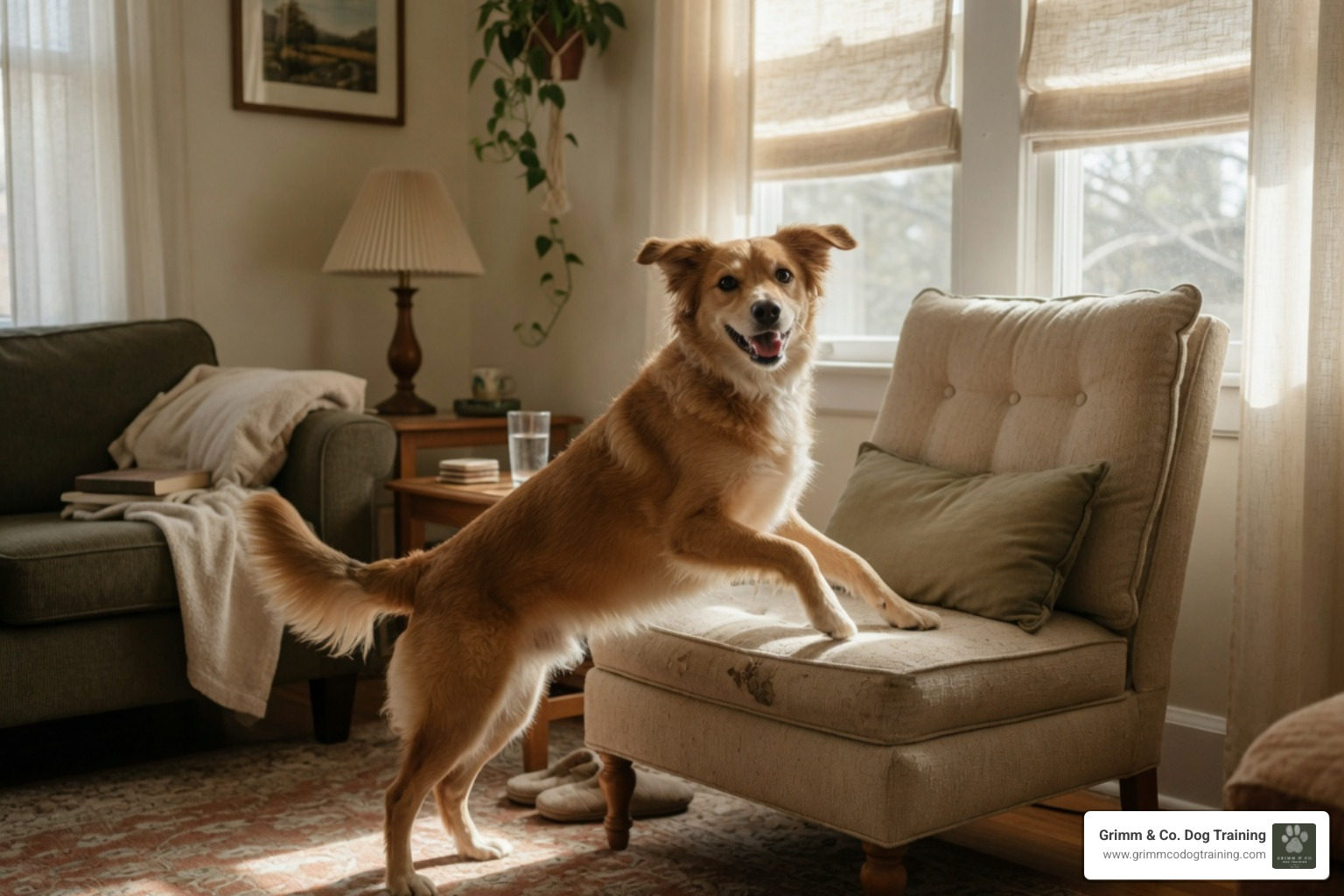
If you're dealing with dog training for jumping issues, here's the short answer on what actually works:
- Manage the environment first — use baby gates, leashes, or crates to stop your dog from practicing the behavior while you train.
- Teach an incompatible behavior — a dog that's sitting can't jump at the same time. Train a solid sit and reward it every time your dog greets someone.
- Remove all attention for jumping — no eye contact, no pushing, no "no." Any response can accidentally reinforce the behavior.
- Be consistent across everyone — family members, visitors, and strangers on walks all need to follow the same rules.
- Seek professional help if the jumping is paired with anxiety, mouthing, or aggression.
Jumping is one of the most common behavior complaints among dog owners and one of the most misunderstood. Your dog isn't trying to be rude. To them, jumping is a completely natural greeting. Dogs meet face-to-face. They jump to reach yours.
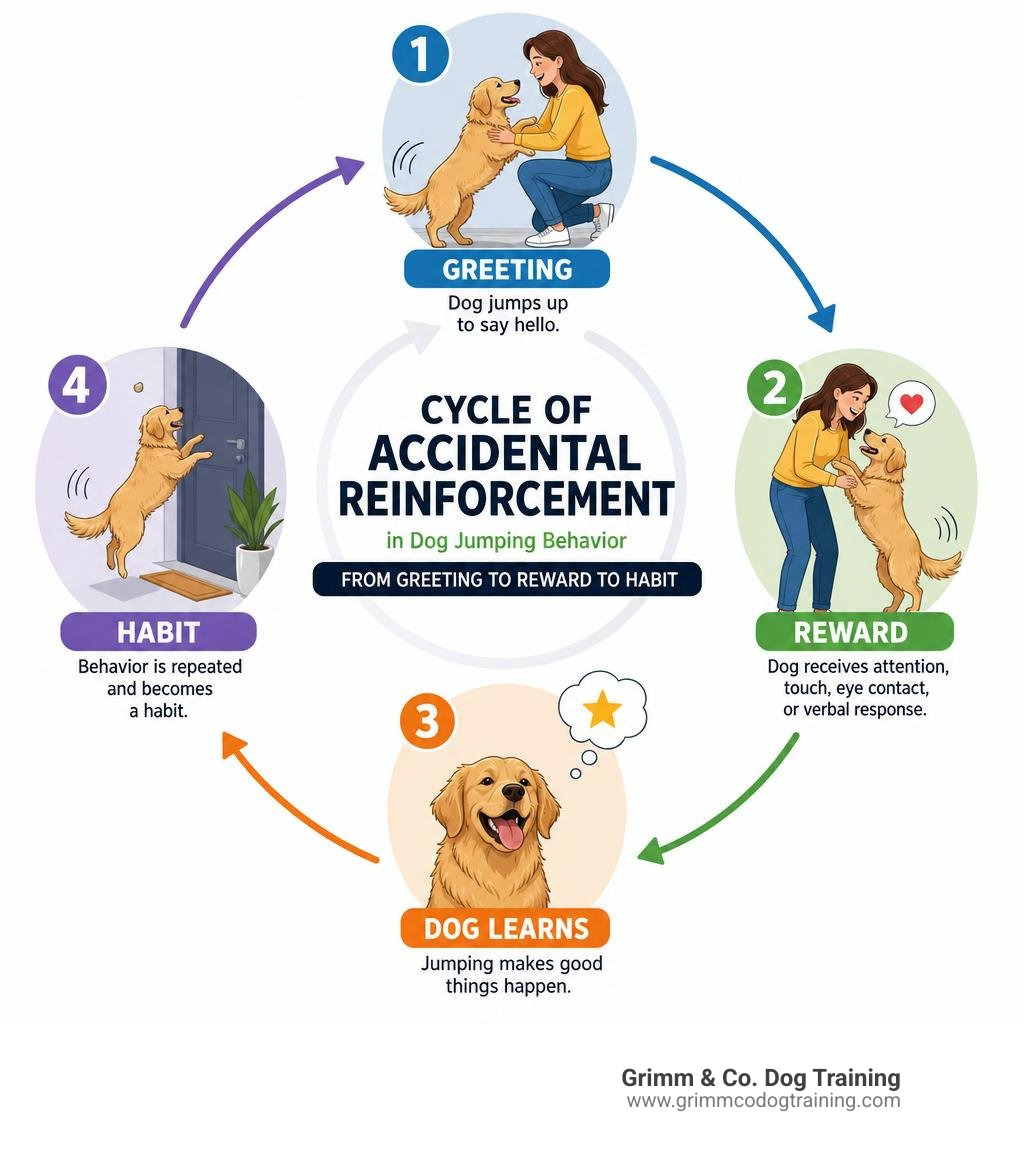
The problem? Most owners accidentally teach their dogs that jumping works.
A push away, a "no," a laugh, a shout, to your dog, that's all attention. And attention is exactly what they wanted. So the jumping continues, and often gets worse.
It becomes a daily frustration. Fresh clothes get paw prints. Elderly relatives lose their balance. Kids' friends stop wanting to visit. What started as a cute puppy habit turns into a real problem.
The good news: jumping is a learned behavior, which means it can be unlearned. With the right approach, one based on clear communication and consistency, most dogs show meaningful improvement within just a few weeks.
Why Do Dogs Jump? Understanding the Root Causes
To solve a behavior, we must first understand why it happens. Dogs do not jump out of spite, dominance, or a desire to ruin your clean work clothes. In the canine world, jumping is highly functional, communicative, and natural.
When puppies greet their mothers, they lick the muzzle to show respect, gather information, and sometimes solicit regurgitated food. As they grow and live alongside humans, that hardwired desire to greet face-to-face remains. Because our faces are several feet above theirs, they launch themselves upward to close the gap.
Beyond this basic greeting ritual, jumping serves as a powerful sensory tool. Dogs gather massive amounts of chemical information through our scent, facial expressions, and breath. By jumping up, they get a front-row seat to your personal scent profile. However, while the initial impulse is instinctual, the continuation of the behavior is almost always learned.
Excitement and Attention-Seeking Habits
For most dogs, jumping is a self-rewarding behavior driven by pure excitement and attention-seeking. This is where basic operant conditioning comes into play: behaviors that are reinforced will be repeated.
When your dog jumps on you, they are looking for a reaction. In their minds, any reaction is a win. If you push your dog down, grab their paws, yell "off," or even make direct eye contact, you have just given them physical contact and attention.
To an overexcited dog, a physical push feels like a fun wrestling match. A verbal "no!" is just you barking back in excitement. This interaction triggers a dopamine release in their brain, cementing the habit. Over time, what started as a puppy's instinctual greeting becomes a deeply ingrained ritual because they have learned that launching themselves like a furry missile is the single fastest way to get you to engage with them.
Anxiety and Frustration-Based Jumping
While excitement is the most common culprit, jumping isn't always a happy dance. For some dogs, jumping is a displacement behavior triggered by anxiety, stress, or frustration.
When a dog is overstimulated or unsure of how to handle a situation, such as a guest entering the home or a passing stranger on a walk, their internal arousal levels spike. If they don't have a structured outlet for this emotional energy, they may resort to jumping, sometimes accompanied by frantic mouthing or grabbing at clothes.
This is particularly common in dogs with restricted movement. When a dog is on a tight leash, their natural flight-or-fight options are limited. This restriction can cause intense frustration, leading them to jump up at their handler as a way to cope with the overwhelming environmental stimuli.
Understanding this emotional component is vital. If a dog is jumping out of fear or anxiety, ignoring them or turning your back can sometimes increase their insecurity, making the behavior worse. For a deeper dive into how emotional states impact canine behavior, the Veterinary Partner Behavior Guide offers clinical insights into how stress manifests in domestic dogs.
Immediate Management Strategies to Stop the Rehearsal
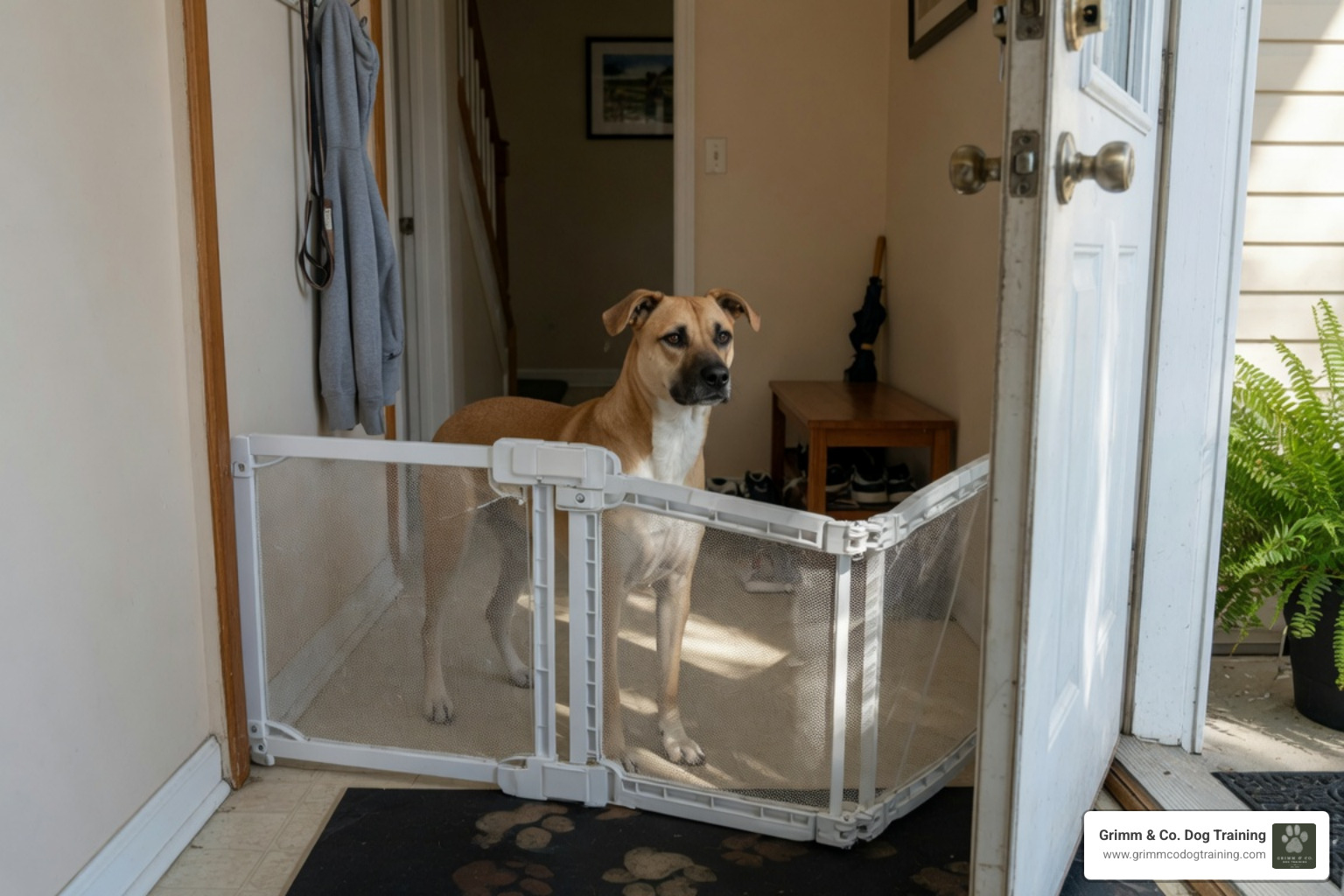
Before we can successfully train a dog to stop jumping, we must stop them from practicing the behavior. Every single time your dog successfully jumps on someone, the neural pathway for that habit is reinforced. Training cannot compete with a behavior that is being practiced and rewarded multiple times a day.
Management is the bridge that keeps your sanity intact while training is underway. It involves setting up your environment so that jumping is physically impossible. By utilizing tools like baby gates, crates, and short leashes, you can control your dog's access to people during high-arousal moments, ensuring they never have the opportunity to make a mistake.
The Scatter Technique for Quick Redirection
One of our favorite immediate management tools is the scatter technique. This method redirects your dog's intense energy downward before they even think about launching upward.
When you open the front door or walk into a room where your dog is waiting, immediately drop a handful of low-calorie, high-value treats directly onto the floor.
This simple action does two things:
- Redirects physical energy: It forces your dog's nose and paws to the ground to search for the food, making jumping physically impossible in that moment.
- Changes the emotional state: Sniffing is a naturally calming behavior for dogs. It lowers their heart rate and shifts their brain from a state of high-arousal excitement to a focused, calm searching state.
This technique is highly effective for enthusiastic greeters and is a staple recommendation in guides like the How to Stop Your Dog Jumping Up at People | Dogs Trust resource, which emphasizes moving the dog's focus to the floor to prevent the initial jump.
Using Barriers and Leashes Indoors
To protect visitors and maintain control inside your home, you need physical boundaries. We recommend setting up "greeting zones" using baby gates or exercise pens.
When guests arrive at your home in San Francisco or Daly City, your dog should be safely behind a barrier. This allows your dog to see the visitor and process their arrival without having physical access to them. Only when your dog has settled down and has all four paws on the floor should the guest approach the barrier to offer calm praise.
If your home's layout doesn't support baby gates, keep a short leash attached to your dog's collar during guest arrivals. You can step on the leash (leaving enough slack for your dog to stand comfortably, but not enough to jump) or secure it to a heavy piece of furniture (tethering). This simple environmental setup ensures your guests remain safe and your dog cannot rehearse unwanted behaviors.
Effective Dog Training for Jumping Issues: Force-Free Solutions

Once we have managed the environment to prevent rehearsal, we can focus on active training. Our approach to dog training for jumping issues is rooted in relationship-based, force-free methods. We do not need to intimidate, scare, or punish a dog to change their behavior. Instead, we use operant conditioning to teach them that polite behaviors yield much better rewards than jumping ever did.
The core scientific principle we use is called Differential Reinforcement of an Incompatible behavior (DRI). This simply means we choose a behavior that is physically impossible to perform at the same time as the unwanted behavior, and we reward it heavily. A dog cannot sit and jump simultaneously. By making "sitting politely" the most lucrative option in your dog's behavioral repertoire, the desire to jump naturally fades away.
Implementing Incompatible Behaviors in Dog Training for Jumping Issues
To implement this successfully, we must teach and generalize the alternative behavior in a low-distraction environment first. If your dog doesn't sit reliably when the house is quiet, they certainly won't do it when a guest walks through the door.
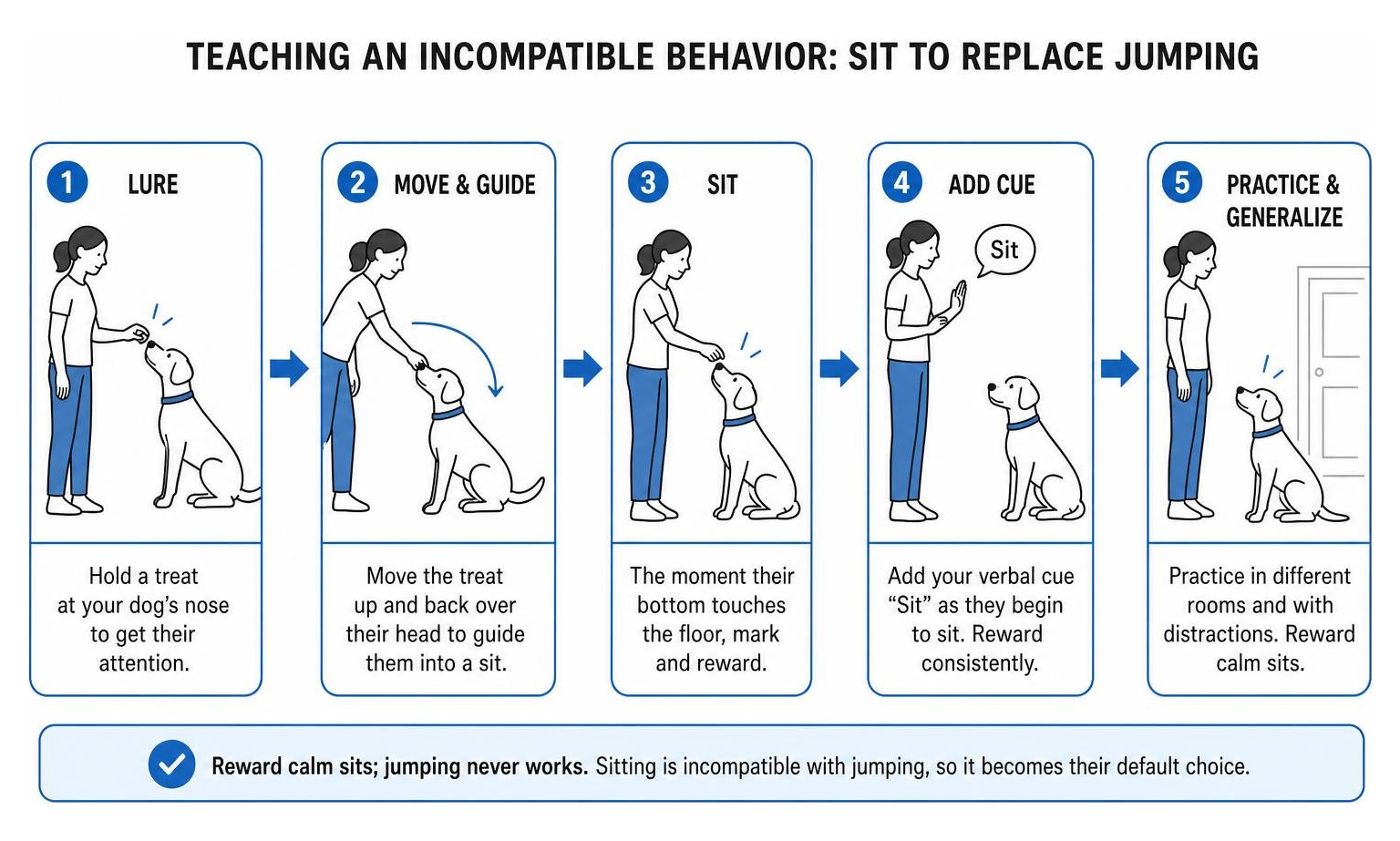
Here are three excellent incompatible behaviors you can teach:
- The Default Sit: Train your dog that sitting is the "magic key" that unlocks all good things; food, doors opening, leashes being attached, and human greetings. If they want to say hello, they must sit first.
- The Hand Touch: Teach your dog to target their nose to your open palm. This redirects their head downward and keeps their focus on your hand level rather than your face.
- Holding a Toy: For highly excitable mouthy dogs, carrying a favorite toy in their mouth during greetings is a game-changer. It is incredibly difficult for a dog to bark, mouth, or jump when they are proudly showing off a plush toy.
To build the foundation of these behaviors, check out our guide on Foundations for Effective Dog Training, which outlines how to set your dog up for success before adding real-world distractions.
The Role of Timing, Consistency, and Reward Value
For DRI to work, your timing must be precise. You must mark and reward the exact moment your dog chooses the correct behavior. Use a marker word like "yes!" or a clicker the millisecond your dog's bottom hits the floor, followed immediately by a high-value treat delivered at ground level.
When dealing with high-intensity greeting excitement, standard kibble won't cut it. You are competing with the massive dopamine rush of greeting a human. You must use high-value rewards. Think freeze-dried liver, small pieces of cheese, or roasted chicken.
Furthermore, consistency across the entire household is non-negotiable. If you ignore jumping but your partner or children allow the dog to jump "just this once" because they missed them, the dog will continue to jump. Inconsistent rules create a slot-machine effect: the dog will keep pulling the lever (jumping) because every now and then, they hit the jackpot of attention.
To help your entire family get on the same page, group environments can be incredibly beneficial. Learn more about how structured learning environments help build consistency in our article on Why Dog Training Classes Might Be the Right Fit for You.
Navigating Real-World Scenarios: Visitors, Walks, and Children
Training in your living room is one thing; maintaining polite behavior when the doorbell rings or when a friendly stranger approaches you at Muscle Rock Park is another. Real-world scenarios involve unpredictable human behavior and high-arousal environments that can easily push your dog over their threshold.
To navigate these challenges, we must have clear, proactive protocols for different social situations.
| Scenario | Immediate Management Tool | Training Goal / Incompatible Behavior | Handler Action |
|---|---|---|---|
| Visitors at the Door | Baby gate, crate, or short leash | Default sit or go-to-mat cue | Brief guests before entry; reward calm sitting at a distance. |
| Strangers on Walks | 3-to-6 foot fixed leash (no retractables) | "Watch me" cue or hand touch | Maintain a buffer zone; ask strangers to ignore the dog unless sitting. |
| Interacting with Children | Physical barrier or tether | Scatter feeding on the ground | Keep interactions brief; reward calm, ground-level focus. |
Outdoor Dog Training for Jumping Issues on Walks
When walking your dog around Daly City, Emeryville, or San Francisco, you are bound to encounter people who want to pet your dog. This is where proactive communication is vital.
Always maintain a "buffer zone" between your dog and passing pedestrians. If someone asks to pet your dog, do not let them approach if your dog is pulling, whining, or highly aroused. Instead, advocate for your dog by saying, "We're training right now! You can say hello if he sits."
If your dog remains calm and sits, invite the person to approach. If your dog breaks the sit and attempts to jump, calmly step back to increase the distance (the buffer zone) and try again. This teaches your dog that pulling and jumping actually move the person further away, while remaining calm brings the person closer.
Protecting Children and Vulnerable Visitors
Children and elderly visitors are at the highest risk of injury from a jumping dog. Children move quickly, make high-pitched noises, and are naturally at eye-level with many medium-to-large dogs, which can easily trigger predatory play or intense greeting arousal.
To keep everyone safe:
- Never allow unsupervised interactions between your dog and young children.
- Keep your dog on a leash or behind a barrier when children or vulnerable guests are visiting.
- Teach children to stand "like a tree" (arms crossed, looking at their feet, quiet and still) if the dog approaches them with too much energy. Movement and high-pitched squeals will only encourage the dog to jump more.
- Deliver rewards at ground level to keep your dog's focus downward.
When To Seek Professional Help for Your Dog's Jumping
Many owners can successfully resolve minor jumping issues with consistent management and basic training. However, there are times when DIY methods are not enough, and continuing without professional guidance can lead to frustration or safety risks.
If your dog is a large breed, if you have vulnerable family members at home, or if the jumping has been happening for years, working with a professional can save your sanity and speed up the learning process. Additionally, a professional can help rule out underlying medical issues. Sudden behavioral changes or increased irritability can sometimes be linked to pain or joint discomfort, which should always be evaluated by a veterinarian first.
Distinguishing Between Nuisance Jumping and Emotional Distress
It is crucial to distinguish between a dog who jumps out of joyful excitement and one who jumps due to emotional distress.
If your dog's jumping is accompanied by any of the following signs, it is a clear indicator of conflict behavior, anxiety, or hyper-arousal:
- Frantic mouthing, nipping, or grabbing at clothes or leashes
- Growling, stiff body posture, or whale eye (showing the whites of their eyes)
- Submissive urination during greetings
- An inability to calm down or settle even after the trigger has left
These are not simple nuisance behaviors; they are signs that your dog is struggling to cope with their environment. In these cases, a cookie-cutter approach won't work. You need a customized, relationship-based training plan designed by experts who understand canine behavior inside and out.
To explore personalized coaching options tailored to your home and lifestyle, check out our Dog Training Services.
Frequently Asked Questions About Dog Jumping
Why does my dog only jump on certain people?
Dogs are incredibly observant. They quickly learn to distinguish between people who enforce polite behavior and those who don't.
If your dog only jumps on your cousin or a specific neighbor, it's highly likely that person has selectively reinforced the behavior. Even if they say, "Oh, I don't mind! I love dogs!" their high-pitched voice, physical petting, and excited body language are rewarding the jump. Your dog has simply learned that this specific human is a walking jackpot for high-energy interactions.
Should I use a knee or physical correction to stop jumping?
Absolutely not. Old-school training advice often recommended kneeing a dog in the chest, stepping on their back paws, or using a pinch collar to stop jumping. These physical corrections are not only unnecessary, but they can also be highly dangerous.
As outlined in How to Stop a Dog From Jumping on People in 2026: A Step-by-Step Training Guide That Actually Works, physical corrections damage the bond of trust between you and your dog. They can cause physical injury, make your dog hand-shy, or transform an excited greeting into a defensive, fear-based aggressive response. Punishment teaches a dog what not to do through pain or intimidation, but it fails to teach them what they should do instead.
How long does it take to resolve jumping issues?
The training timeline depends on several factors, including your dog's age, how long they have practiced the behavior, and your consistency.
- Puppies: Because they haven't had years to practice the habit, puppies often show dramatic improvement within 2 to 4 weeks of consistent training.
- Adult Dogs: Adult dogs with deeply ingrained jumping habits typically take 4 to 8 weeks of dedicated, daily practice to generalize polite greetings across different environments.
Behavior change is not linear. You may experience an "extinction burst," a temporary spike in the intensity of the jumping when you first start ignoring it, as your dog tries harder to get your attention. Stay the course; this is a sign that the training is working!
So if You're Fed Up with the Dog Jumping
At Grimm & Co. Dog Training, we believe that resolving behavior challenges like jumping isn't about controlling or suppressing your dog. It's about building a deep, relationship-based partnership rooted in clear communication, trust, and mutual respect.
Living in the bustling Bay Area, from the busy streets of San Francisco to the beautiful parks of Daly City and Treasure Island, means our dogs are constantly exposed to high-distraction environments. Helping them navigate these spaces calmly is the ultimate gift we can give them.
If you're ready to stop the embarrassing greetings, protect your guests, and finally enjoy peaceful walks, we are here to support you. We offer personalized private lessons, supportive group classes, and specialized training tailored to your unique dog and lifestyle.
Let's build a polite, confident dog together. For more information on how we can help you save your sanity, visit our More info about our services page and join our thriving Bay Area dog training community today!