
The Ultimate Guide to Finding a Trusted Private Dog Trainer
Find a Trusted Private Dog Trainer

Private dog training is one-on-one coaching built around your dog, your home, and the behaviors affecting daily life. To find a trainer you can trust, look for someone who can clearly explain their methods, assess your dog's triggers and environment, teach you how to practice, and provide a realistic plan for follow-through.
This format is especially useful for leash reactivity, pulling, jumping, barking, door dashing, resource guarding, and inconsistent obedience. Because sessions can happen where problems occur, such as your front door, neighborhood sidewalk, or a busy Bay Area park, the trainer can build skills in the settings that matter most.
A qualified private trainer should adapt the plan to your dog's age, temperament, learning history, and safety needs. For serious fear, aggression, or reactivity, individual work in a controlled setting is often a better starting point than a group class.
I am Bailey Milne-Davies, a trainer and lifelong student of dog behavior whose work with my own dog, Grimm, began with a need for clearer structure, better leash skills, and a stronger partnership. Through formal training, seminars, shadowing, coaching classes, and hands-on private dog training experience, I help owners become calm, consistent teammates for their dogs.
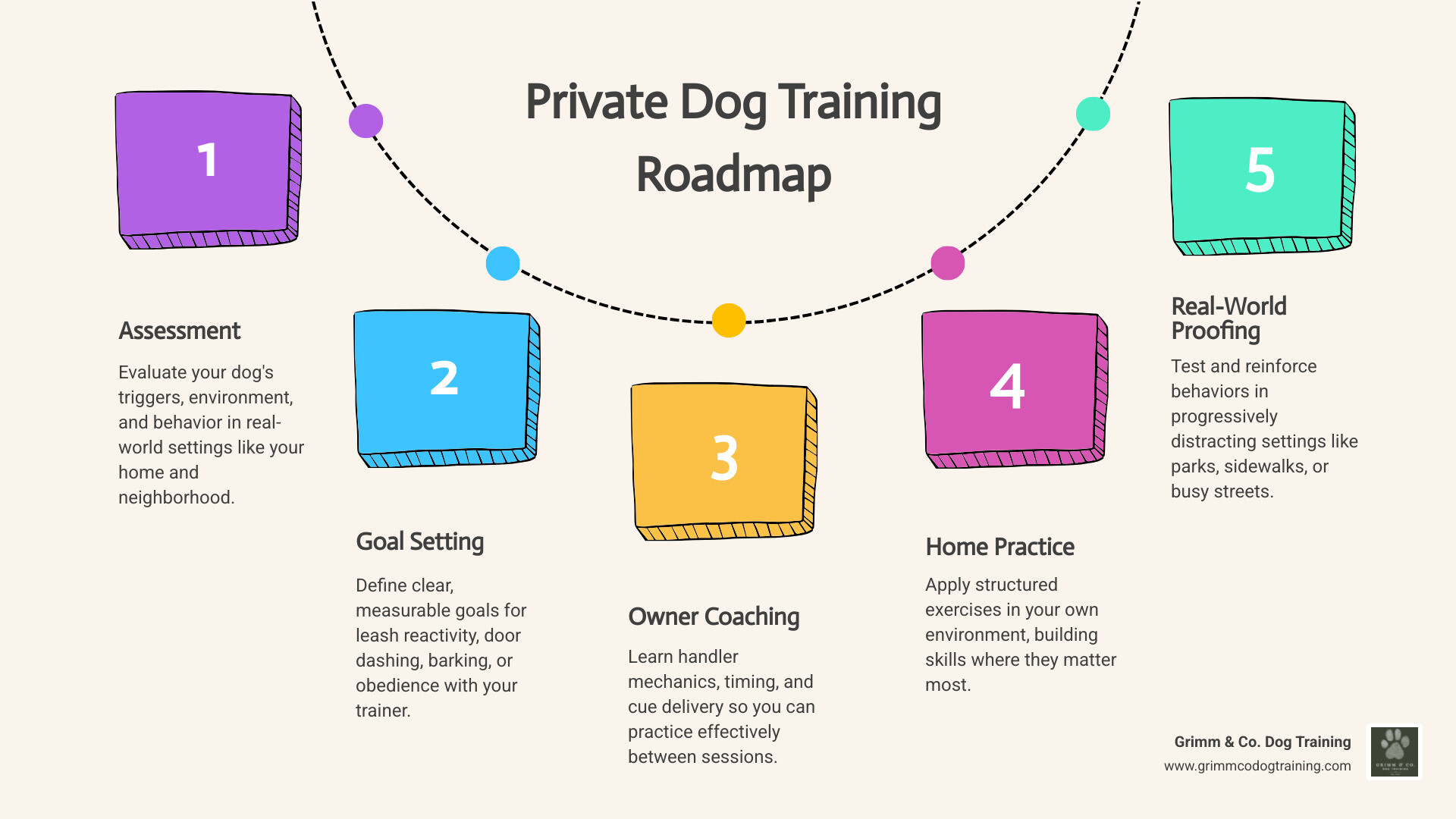
The Core Pillars of Effective One-on-One Instruction
When evaluating private dog training, it helps to understand what separates superficial obedience drills from comprehensive behavior modification. A high-caliber private coaching program rests on four essential pillars:
- Diagnostic Environmental Assessment: Instead of asking you to recreate a problem in an unfamiliar commercial facility, a private trainer evaluates the exact physical and social triggers your dog faces daily. This includes the layout of your entryway in Daly City, the narrow stairwells of a San Francisco Victorian, or the high-stimulus pedestrian traffic outside your apartment building.
- Mechanical Handling and Human Coaching: Dogs learn through clear, consistent communication. A major portion of private sessions is dedicated to refining your mechanical skills, including leash pressure, marker timing, body positioning, and spatial awareness. The goal is to make the handler confident, capable, and self-sufficient.
- Structured Relationship Building: Reliable obedience is not merely transactional; it is built on clarity, fair boundaries, and mutual trust. Private lessons help you establish daily routines, structured play, and impulse control exercises that shift your dog's focus naturally back to you.
- Progressive Desensitization and Proofing: Behavior change must be systematically generalized across varying levels of distraction. Private instruction creates a stepwise roadmap, advancing from low-arousal environments inside the living room to challenging outdoor settings like Oyster Point Marina or the busy multi-use trails around Mussel Rock Park.
What to Look for in a Professional Evaluation
A reputable private dog trainer will always begin with an in-depth behavioral intake. During this initial consultation, the trainer should explore several critical facets of your dog's life:
- Daily Energy and Arousal Cycles: Understanding when your dog experiences peak arousal, physical exercise levels, mental enrichment, and quality of rest.
- Reinforcement and Motivation: Determining what truly motivates your dog, whether high-value food, biological fulfillment, play, or spatial freedom.
- Trigger Thresholds: Identifying the exact distance and context in which your dog shifts from calm observation to over-arousal, fear, or defensive reactivity.
- Handler Goals and Lifestyle Constraints: Designing protocols that seamlessly integrate into your actual work schedule and daily neighborhood walk routes across the Peninsula or East Bay.
Why Private Dog Training Outperforms Generic Training Formats
Living with a dog in the San Francisco Bay Area presents unique environmental variables. Between narrow sidewalks in San Francisco, multi-unit apartment hallways in Daly City, wind corridors near the coast, elevator lobbies, crowded weekend farmers markets, and bustling outdoor dining corridors in San Mateo or Berkeley, generic training protocols frequently fail. A cookie-cutter curriculum taught in an artificial, distraction-free warehouse rarely prepares a dog for the rapid sensory shifts of dense coastal living.
This is where private instruction proves fundamentally superior. By tailoring every repetition to your dog's distinct baseline, private lessons bridge the gap between classroom theory and real-world reliability. The trainer can adjust distance, duration, reinforcement, equipment, and criteria in the moment, rather than asking your dog to fit a preset lesson plan.
Comparing Private Lessons, Group Classes, Pack Walks, and Mantrailing
To make an informed decision for your household, it helps to understand where each training format fits. These options are not mutually exclusive. In a well-designed training plan, they often support different stages of the same behavior goals.
- Private One-on-One Lessons: Offers direct, personalized instruction for both dog and owner. Sessions occur in your home, neighborhood, or public parks. You receive customized feedback on your handling mechanics, and the progression moves strictly at your dog's individual learning pace. This format is the strongest starting point for leash reactivity, door manners, household structure, resource guarding protocols, recall foundations, and any behavior that is highly context-specific.
- Group Obedience Classes: Excellent for proofing basic obedience around controlled distractions once your dog has enough foundation to work near other teams. Group classes can help dogs practice focus, settling, leash skills, and neutrality in a structured social environment. They are usually less appropriate as the first intervention for dogs who are already over threshold around unfamiliar dogs, people, skateboards, or tight indoor spaces.
- Pack Walks: A useful bridge between private coaching and everyday public reliability. Pack walks give dogs practice moving calmly near other dogs without the pressure of direct greeting or chaotic play. For many Bay Area dogs, this is more relevant than uncontrolled social exposure because daily life often involves passing dogs on narrow sidewalks, shared trails, lobby entrances, and park paths.
- Mantrailing: A structured scent-based activity that gives dogs a biologically fulfilling job while building confidence, focus, and handler teamwork. For energetic, anxious, or environmentally sensitive dogs, mantrailing can provide mental work without relying on high-conflict social situations. It is also a valuable way for owners to learn how to observe changes in body language, breathing, pace, and problem-solving style.
The key is sequence. A reactive dog may begin with private dog training to reduce rehearsal of lunging and barking, then move into carefully chosen pack walks or group classes once the dog can recover, take direction, and stay under threshold. A confident adolescent dog may start in a class but benefit from private lessons when a specific home behavior, such as counter surfing or barking at hallway noise, needs a more precise plan.
The Science of Individualized Behavior Modification
Modern canine training combines behavioral science, biological understanding, and practical handling tools. Principles of operant conditioning dictate that timing, consistency, and clear criteria govern how quickly animals learn new patterns of behavior.
In a private setting, an experienced trainer observes subtle micro-expressions, shifts in body weight, ear posture, tail carriage, mouth tension, scanning patterns, and respiratory changes that indicate rising stress or conflict before a full behavioral blowout occurs. Catching these early signals allows handlers to interrupt rehearsed unwanted behaviors, redirect attention, and reward appropriate choices before frustration sets in.
Private coaching also makes it easier to separate symptoms from causes. A dog who barks at the window may be responding to territorial arousal, barrier frustration, startle sensitivity, boredom, or repeated reinforcement from watching pedestrians leave. A dog who pulls on leash may lack reinforcement history near the handler, may be under-exercised, may be chasing scent, or may have learned that steady pressure is simply how walks work. The right plan depends on the function of the behavior, not just the visible behavior itself.
For affluent, busy Bay Area households, this level of diagnostic precision matters. You may need protocols that work with a dog walker, children coming through the front door, an au pair, a shared garage, a small elevator, or a schedule that includes commuting between San Francisco, the Peninsula, and the East Bay. Private dog training allows the trainer to design realistic rules and routines that multiple people in the home can follow consistently.
Navigating Training Equipment and Methodology with Clarity
An educated dog owner deserves a transparent, thoughtful discussion regarding training tools and methodologies. High-quality private dog training utilizes a comprehensive, relationship-based framework tailored to each individual dog rather than adhering to rigid dogmas.
- Flat Collars and Back-Clip Harnesses: Useful for early puppy management and basic foundational work, though back-clip harnesses can inadvertently trigger an opposition reflex in strong pullers.
- Slip Leads, Martingales, and Prong Collars: Precision tools designed to communicate directional guidance and clear spatial boundaries with minimal physical effort, preventing airway pressure associated with standard flat collars during heavy pulling.
- Long Lines (15 to 30 Feet): Indispensable for proofing recall, structured decompression walks, and building reliable off-leash obedience in expansive outdoor spaces like the coastal bluffs of Pacifica or open fields in South San Francisco.
- Remote Training Collars (E-Collars): When properly introduced through low-level tactile conditioning, modern e-collars act as an invisible leash, providing subtle communication across vast distances for reliable off-leash freedom and trail safety.
Equipment should never substitute for timing, criteria, relationship, and environmental awareness. A thoughtful trainer will explain why a tool is being considered, how it will be introduced, what the dog should learn from it, and how the owner should handle it safely. The standard is not whether a tool belongs to a particular ideology. The standard is whether the dog understands the communication, whether the handler can use it consistently, and whether the overall plan improves clarity, safety, and quality of life.
Essential Questions to Ask Before Hiring a Private Dog Trainer
Before committing to a private training program, ask prospective trainers the following questions to ensure their philosophy aligns with your standards:
- How do you tailor your program to real-world Bay Area environments? Look for trainers who routinely work in authentic urban and suburban conditions rather than solely within a closed facility.
- How do you address unwanted behaviors beyond simply ignoring them? Effective trainers provide proactive replacement behaviors, clear management strategies, and fair communication to stop unsafe habits like resource guarding or lunging.
- What does your owner-coaching component look like? Your trainer should spend substantial time coaching you through handling drills, video review, and written homework to ensure lasting success between sessions.
- What follow-up support is provided between private lessons? Trustworthy professionals offer clear communication channels, progress check-ins, and step-by-step accountability to help you maintain momentum throughout your training journey.
- How will we measure progress? A credible trainer should define observable criteria, such as decreased recovery time after a trigger, improved leash tension, longer duration of calm behavior, cleaner marker timing, or the ability to pass a dog at a specific distance without escalation.
- What should I practice between sessions? Private lessons are most effective when homework is specific, brief, and repeatable. You should leave each session knowing exactly what to practice, where to practice it, how often to rehearse it, and when to make the exercise easier or harder.