
Dog Training for Impulse Control in San Francisco
Managing Urban Triggers Through Canine Impulse Control
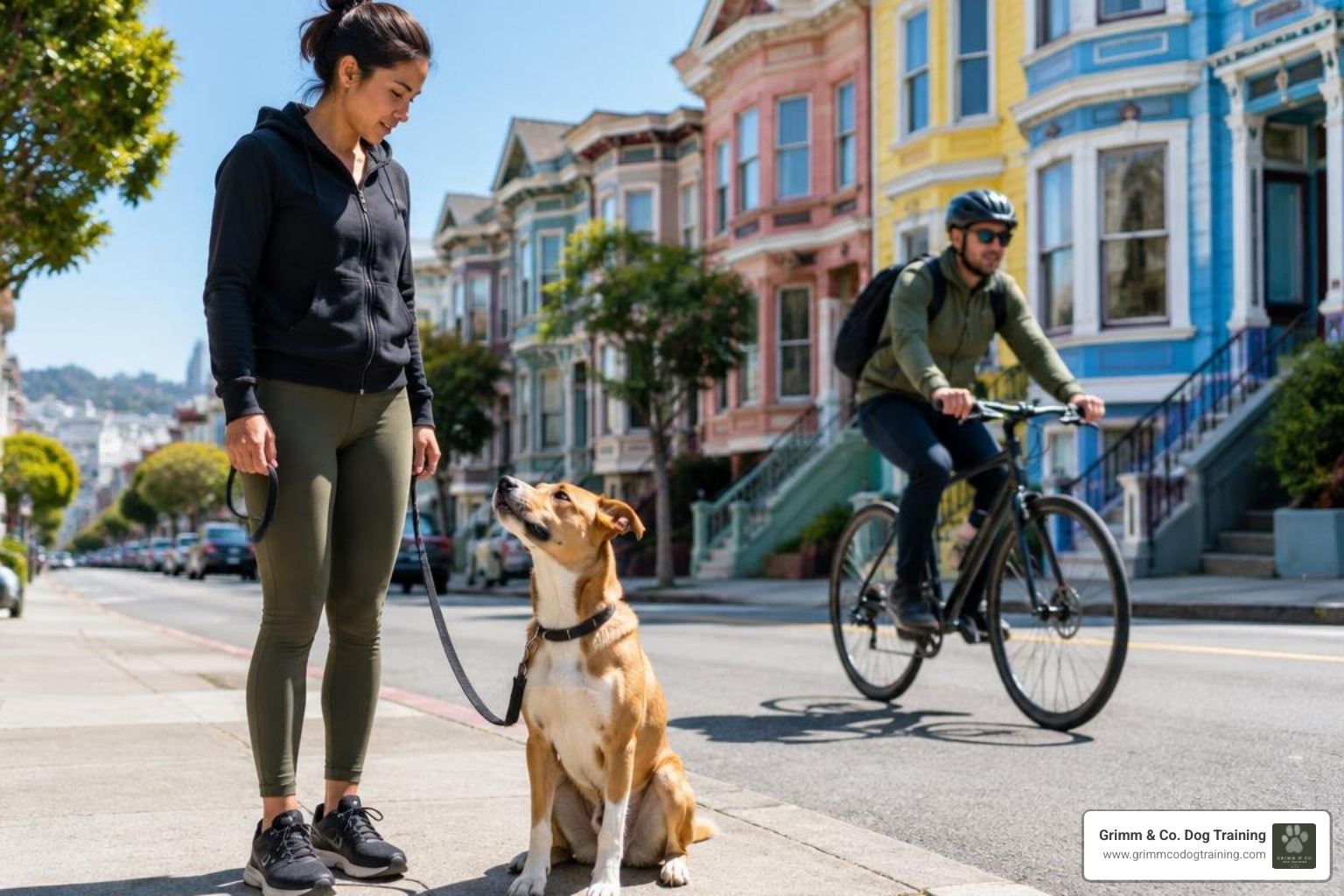
Impulse control training in San Francisco teaches dogs how to pause, process their surroundings, and stay engaged with their handler in dense urban settings. Rather than relying on constant verbal management, this work builds steady default behaviors. The result is a dog capable of pausing at entryways, holding curbside boundaries, and disregarding passing distractions along busy sidewalks.
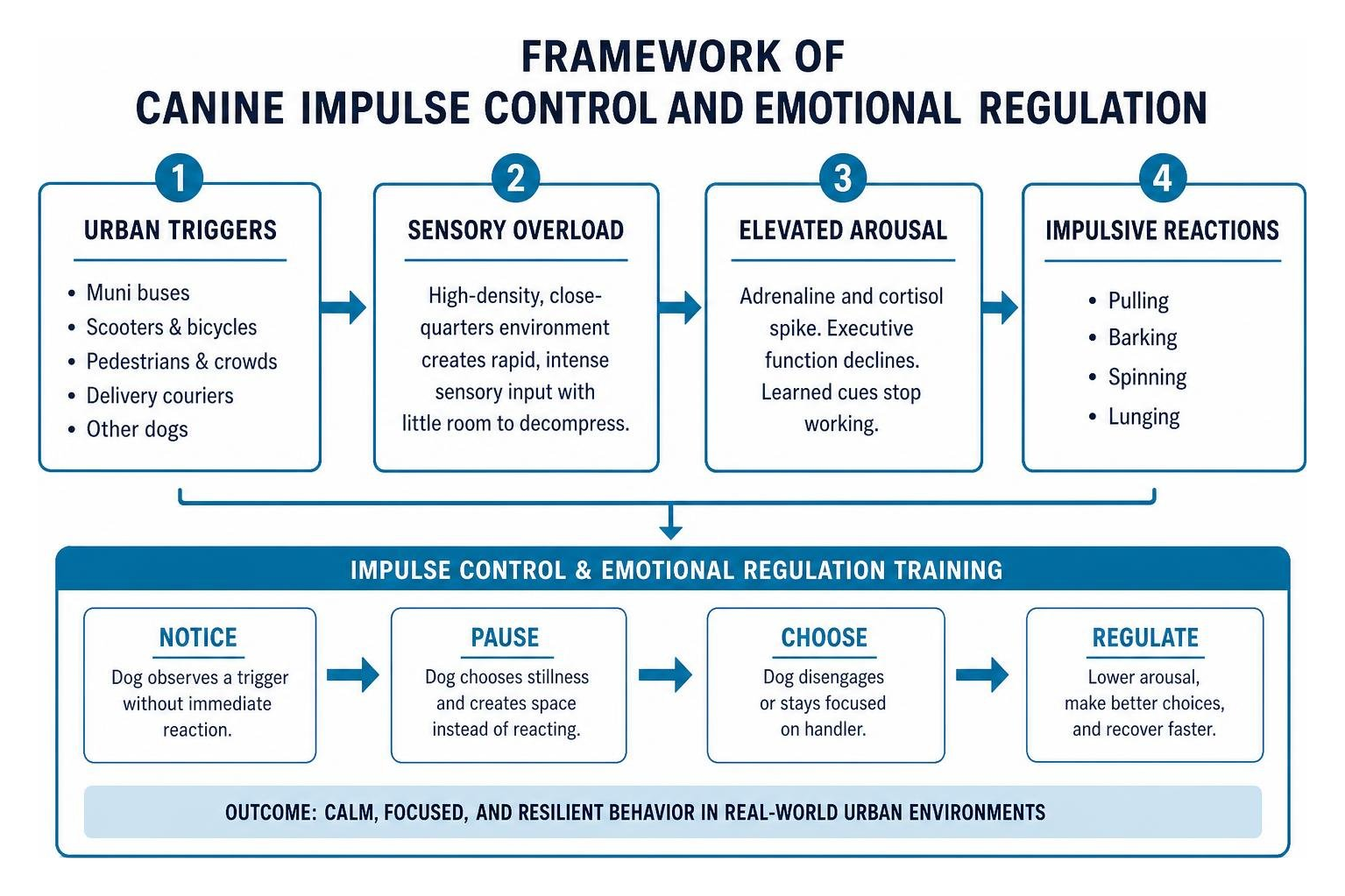
Living in San Francisco presents an environmental profile unlike most suburban settings. Dense Victorian flats, narrow sidewalks, and steep hills with blind corners place dogs in close proximity to rapid, unpredictable activity. A single morning walk in neighborhoods like the Mission, Hayes Valley, or Pacific Heights can involve Muni buses, delivery couriers, electric scooters, and off-leash dogs in neighborhood parks.
Without structured impulse management, high-density environments easily overwhelm a dog. In lower-density areas, dogs have space to process novel sights at a distance. In the Bay Area, tight apartment corridors and crowded sidewalks remove that spatial buffer. When an approaching dog on an extended lead appears around a tight corner, your dog has minimal physical margin for error.
When arousal spikes unchecked, basic obedience cues often fall apart. The dog shifts from attentive learning into immediate, impulsive reactions like pulling, barking, spinning, or lunging. This reality is why handlers seeking reactive dog training in San Francisco need to build emotional stability and clear communication rather than simply drilling stationary obedience cues at home.
Impulse Control vs. Traditional Obedience
Many owners wonder how basic obedience differs from impulse control. Obedience training teaches a dog to perform specific actions on cue: sit, down, stand, or heel. These foundational exercises are valuable, but they rely on cognitive compliance when the dog is already composed.
Impulse control, by contrast, targets frustration tolerance and arousal management. It gives a dog the capacity to choose neutral stillness or deferred gratification without continuous verbal prompting. A dog with solid impulse control spots a dropped pastry on Valencia Street, a running dog at Alamo Square, or a passing skateboarder and naturally hesitates rather than lunging.
Understanding how these two training areas complement each other helps guide real-world handling:
| Feature | Traditional Obedience Training | Impulse Control Training |
|---|---|---|
| Primary Goal | Executing specific physical actions on cue | Building patience, neutrality, and frustration tolerance |
| Mechanisms | Cued responses (e.g., "Sit", "Down", "Stay") | Default pauses, boundary rules, and handler focus |
| Arousal State | Often practiced in low-to-medium arousal settings | Systematically tested across realistic, active environments |
| Urban Application | Canine sits when told, but may break position if startled | Canine evaluates distractions and remains composed |
| Long-Term Outcome | Direct compliance dependent on handler cues | Consistent neutrality and voluntary focus on walks |
Demanding a mechanical sit while an intense trigger passes three feet away often builds physical tension under the surface. If the dog has not developed genuine patience, that bottled energy can result in sudden lunging once released. Impulse control training establishes reliable baseline calm under real-world pressure.
Why Barrier Frustration Leads to Leash Reactivity
Leash reactivity is one of the most common challenges for dog owners across San Francisco, Daly City, and the East Bay. In most cases, this behavior does not stem from unprovoked aggression. Instead, it develops from excitement or mild wariness combined with leash restriction.
When a dog spots an engaging stimulus, their natural inclination is either to investigate or move away. The leash restricts both choices. When a dog lacks self-restraint, this physical restriction creates immediate barrier frustration. As the dog strains against the collar or harness, that physical tension heightens their arousal.
Over time, this dynamic solidifies into a predictable barking and lunging habit. The dog discovers that loud vocalizations create space or vent internal pressure. Without structured guidance, the working distance required for the dog to stay composed expands. You can learn more about managing these patterns in our comprehensive leash reactivity guide.
Structured Exercises for Urban Environments
Building steady self-control requires a systematic progression from low-distraction indoor setups to dynamic public spaces. Dogs do not automatically generalize behaviors across contexts; waiting patiently for a food bowl in a quiet kitchen does not mean a dog is ready to handle a busy intersection on Broadway or Mission Street.

Developing dependable focus requires clear, consistent boundaries during daily routines. Participating in structured dog obedience training classes provides the controlled environment needed to proof foundational habits around neutral working dogs before testing them on bustling city blocks.
Essential Daily Exercises for City Dogs
Practical impulse control relies on consistent daily protocols that reinforce patience and handler engagement:
- Threshold Pauses (Doorways and Elevators): Teach your dog to wait at exterior doors, elevator gates, and vehicle doors until given a release cue. Asking for eye contact before stepping forward turns entryways into natural pause points, preventing sudden collisions in narrow apartment building hallways.
- The Default "Leave It" Exercise: Move beyond using "leave it" solely as a reactive verbal cue. Hold high-value food in a closed hand. Allow your dog to sniff or paw. The moment they back away and disengage voluntarily, mark the behavior and reward from the opposite hand. This teaches the dog that ignoring valuable items earns high-value reinforcement.
- Stationing and Place Work: Direct your dog to remain on a designated bed or cot during lively household moments, such as package deliveries, dinner preparation, or guests arriving. This exercise builds duration, distance, and tolerance for movement.
- Curb Pauses on City Walks: Use street crossings as automatic pause points. Implement a brief halt at every curb before stepping into the crosswalk. This habit prevents dogs from pulling into traffic and reinforces handler check-ins while in motion.
- The Engage-Disengage Sequence: When a distraction appears at a workable distance, mark and reward the moment your dog looks at it without reacting. Once that response is consistent, raise the criteria: mark only when the dog notices the trigger and voluntarily turns back to make eye contact with you.
Developing Reliable Recall Around City Distractions
Reliable recall is one of the most demanding tests of impulse control. Calling a dog away from a quiet resting spot at home is straightforward; calling them away from food scraps on the pavement, ocean birds at Crissy Field, or running dogs at Fort Funston requires thorough proofing.
Building this reliability requires deliberate distance work and high-value reinforcement. Handlers should avoid calling their dog only to end outdoor fun or attach the leash. Frequently call your dog in, reward them generously, and release them right back to their activity. For dogs with strong prey drive, structured play with tugs or flirt poles directs that drive into handler-centered engagement. Learn how to progress these skills in our guide to dog training for off-leash control.
Choosing the Right Training Format
Every dog brings an individual combination of breed traits, temperament, and past handling history. Selecting the right training format depends on your dog's current threshold levels, your neighborhood environment, and the time you can invest in weekly practice.

A high-drive dog exhibiting intense reactivity on tight streets requires a different plan than an adolescent dog who simply pulls toward passing greetings. Working with professionals who apply a balanced, relationship-focused training approach gives your dog clear boundaries alongside meaningful rewards, establishing durable habits that hold up across Bay Area neighborhoods.
In-Home Private Training vs. Structured Group Work
Deciding between private lessons and group classes depends on your dog's current skill level and focus:
- In-Home Private Training: This setup is ideal for dogs struggling with high environmental sensitivity, noise sensitivity, or reactivity in tight spaces. Training in your home, apartment hallway, and neighborhood walking route allows the trainer to address daily routines and threshold manners directly. It delivers customized, one-on-one private dog training structured around your dog's specific needs without flooding their nervous system.
- Structured Group Classes and Pack Outings: Group environments suit dogs that have established basic household manners and are ready for controlled distraction work. In a well-run class, every dog works under direct guidance, providing a safe space to practice neutrality around other dogs without the unpredictability of off-leash park encounters.
Realistic Timelines for Behavior Modification
Modifying entrenched habits takes time, repetition, and consistent daily structure, guided by principles of neuroplasticity. Dogs that have practiced pulling, lunging, or barking for months need steady, progressive repetition to replace those patterns with composed default behaviors.
A realistic training timeline generally unfolds across three stages:
- Weeks 1 to 3 (Skill Acquisition): The dog learns mechanics, threshold pauses, and focus cues in minimal-distraction environments. Handlers refine leash handling, timing, and spatial awareness.
- Weeks 4 to 8 (Proofing and Threshold Management): Foundation behaviors are tested around controlled, low-level distractions. The handler identifies the dog's working threshold and steadily closes distance toward urban triggers while keeping engagement solid.
- Weeks 9 to 16 and Beyond (Generalization and Maintenance): The dog practices steady behavior across diverse Bay Area environments, from residential blocks in Burlingame or San Mateo to busy transit hubs in San Francisco and Oakland. Maintaining consistent household rules ensures long-term reliability.
Frequently Asked Questions About San Francisco Impulse Control Training
How can I tell if my dog lacks impulse control or is just being stubborn?
What often looks like stubbornness is usually elevated arousal, competing environmental motivators, or a lack of training fluency under distraction.
When a dog is over-threshold, physiological signs appear quickly: widened eyes, stiff facial muscles, rapid panting, refusal of preferred treats, and tense scanning of the surroundings. Under high stimulation, a dog struggles to process verbal cues that they perform easily at home. Rather than willful disobedience, this response indicates that the current environment exceeds the dog's current training foundation.
What is the most common mistake handlers make when training impulse control?
The most frequent issue is advancing distractions too rapidly. Handlers often practice a skill successfully in their living room and immediately test it outside a crowded neighborhood cafe or near an active dog run.
When the dog falters, handlers tend to repeat cues with increasing urgency, adding noise and tension to the interaction. Build impulse control systematically by increasing duration first, then distance, and finally environmental distraction. If your dog misses a cue repeatedly, increase working distance, reinforce successful engagement, and progress forward at a sustainable pace.
Can adult and rescue dogs develop reliable impulse control in busy cities?
Yes. While puppies absorb new routines readily, adult and rescue dogs can build dependable self-control with clear communication and consistent daily handling.
Adult dogs often benefit from a deliberate decompression phase when settling into a new urban home. Establishing predictable routines, clear house rules, and gradual outdoor exposure allows mature dogs to look to their handler for direction rather than reacting impulsively to neighborhood sights and sounds.
Building Dependable Urban Manners
Developing impulse control is essential for dogs navigating dense urban environments across San Francisco, Daly City, and the Peninsula. Replacing frantic reactions with steady habits turns everyday walks into a manageable, structured routine.
At Grimm & Co. Dog Training, we work with dogs and handlers across the Bay Area to build reliable obedience, clear communication, and practical handler engagement. Alongside reactivity rehabilitation and foundation obedience, we offer working avenues like mantrailing, giving active dogs a productive outlet for their instincts while strengthening handler teamwork.
To begin establishing clear boundaries and dependable city manners, explore our comprehensive dog training services and connect with our team today.
