
Socializing Your Pup in Daly City Without Losing Your Mind
Why Early Exposure Matters More Than You Think

If you are looking for daly city puppy socialization options, here is what you need to know upfront:
| What You Need | Key Details |
|---|---|
| Critical window | 3 to 12 weeks of age; exposure before 16 weeks shapes behavior for life |
| Vaccine requirement before group classes | Rabies, DA2PP series, and Bordetella |
| Safe prevaccine socialization | Carry your puppy in public; invite vaccinated dogs to your home |
| Local health risks to know | Leptospirosis from urban wildlife; ticks on Bay Area trails; coyotes at coastal parks |
| When to visit public dog parks | After completing the full DA2PP series, typically around 16 weeks |
| Local group class options | Look for small groups, professional supervision, and rest periods built into sessions |
Daly City is not an easy place to raise a puppy. The coastal bluffs, dense foot traffic, Highway 1 noise, and the particular wildlife pressure from raccoons, skunks, and coyotes all create an environment that asks a lot of a young dog's nervous system. Get the early exposure right, and you build a dog that handles all of it without a second thought. Get it wrong, or skip it entirely, and you will be managing fear and reactivity for years.
The research is clear on the timeline. The socialization window opens around three weeks of age and begins closing by twelve weeks. That is a narrow runway, and most of it passes while your puppy is still working through their vaccine series. That tension between immunological safety and behavioral development is the central challenge every new owner in this area faces, and it has a real answer. It just requires some deliberate planning.
I'm Bailey Milne Davies, founder of Grimm and Co. Dog Training, and my own experience with daly city puppy socialization started the hard way, watching my dog Grimm develop frustrating habits because early structure and exposure were not handled with enough intention. That experience, combined with formal training at Tarheel Canine and years of applied work with dogs and their owners across the South Bay, shapes everything in this guide.
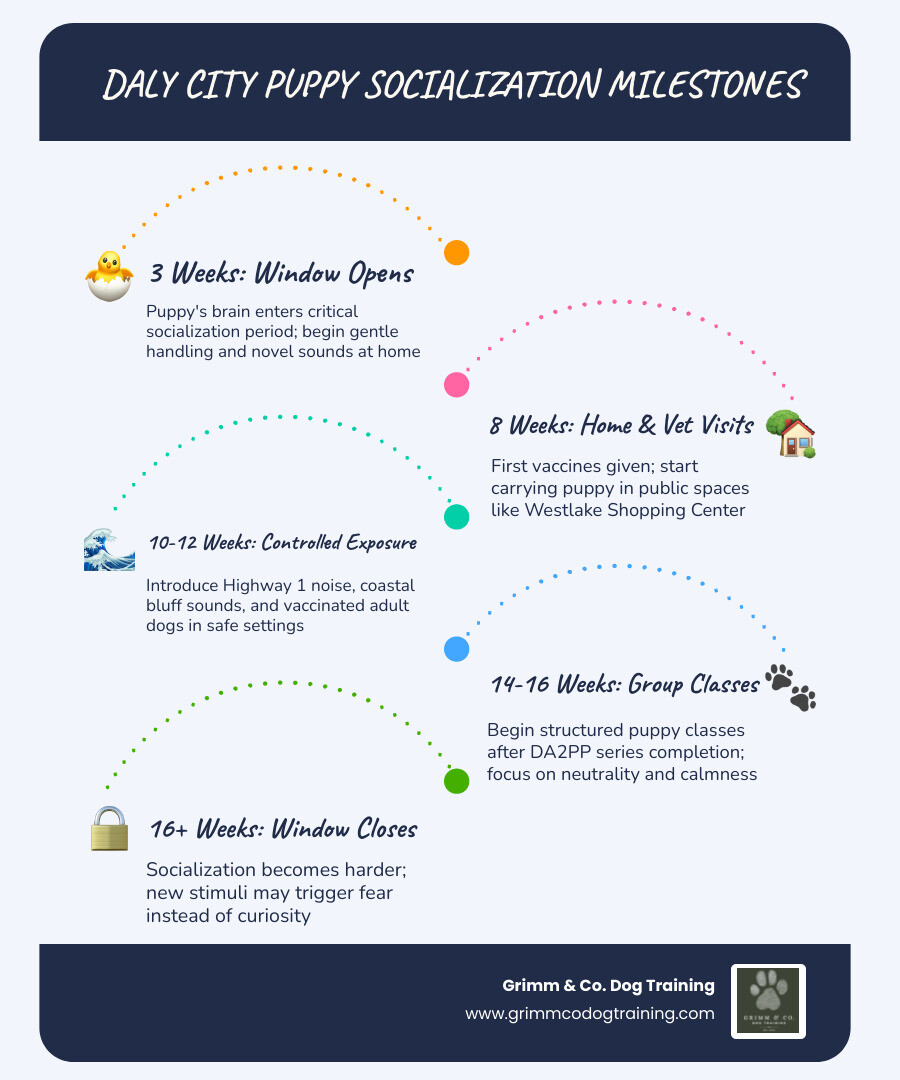
When we discuss early exposure, we are not talking about letting your puppy run wild with every dog they meet at Westlake Shopping Center. Real socialization is the process of teaching your young dog to remain calm, neutral, and observant in the face of novel stimuli. In our coastal environment, this means teaching them that the roar of the Pacific Ocean waves and the rush of heavy traffic on Highway 1 are just background noise, not threats to be feared or targets to chase.
Understanding the Critical Window of Early Canine Development
The developmental window between three and twelve weeks of age represents a unique neurological phase where a puppy's brain is highly receptive to new experiences. During this brief period, novel sights, sounds, and surfaces are integrated into their worldview as normal and safe. Once this window closes, the developmental focus shifts from curiosity to natural caution, making it substantially harder to convince a dog that an unfamiliar object or sound is harmless.
Many owners make the mistake of keeping their puppy completely isolated until they are fully vaccinated at sixteen weeks. This creates a behavioral vacuum. By trying to protect the puppy from physical pathogens, owners inadvertently expose them to the much higher risk of lifelong behavioral issues, including fear reactivity and chronic anxiety. To understand how early communication shapes these responses, our article on What Your Puppy Is Trying to Tell You and How to Respond outlines how to read your dog's subtle stress signals during these critical exposures.
Avoiding common pitfalls during this phase is essential for long term success. We detail these developmental landmines in our guide on The Top 3 Mistakes to Avoid When Raising a Puppy or Newly Adopted Dog. One of the most effective tools for managing early development and preventing behavior regressions is structured confinement. If you want to build a secure, independent adult dog, it is highly beneficial to understand the benefits of crate training, which we discuss in our post on Why You Should Be Crate Curious.
Physical development and mental development are closely linked. The quality of your puppy's diet directly impacts their cognitive function and focus during training sessions. Puppies have specific nutritional requirements, starting with four meals per day for those under four months, transitioning to three meals per day between four and six months, and finally two meals per day up to twelve weeks and beyond. To ensure your puppy has the physiological support they need for learning, read our resource on Canine Nutrition and Behavior.
Navigating Immunity and Exposure in the Peninsula

Managing your puppy's safety on the Peninsula requires a clear understanding of local pathogens and wildlife vectors. Daly City and San Mateo County present specific environmental risks that you must navigate deliberately. The San Francisco Bay Area has documented surges in canine leptospirosis, a severe bacterial infection transmitted through the urine of urban wildlife such as raccoons, skunks, and rats. These animals are highly active in local backyards and suburban neighborhoods, meaning even a simple puddle after a coastal rain can carry the bacteria.
Physical safety also means protecting your puppy from predatory wildlife. Coyotes are active along the Daly City coastal bluffs and near Mussel Rock Park. Socialization in these coastal areas must always be conducted on a secure leash, especially during the low light hours of dawn and dusk. Additionally, if you take your puppy exploring near San Bruno Mountain, Sweeney Ridge, or Milagra Ridge, you must perform thorough tick checks immediately afterward to prevent tick borne illnesses.
San Mateo County requires all dogs over three months of age to be licensed, and new residents have sixty days to complete this registration. This licensing requires proof of a current rabies vaccination. For a comprehensive medical roadmap of your puppy's first twelve months, including vaccine schedules and local veterinary guidelines, you can consult the Puppy First Year Guide from Daly City Pet Hospital.
Balancing Vaccine Schedules and Daly City Puppy Socialization
The traditional veterinary recommendation to keep a puppy indoors until their final booster at sixteen weeks often conflicts with critical behavioral development. The core vaccination series for distemper, adenovirus, parvovirus, and parainfluenza, known as the DA2PP vaccine, typically begins between six and eight weeks of age, with boosters administered every three to four weeks. While maternal antibodies provide initial protection, they gradually decline, leaving a window where the puppy is vulnerable to disease but desperately needs exposure.
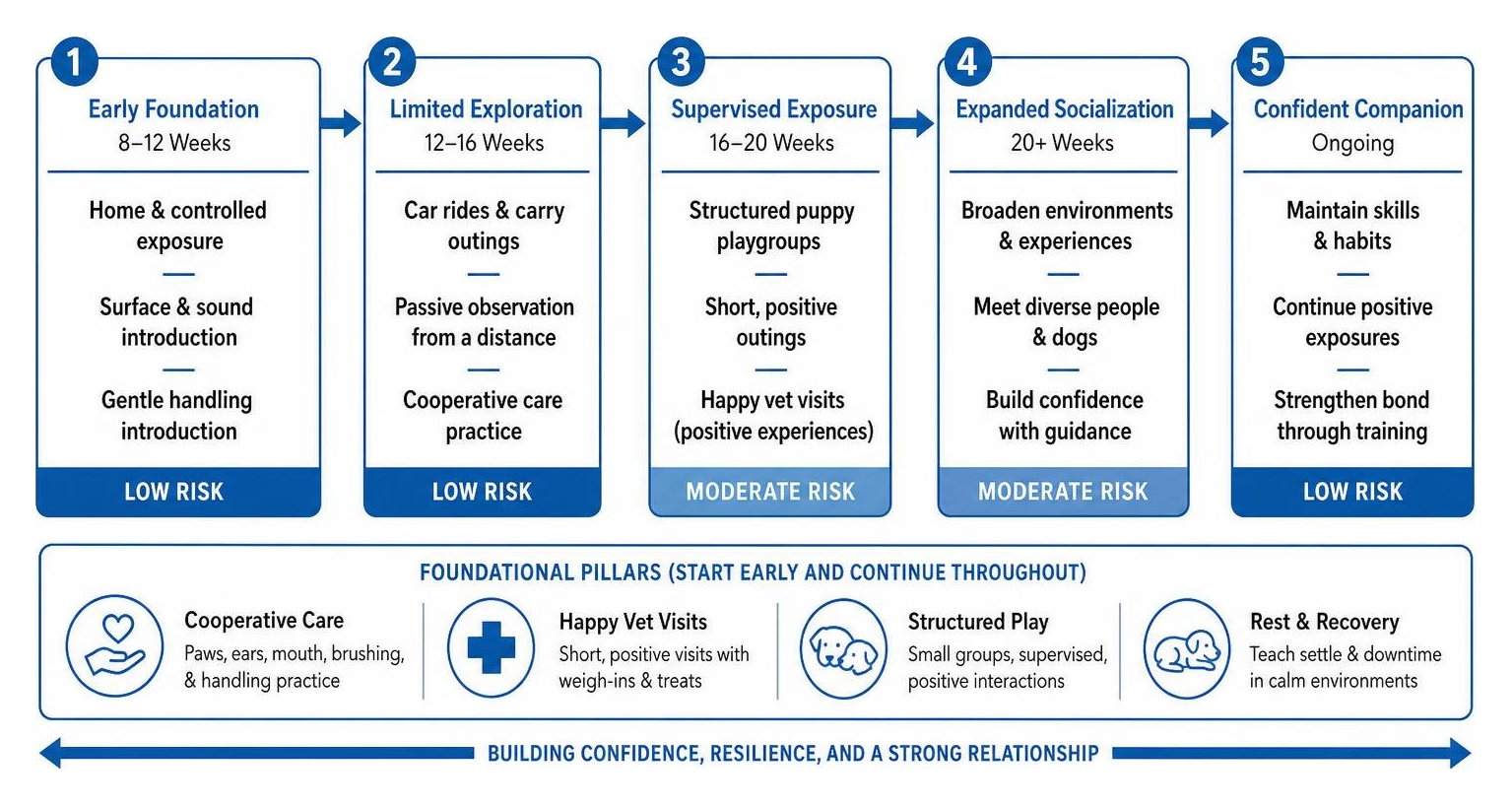
You can safely bridge this gap by using smart, controlled exposure strategies. You do not need to let your puppy's paws touch the ground in high traffic public areas to socialize them. Carrying your puppy in a secure sling, taking them for car rides to observe busy shopping centers, and inviting healthy, fully vaccinated adult dogs to play in a private, enclosed yard are excellent ways to build confidence without exposing them to parvovirus.
Working with professional trainers who understand how to balance physical safety with behavioral milestones is the safest path forward. Our team of Puppy Trainers specializes in designing customized exposure plans that respect your puppy's vaccine schedule while maximizing their developmental window. You can explore our structured programs on our Puppy Training Landing Page.
How to Structure a Sophisticated Socialization Strategy

A sophisticated socialization strategy focuses on environmental neutrality rather than active interaction. The goal is not to teach your puppy that every dog and human is a playmate, but rather that they can exist calmly in their presence. If your puppy expects to greet every single trigger, they will quickly develop frustration, which often manifests as barking, lunging, and leash reactivity as they mature.
To set your puppy up for success, you must structure each outing so they remain below their stress threshold. This means choosing environments where you can easily control the distance between your puppy and the stimulus. Our guide on Setting Your Dog Up for Success Foundations for Effective Dog Training explains how to establish these core principles. Once your puppy has the foundational skills, transitioning to professional Dog Training Classes provides the controlled, high quality exposure they need to generalize their training.
Designing a Safe Exposure Plan for Daly City Environments
To help you visualize where to safely take your partially vaccinated puppy versus where to wait, we have compiled a comparison of local environments.
| Environment Type | Risk Level | Recommended Activities | Local Examples |
|---|---|---|---|
| Private Yards & Controlled Spaces | Low | Controlled play with vaccinated dogs, surface exposure, basic handling | Your home, private yards in Westlake |
| Car Rides & Carry Outings | Low | Sound desensitization, passive observation from a distance | Car rides near Highway 1, carrying near coastal bluffs |
| Uncontrolled Public Parks | High | Avoid until fully vaccinated (16 weeks plus) | Mission Hills Dog Park, Palisades Park, Centennial Way |
| Open Wild Trails | High | Avoid until fully vaccinated; high risk of ticks and wildlife | San Bruno Mountain, Sweeney Ridge |
Early exposure should also include cooperative care, which is the practice of teaching your puppy to participate willingly in grooming and veterinary handling. Gently handling your puppy's paws, checking their ears, and examining their mouth starting at a young age will prevent future vet visit anxiety. You can also utilize happy visits, which are short trips to the veterinary clinic where your puppy simply gets weighed, receives high value treats, and experiences positive attention without any medical procedures.
What to Look For in a Professional Group Class
When selecting a group class for your young dog, you must look for specific quality indicators to ensure the environment is safe and constructive. A well run puppy class does not allow unstructured, chaotic play. It should feature small group sizes to ensure every puppy receives individual attention and is not overwhelmed by too many dogs.
Professional supervision is non negotiable. The instructor must be able to read subtle canine body language and intervene before play escalates into bullying or fear. The facility must also maintain strict sanitization standards, using veterinary grade disinfectants to protect partially vaccinated puppies. Finally, look for classes that incorporate structured rest periods, teaching puppies how to settle and relax amidst distractions. To understand why these structured environments are so beneficial, read our article on Why Dog Training Classes Might Be the Right Fit for You.
Managing the Transition with Resident Animals at Home
Introducing a new puppy to a home that already has resident dogs or cats requires a slow, structured approach. Rushing these first meetings can create lasting tension and defensive behaviors that are incredibly difficult to reverse. For feline residents, safety is the absolute priority. You must provide your cat with vertical escape routes and use secure baby gates so the animals can observe each other from a safe distance before any direct physical contact is allowed.
When introducing a new puppy to a resident adult dog, neutral ground is always best. Start by taking both dogs on a parallel walk, keeping them at a distance where they can see each other but cannot interact. This allows them to get used to each other's presence and movement without the pressure of a face to face meeting.
If you are already dealing with a dog that shows signs of frustration or fear around other animals, managing these introductions requires even greater care. Our detailed post on Living With a Reactive Dog What Does Progress Really Look Like offers realistic guidance on navigating these complex household dynamics. Understanding how seasonal changes and increased outdoor activity can impact your dog's underlying stress levels is also crucial, as explained in Your Dog's Reactivity Isn't Getting Worse Spring Just Exposed It.
Building a Resilient Foundation for Your Dog
Raising a puppy in Daly City does not have to be an overwhelming experience. By understanding the critical developmental windows, managing local environmental risks, and focusing on neutral, structured exposure, you can build a confident, resilient companion. Our relationship based training approach is designed to help you navigate these early challenges while building a deep bond with your dog.
If you are ready to take the next step in your puppy's development, we invite you to join our supportive community. We offer personalized coaching and structured group environments to ensure your dog grows into a well adjusted adult. Explore our available Group Classes and learn more about our unique Training Approach today.