
Can a Hobbyist Actually Manage a Professional Mantrailing Bloodhound
Start Mantrailing With a Simple, Rewarding Trail
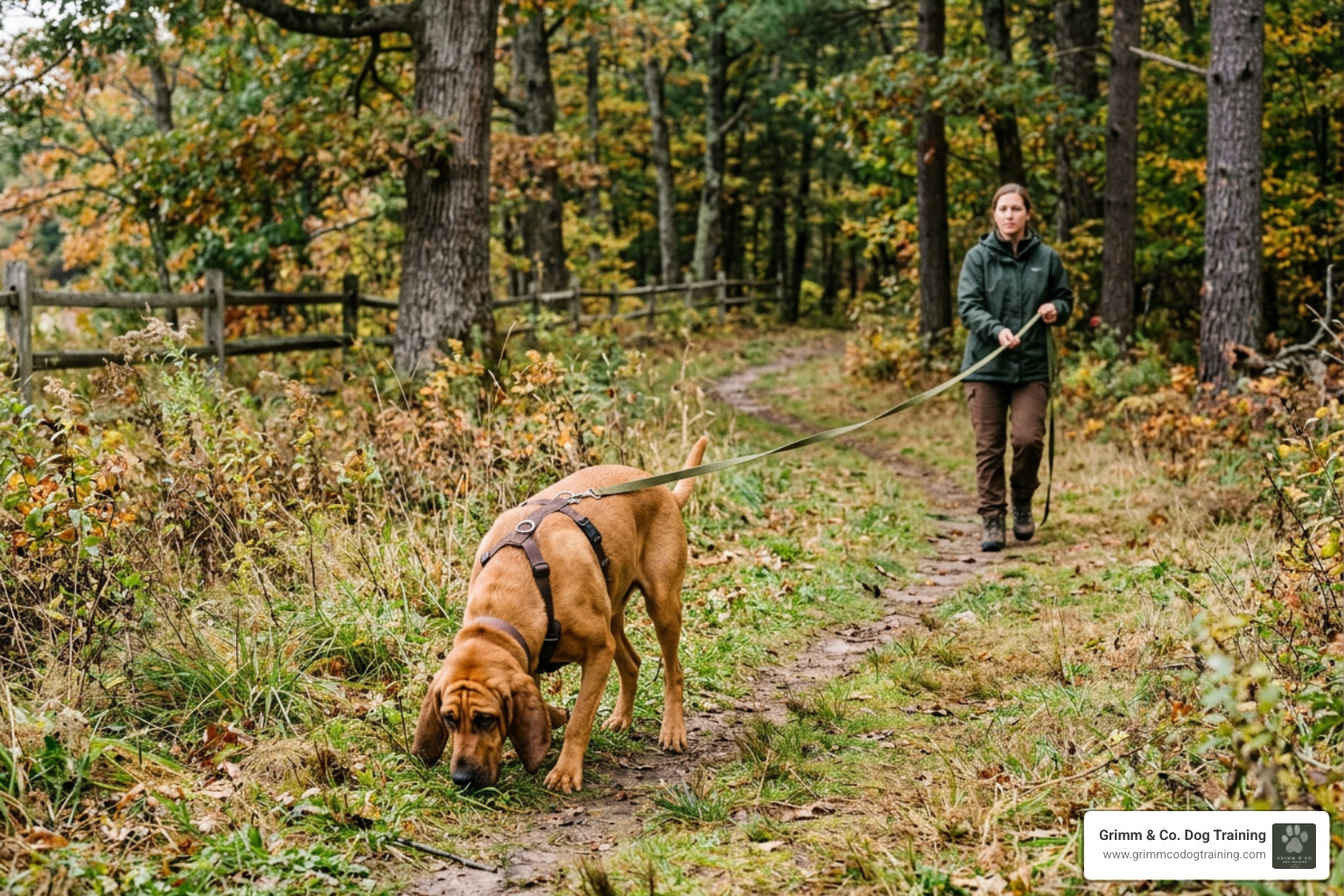
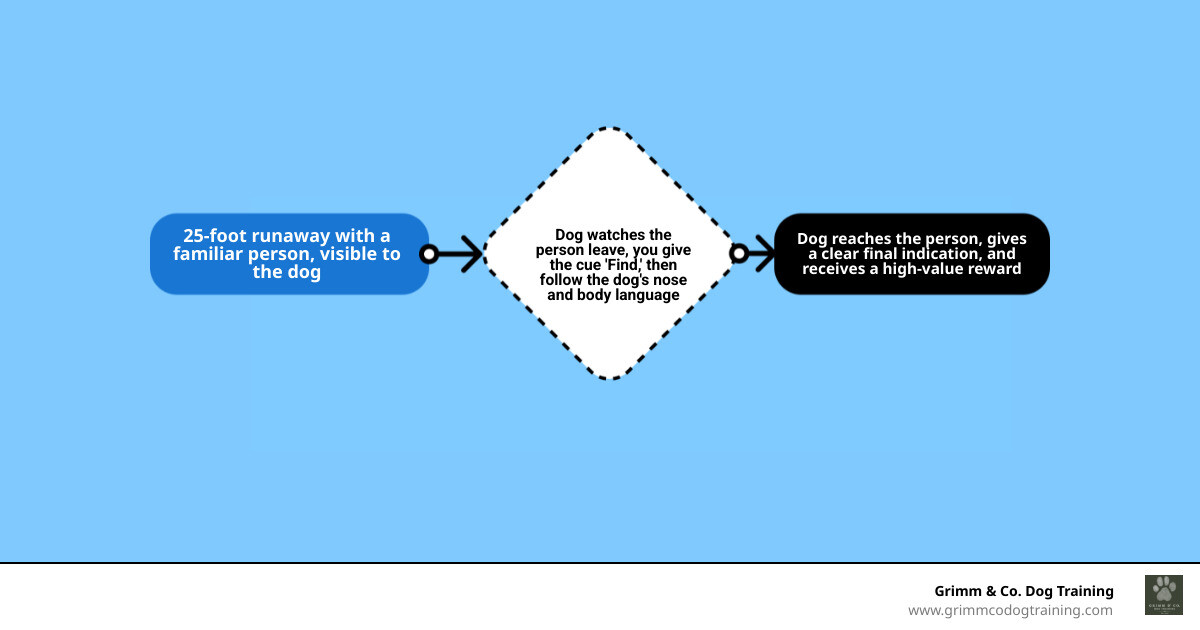
To begin mantrailing, use a well-fitted harness, a 15-to-20-foot long line, and a person your dog enjoys. Have that person move about 25 feet away, let your dog watch them leave, give one consistent cue such as "Find," and reward generously when your dog reaches them. Keep early trails short, fresh, and easy. Increase only one challenge at a time, such as distance, trail age, turns, or distractions.
Mantrailing teaches a dog to follow one person's unique scent, including shed skin cells carried across grass, pavement, buildings, and changing terrain. Unlike AKC tracking, the dog does not need to place its nose in every footprint or find dropped articles. The goal is to locate and clearly identify the person at the end.
Bloodhounds are exceptionally suited to this work. They have roughly 200 to 300 million scent receptors, at least double the number often cited for many other breeds, plus the stamina and persistence to stay engaged with an aging scent trail. Still, the handler's job matters just as much: learn to read the dog, keep steady line pressure, and resist the urge to steer when the hound is working out the scent.
I am Bailey Milne-Davies, a dog trainer and scientist whose work with my own dog, Grimm, includes trailing and locating sports, obedience, and relationship-based behavior training. While this guide focuses on bloodhound mantrailing, the same careful training principles help dogs and handlers build clearer communication, confidence, and purpose.
The Biological Genius of Bloodhound Mantrailing
The canine olfactory system is an extraordinary feat of evolutionary engineering, but the Bloodhound occupies a category entirely its own. While the average pet dog possesses roughly 100 million to 125 million olfactory receptors, and a human navigates the world with a modest 5 to 6 million, a Bloodhound boasts upwards of 300 million scent receptors. Relative to overall brain volume, a dog's olfactory bulb is roughly forty times larger than that of a human, allowing these hounds to deconstruct complex olfactory tapestries into precise biological markers.
| Canine Breed Group / Type | Approximate Olfactory Receptor Count | Primary Scent Processing Characteristics |
|---|---|---|
| Bloodhound | Up to 300,000,000 | Deep olfactory surface area, specialized anatomical traps, extreme persistence on aging trails |
| German Shepherd / Malinois | 200,000,000 – 225,000,000 | High operational versatility, agile air-scenting, rapid ground tracking |
| Retriever Breeds (Lab / Golden) | 125,000,000 – 150,000,000 | Strong air-scenting capability, excellent scent discrimination in wet/cover environments |
| Average Pet Dog (All-Breed Mean) | ~100,000,000 | Functional environmental scenting, quick fatigue on aged or highly contaminated trails |
| Human (Homo sapiens) | 5,000,000 – 6,000,000 | Visual-dominant perception, minimal individual scent differentiation |
Beyond cellular biology, the hound's macroscopic anatomy serves as an active scent collection mechanism. The long, pendulous ears sweep the ground as the head lowers, physically disturbing settled skin cells and funneling airborne micro-particles toward the nares. Simultaneously, the heavy facial wrinkles, known historically as the "shawl" or hood, fall forward to create a physical pocket around the muzzle. This structural enclosure traps scent plumes, shielding the delicate nasal cavity from dispersing wind currents and concentrating trace chemicals for deep analysis. To explore how these physical adaptations align with the broader physical standard, review the Bloodhound anatomical traits and olfactory physiology documentation.
700 Years of Monastic Pedigree and Working Lineage
The singular focus of the modern Bloodhound is the result of intensive selective breeding. Beginning in the Middle Ages, monks at the Saint Hubert Monastery in the Ardennes region of Belgium spent over 700 years curating and documenting purebred lines of these tracking hounds. The name "Bloodhound" originated not from hunting wounded, bleeding quarry, but from "blooded hound," denoting an aristocratic, purebred pedigree maintained with meticulous monastic recordkeeping.
These early Saint Hubert hounds were renowned for their calm persistence and methodical pace, qualities that made them indispensable across Europe. Over centuries of refinement, their abilities transitioned from estate tracking to civil recovery. By the late nineteenth and twentieth centuries, the Bloodhound had earned unique standing: it became the only breed in the United States whose scent-identification work was recognized in courts of law as admissible evidence to corroborate an individual's presence or flight path.
Why Bloodhound Mantrailing Differs Fundamentally from AKC Tracking
Many handlers entering canine scent work ask how mantrailing differs from traditional American Kennel Club (AKC) tracking. While both test a dog's olfactory prowess, their underlying operational mechanics and training philosophies are distinct.
AKC tracking evaluates a dog's precision in adhering strictly to a disturbed ground path. In standard tracking tests, the dog tracks footsteps, crushed vegetation, and bruised earth along a pristine track aged between one and five hours. The dog must follow exact geometric turns, indicating intermediate articles dropped along the line, with no individual waiting at the end.
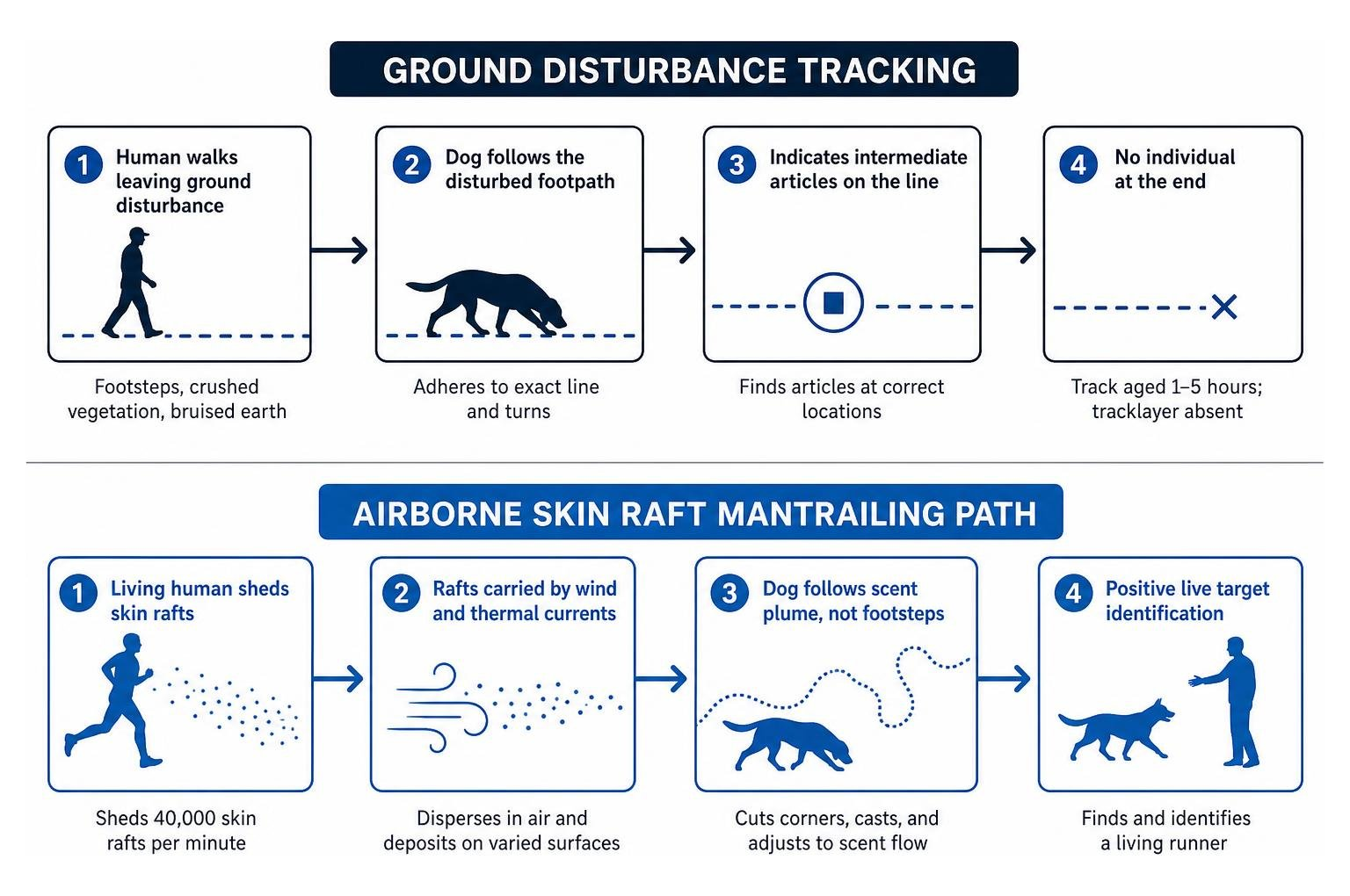
In contrast, the mantrailing dog sport focuses exclusively on discriminating and following the specific biological odor of an individual human. As people move through an environment, they shed microscopic epithelial rafts. Trailing dogs follow this airborne scent plume and its settled residue. Because wind, thermal lift, and structural obstacles push scent away from the physical footprints, a mantrailing hound does not follow exact steps. They cast, drift, cut corners, and adjust their working distance to match the scent flow, culminating in a clear identification of a living runner at the end of the line.
Essential Gear, Safety Equipment, and Scent Theory
Setting up your trailing team requires the right gear. Working with a powerful hound on a long lead through urban friction points or uneven coastal fields demands durable, purpose-built equipment.
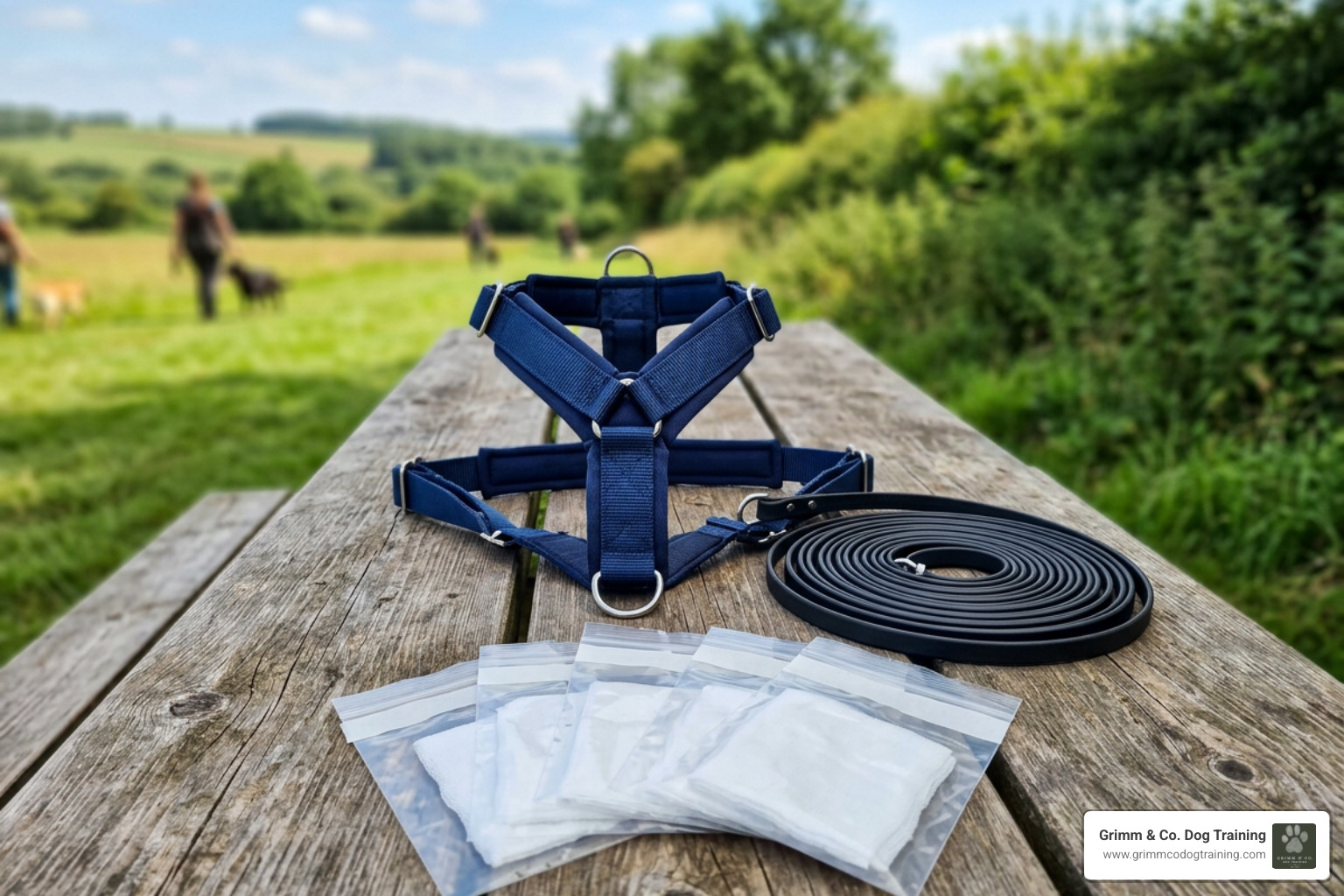
- Non-Restrictive Y-Front Harness: The harness must distribute forward pulling force across the dog's chest and shoulders without constricting the trachea or impeding shoulder extension. Use this harness only when trailing; putting it on serves as a clear contextual cue that it is time to work.
- Trailing Long Line (15 to 20 Feet): A high-quality Biothane or durable tubular webbing line is essential. Biothane resists moisture, wipes clean after running through mud, and prevents snags in heavy underbrush.
- Heavy-Duty Gloves: Operating a working line behind a focused Bloodhound generates friction. Quality leather or reinforced synthetic gloves protect your hands from rope burns during sudden acceleration.
- Supportive Footwear: Trailing handlers must navigate varied terrains, from steep, uneven scrub near coastal parks to fractured urban sidewalks, making supportive trail boots mandatory.
- Sterile Scent Articles and Storage: Clean scent samples, such as cotton gauze pads, worn bandanas, or shirts, must be sealed in double Ziploc bags to preserve integrity and eliminate cross-contamination.
Structured gear conditioning is a natural extension of comprehensive dog scentwork training, establishing clear environmental boundaries so the hound understands precisely when they are on an active trail versus casual walking.
Scent Dynamics and Environmental Factors
Human scent consists of roughly 40,000 microscopic skin rafts shed every minute, carrying personal bacteria, fatty acids, and metabolic byproducts. Once shed, these rafts interact with dynamic atmospheric elements:
- Relative Humidity and Moisture: Moderate humidity and light morning fog hydrate scent rafts, prolonging bacterial viability and keeping scent particles low to the ground. Extremely dry environments cause scent rafts to desiccate and dissipate rapidly.
- Solar Radiation and Thermal Lift: Direct midday sun heats ground surfaces, causing thermal updrafts that lift scent particles into higher air columns. This forces trailing dogs to transition from ground sniffing to elevated air-scenting.
- Wind Currents and Microclimates: Wind creates scent cones that drift downwind from the runner's physical path. In tight suburban corridors or wooded valleys, wind wraps scent around solid fences and dense hedgerows, creating scent pools far from the original path.
- Hard Surfaces vs. Vegetative Cover: Porous soil, grass, and coastal scrub hold skin rafts securely for days. Non-porous hardscapes, such as asphalt or concrete, expose scent to wind sweep and solar degradation, requiring advanced scent discrimination.
Core Commands and Leash Handling Mechanics
Precise line handling prevents handler interference while keeping the dog safe. Handlers should focus on three foundational cues:
- "Find Him" (or "Trail"): The primary operational cue given immediately after presenting the scent article.
- "Leave It": A crucial safety cue used to redirect the hound from discarded food wrappers, domestic animals, or wildlife droppings along the trail path.
- "Wait": A stationary control cue that asks the hound to pause on the line while the handler untangles gear, steps over obstacles, or evaluates blind traffic crossings.
Maintain consistent, light line tension so you can feel changes in the dog's drive without restricting their movement. Learn to read subtle physical shifts: a sudden drop in head carriage, an accelerating pace, or purposeful tail rhythm signals that the hound is in the primary scent cone. Conversely, high head casting and erratic checking indicate the dog has hit a scent void and is working out the perimeter.
Step-by-Step Training Progression for Trailing Teams
Building a reliable mantrailing team requires methodical progression. Moving too fast before foundational skills are locked in is the most common reason dogs lose focus or abandon difficult trails.
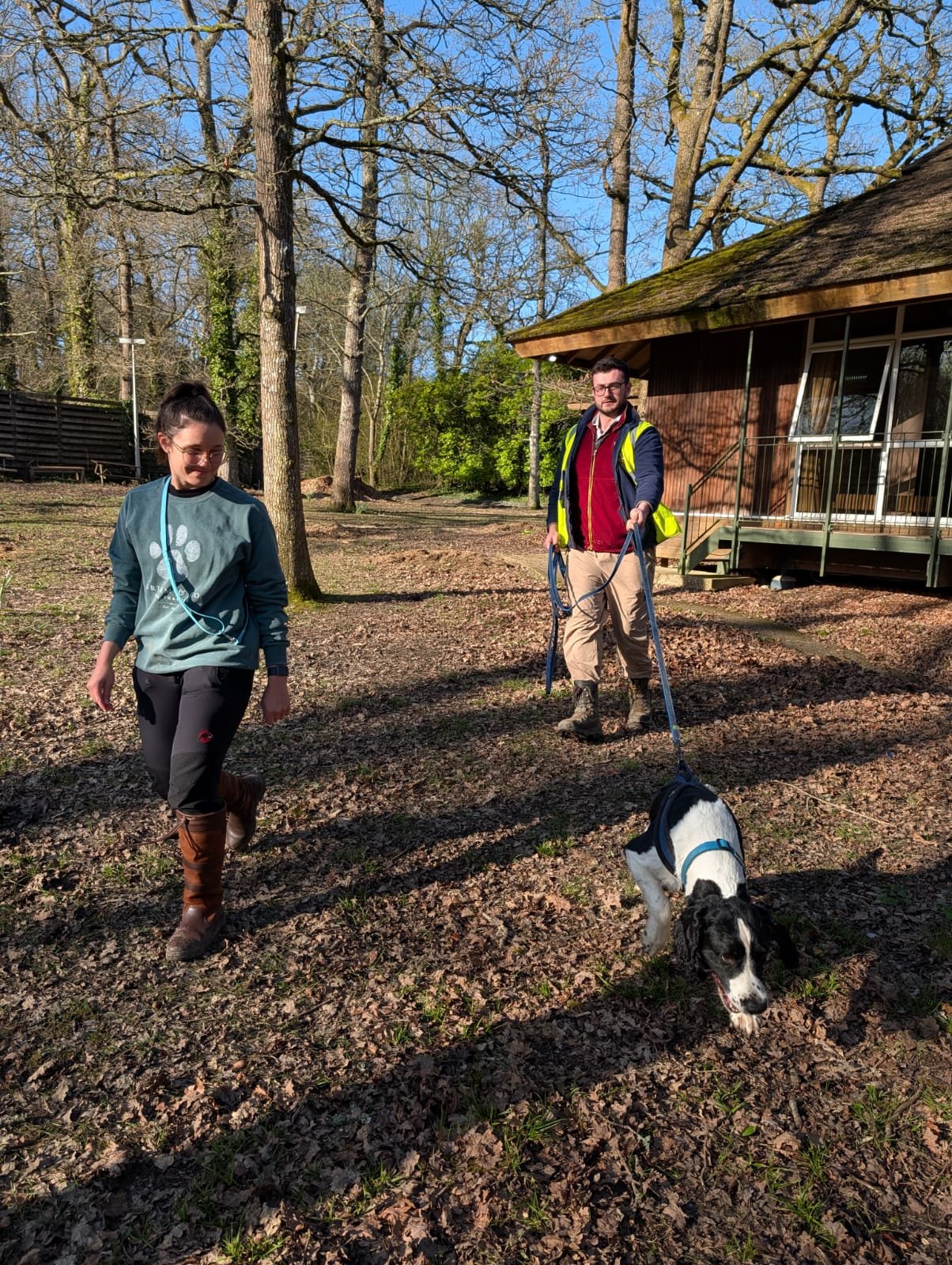
Building Drive Through Runaways and Scent Discrimination
Training begins by tapping into the dog's natural chasing and locating instincts through visual "runaways."
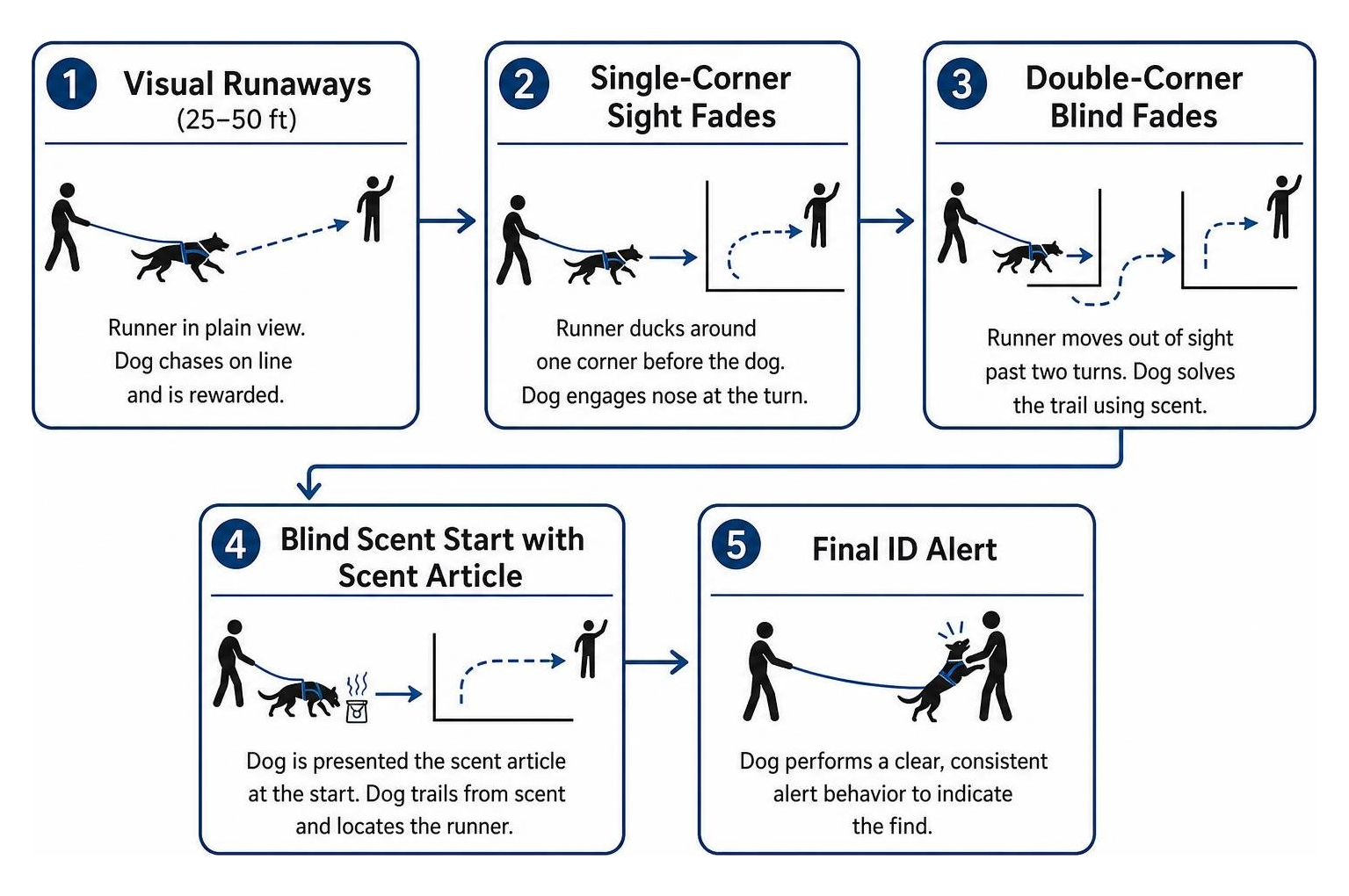
- Visual Runaways (25–50 Feet): An assistant runner excites the puppy or novice hound with high-value food or a favored toy, runs roughly 25 feet into an open field in plain view, and waits. The handler buckles the trailing harness, presents the start cue ("Find"), and allows the dog to charge forward on the line. Upon reaching the runner, the dog receives an immediate high-value reward.
- Single-Corner Sight Fades: The runner repeats the sequence but ducks around a single natural corner (such as a tree line or building edge) just before the dog is released. The dog sees the start of the run but must engage its nose at the corner to complete the find.
- Double-Corner Blind Fades: The runner moves completely out of sight past two turns. The hound must rely entirely on scent to solve the corners and locate the target.
- Introducing the Scent Article: Present a clean, bagged scent article at the starting stake. Allow the hound to dip its nose into the bag, issue the start cue, and let the dog puzzle out the trail.
- Establishing the Final Identification (ID): Train a clear, unambiguous identification behavior at the runner, such as a confident jump-up with paws on the chest, a solid sit, or a sustained bark alert. For detailed foundation exercises and coaching, review our mantrailing dog training tips guide.
Navigating Distractions and Scent Contamination in Bloodhound Mantrailing
Once your hound understands the core exercise, introduce real-world environmental variables. Urban and suburban trailing routes involve old residual scent, passing pedestrians, domestic pet odors, and vehicle cross-traffic.
Building resilience against scent contamination requires structured nosework mantrailing training. Introduce fresh cross-runners who walk directly across an established trail at a 90-degree angle. The hound must evaluate both scent profiles, ignore the cross-runner, and remain committed to the target scent presented at the starting stake.
The Golden Rule of Progression: Never increase trail length at the same time you increase trail age or environmental complexity. If you extend a trail from 400 yards to 1,000 yards, run it on a fresh track in clean cover. If you age a trail to 12 hours or introduce busy suburban pavement, keep the overall distance short and straightforward.
ABC Trailing Titles and Real-World Operational Search Work
Formal mantrailing provides a clear, objective measurement of a canine team's trailing fidelity. The American Bloodhound Club (ABC) establishes standard titling levels recognized by the AKC, providing structured performance benchmarks for sporting teams.
The American Bloodhound Club Titling Standard: EECT to MTX
The ABC titling progression advances methodically across four distinct levels:
- Event Entry Certification Test (EECT): The entry prerequisite for all trailing titles. Puppies must be at least 6 months old. The trail spans a minimum of 1/4 mile (440 yards), is aged 1 to 2 hours, and features clean terrain with one primary runner. Teams must complete the trail within 1 hour.
- Mantrailer (MT): Requires a trail of 1/2 to 3/4 mile (880 to 1,320 yards), aged 4 to 6 hours. It incorporates at least one turn of 90 degrees or more across natural and suburban cover, testing basic endurance and cornering independence.
- Mantrailer Intermediate (MTI): Spans 1/2 to 3/4 mile with a scent age of 8 to 18 hours. The trail includes moderate human contamination, two distinct directional turns, and two runners positioned at the end spaced 15 feet apart. The dog must discriminate and correctly identify the specific target runner while ignoring the cross-runner.
- Mantrailer Excellent (MTX): The pinnacle sporting title. The trail is 1/2 to 3/4 mile long and aged 24 to 36 hours through heavily contaminated areas. It includes up to three physical obstacles (such as paved roadway crossings, bridges, or water features) and an intentional split-runner scenario where two runners walk together, split, and rejoin.
Complete regulatory guidelines are detailed in the official American Bloodhound Club Trailing Trial Event Standards. Sporting trailing titles certify natural working ability and trail fidelity in controlled sporting trials, which are distinct from professional operational Search and Rescue (SAR) or police K9 deployments.
Non-Bloodhound Breeds and Enrichment for Sensitive Dogs
While the Bloodhound remains the historic standard for human trailing, mantrailing is open to every breed. Working breeds, terriers, sporting spaniels, and mixed-breed rescue dogs often thrive when given a clear scent problem to solve.
Mantrailing is particularly valuable for dog-reactive, anxious, or sound-sensitive pets. Because dogs work one at a time on long lines in open environments, there is no direct pressure from other dogs. Sniffing engages the parasympathetic nervous system, lowering arousal, regulating respiration, and building deep biological fulfillment. Handlers training in the Northern California area can build initial trail engagement at spacious, dog-friendly Bay Area trailing venues like Mussel Rock Park, where steady coastal breezes and open space support early scent tracking.
Frequently Asked Questions About Bloodhound Mantrailing
Can breeds other than bloodhounds excel at mantrailing?
Yes. Every domestic dog retains tens of millions of olfactory receptors and an innate drive to follow biological scent trails. Breeds such as German Shepherds, Belgian Malinois, Labrador Retrievers, Beagles, Coonhounds, and versatile rescue mixes regularly excel in recreational mantrailing. The handler's commitment to clear line handling and consistent training matters far more in sport trailing than having a purebred Bloodhound pedigree.
How old can a scent trail be before a dog can no longer follow it?
In standard sporting trials, advanced trails are aged between 24 and 36 hours. However, under ideal environmental conditions—such as shaded, high-humidity woodland cover or cool, protected coastal brush—highly experienced Bloodhounds have successfully followed scent trails several days to weeks after an individual passed through. Conversely, high heat, dry winds, and direct midday sun on hot pavement can degrade even a fresh scent trail in a matter of hours.
How does sport mantrailing differ from operational Search and Rescue (SAR) work?
Sport mantrailing evaluates a canine team's trail fidelity under controlled guidelines with known trail parameters, defined time limits, and standby judges. Operational Search and Rescue (SAR) and law enforcement tracking require round-the-clock deployment across unpredictable wilderness or dense urban hazards. Operational teams must master forensic evidence handling, wilderness navigation, incident command systems, extreme weather survival, and emergency canine medical care. Sport titling builds valuable foundation skills, but operational work demands separate, specialized organizational certifications.
Unlocking Your Dog's Scent Potential
Mantrailing offers an authentic look into how your dog perceives the world. By stepping back and letting the hound lead, you build a relationship anchored in mutual trust, clear communication, and instinctive fulfillment. Whether your goal is stepping up to American Bloodhound Club trials or simply giving an energetic pet a rewarding job, scent trailing transforms canine energy into calm, focused problem solving.
At Grimm & Co. Dog Training, we specialize in relationship-focused training across San Francisco, Daly City, and the wider Bay Area peninsula. We guide handlers through every stage of scent work, from foundational puppy runaways to complex suburban contamination trails. If you are ready to pick up the long line and channel your dog's natural instincts, discover our structured mantrailing programs and start trailing with purpose.