
A More Considered Guide to Nosework Mantrailing Training
Why Scent Work Belongs in a Thoughtful Dog’s Life

Nosework mantrailing training gives dogs a job that makes deep biological sense to them: follow a specific person's scent trail and find that person at the end. For many dogs, it is one of the clearest paths to more confidence, better focus, and a calmer nervous system.
Here is the practical shape of it:
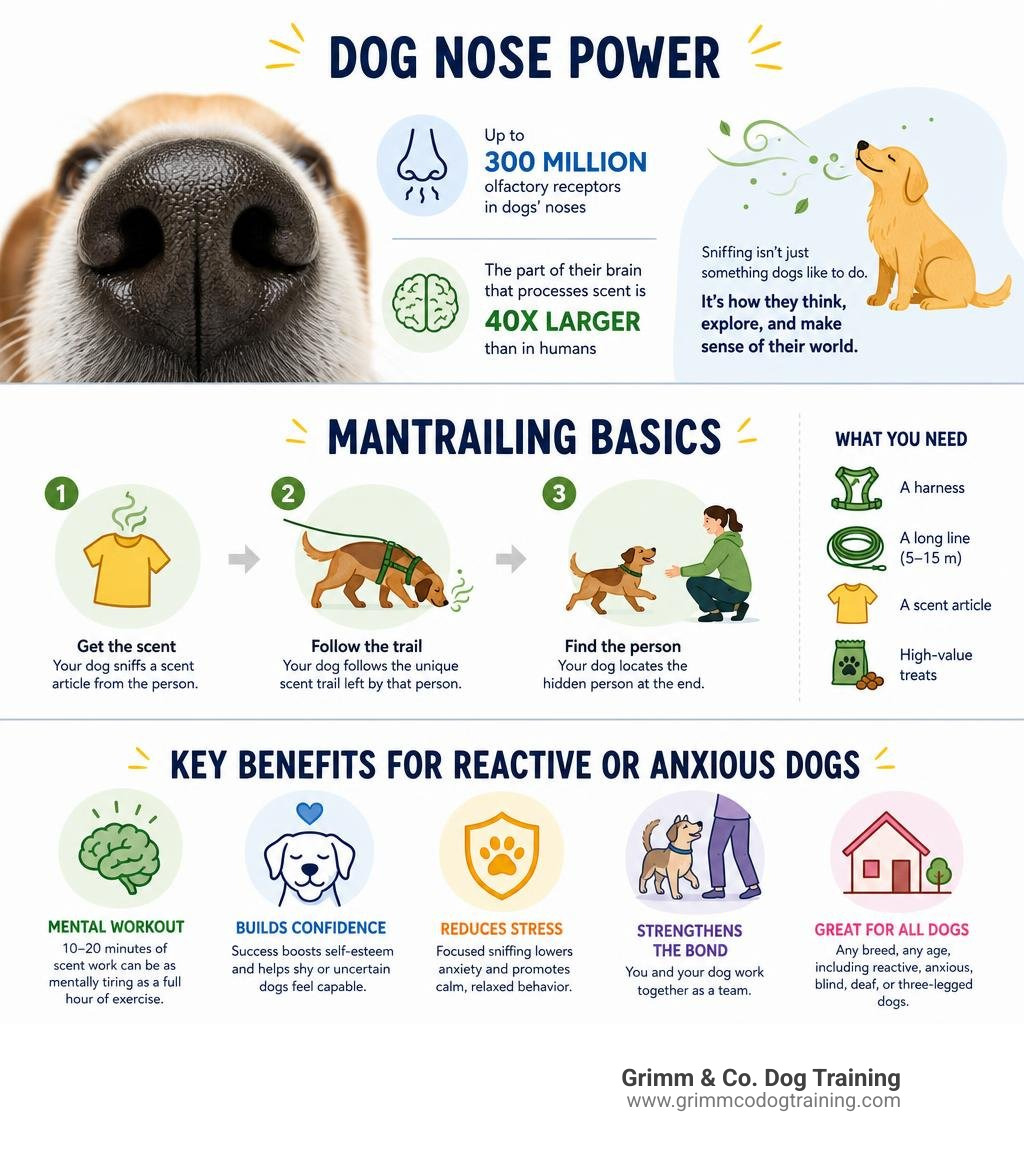
- What it is: Your dog sniffs a scent article, such as a piece of clothing, then follows that person's unique scent trail to locate them
- Who it suits: Almost any dog, including young dogs, older dogs, anxious dogs, reactive dogs, deaf dogs, blind dogs, and dogs with physical limitations
- What you need to begin: A well-fitted harness, a long line, a clean scent article, and rewards your dog genuinely values
- Why dogs love it: It asks them to solve a real problem using their strongest sense
- Where it comes from: Mantrailing has roots in police and search-and-rescue work, though many modern teams practice it as an enrichment activity and sport
Dogs experience the world primarily through smell. Their noses contain up to 300 million olfactory receptors, compared with roughly 6 million in humans, and the portion of the canine brain devoted to scent analysis is proportionally far larger than ours. Sniffing is not a casual hobby for dogs. It is how they gather information, make choices, and understand the spaces we move through every day.
Most pet dogs, however, live in environments designed almost entirely around human priorities. They are asked to walk on sidewalks, ignore distractions, and fit into busy households. Nosework and mantrailing offer something different. They let the dog take the lead in a structured, safe way, and they give the handler a much better view of how intelligent and capable their dog already is.
Nosework, Mantrailing, and Tracking: Similar Noses, Different Jobs
If you are new to canine scent sports, the terminology can be confusing. People often use “scent work,” “nosework,” “tracking,” and “mantrailing” as if they mean the same thing. They are related, but each activity asks the dog to solve a different kind of scent problem.
| Feature | Scent Detection / Nosework | Tracking | Mantrailing / Trailing |
|---|---|---|---|
| Primary Goal | Find hidden target odors, such as birch, anise, or clove, in containers, vehicles, interiors, or exterior search areas. | Follow the physical path left by a person walking, often while finding dropped articles along the route. | Follow a specific person's scent trail to locate that person at the end. |
| Scent Source | Target odor moving through the air and collecting around objects. | Ground disturbance, crushed vegetation, soil change, and heavier ground scent. | Airborne skin rafts, sweat, respiratory particles, and environmental scent pooling. |
| Start Signal | The handler cues the dog to search a defined area. | The dog begins at a specific footprint, flag, or start article. | The dog sniffs a scent article that identifies the target person. |
| Environment | Interiors, urban exteriors, vehicles, containers, and varied search setups. | Fields, dirt, grass, or more uniform natural terrain. | Urban streets, public parks, parking lots, forests, beaches, and other changing environments. |
This distinction matters when starting nosework mantrailing training. In traditional tracking, dogs are usually expected to stay close to the physical path of the tracklayer. In mantrailing, the standard is more naturalistic. The dog is allowed to interpret the scent picture as it actually exists in the environment.
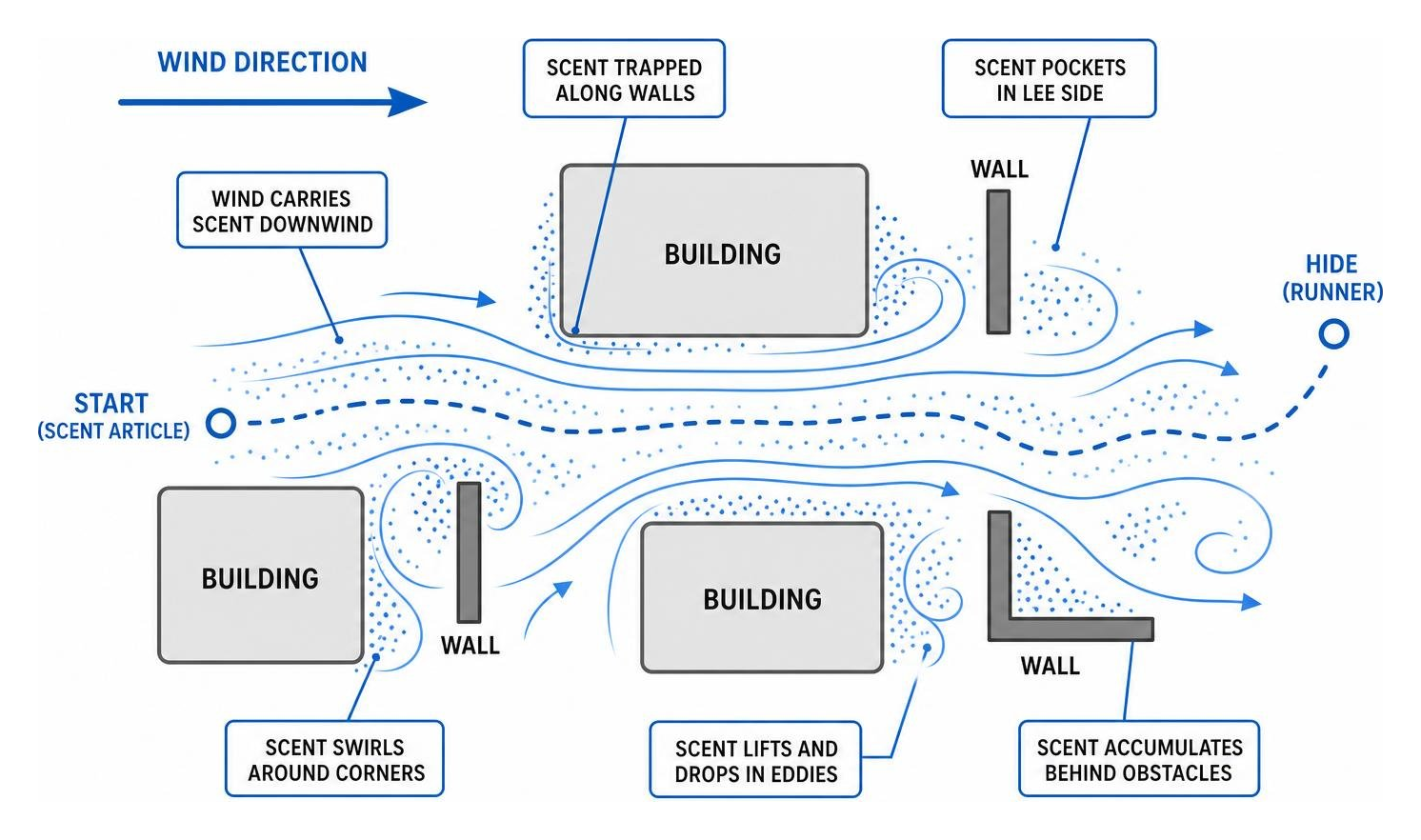
When we practice Mantrailing, we are not asking the dog to perform a tidy obedience exercise. We are asking the dog to locate a person using scent information that moves, collects, disperses, and changes. Human scent does not remain neatly on the ground. It drifts on wind, pools in corners, catches on shrubbery, and behaves differently around walls, cars, stairwells, and open spaces.
A mantrailing dog may use both ground scent and air scenting to locate the target person. If wind carries the target's scent ten feet away from the original walking path, a good trailing dog will often follow the available scent rather than the footprints. That flexibility is part of what makes the work so useful, and it is one reason the skill set overlaps with the real-world demands placed on a Search and Rescue Dog.
For Bay Area dog owners, this is also what makes trailing so rewarding. Dense urban spaces, coastal air, hills, parks, and changing foot traffic all create scent puzzles that are interesting without being chaotic. The dog gets a meaningful task, and the handler learns to observe rather than micromanage.
What Scent Work Gives the Dog, and the Handler
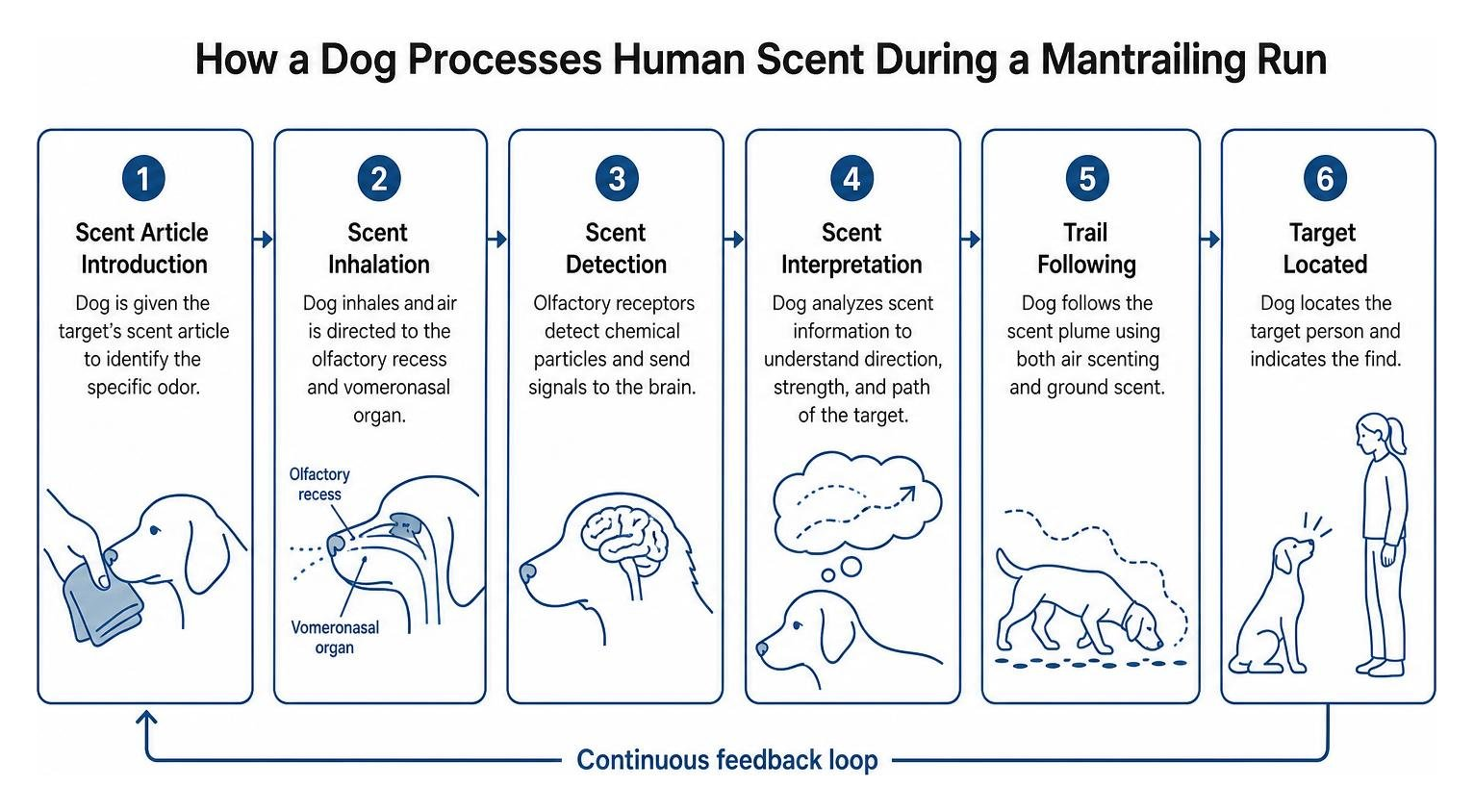
The canine olfactory system is remarkably sophisticated. While humans tend to navigate by sight, dogs build much of their understanding through scent. Their noses collect and separate information with a level of detail we can appreciate intellectually, but never truly experience ourselves.
When a dog sniffs, airflow is directed both toward the lungs and toward the olfactory recess, where scent information is processed. Dogs also have a vomeronasal organ, often called Jacobson’s organ, that helps them detect pheromones and other chemical signals. This is part of why scent can tell a dog who passed through an area, how recently they were there, and sometimes which direction they were moving.
Harnessing that ability through nosework mantrailing training offers benefits that go well beyond “tiring the dog out.” Done thoughtfully, it can change how a dog feels in the world.
- Mental work that feels satisfying: Scent processing requires real concentration. A short, well-designed trailing session can be more settling for many dogs than a much longer walk with constant visual stimulation.
- Confidence for sensitive dogs: Anxious dogs often spend public outings scanning for things that worry them. On a trail, the dog has a specific job. The scent gives them something coherent to follow, which can help them move through new environments with more purpose.
- A workable structure for reactive dogs: In our training, one dog works at a time while the others wait safely away from the working area. That makes mantrailing a strong option for dogs who are not ready for conventional group obedience settings.
- A better handler-dog partnership: Mantrailing asks the human to stop steering every decision. Because you cannot smell the trail, you have to learn the dog in front of you: head turns, pace changes, line tension, casting patterns, breathing, and moments of renewed commitment. That kind of observation improves the relationship in ways that carry into everyday life.
Giving a companion dog meaningful Work for Dogs is not about making pet ownership more complicated. It is about giving the dog an outlet that respects how they are built, then using that work to build steadier behavior and a more thoughtful partnership.
How to Begin Without Rushing the Dog
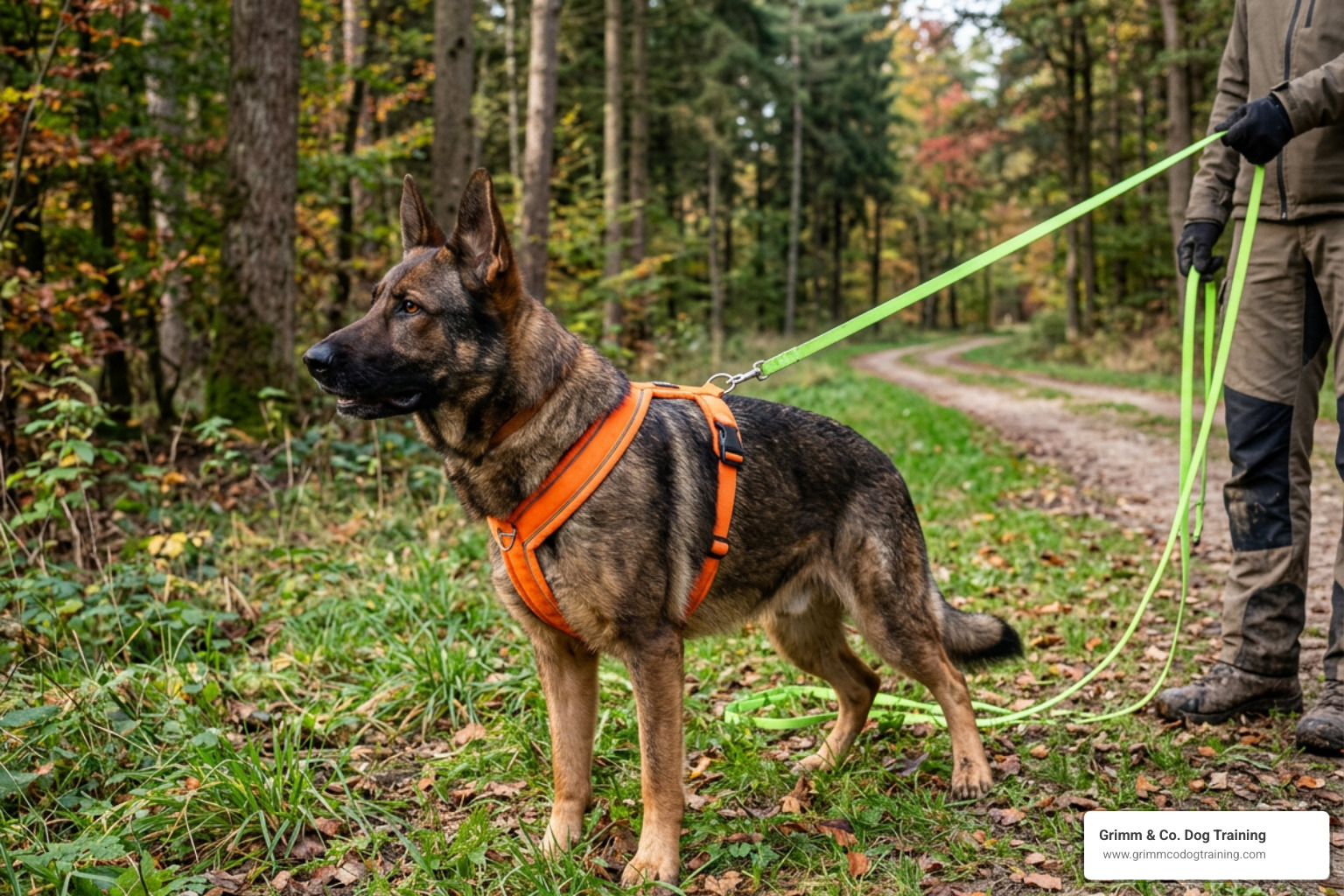
Before your first session at a quiet park, a school lot on a weekend, or a low-traffic Bay Area trailhead, it is worth setting the dog up carefully. The right equipment keeps the dog comfortable and helps create a clear context: this is not a heel, a neighborhood walk, or a casual sniff around the block. This is work.
For nosework mantrailing training, start with the following:
- A well-fitting Y-front harness: The dog will pull forward while trailing, so the harness should allow shoulder movement and avoid pressure on the throat. Use this harness only for trailing if possible, so it becomes part of the dog’s working picture.
- A long line, usually 5 to 15 meters: Biothane or webbed nylon tends to work well. Avoid retractable leashes, which create constant pressure and are poorly suited for real line handling.
- A clean scent article: This may be a shirt, pillowcase, glove, or other object handled by the target person. Store it in a clean plastic bag so it is not contaminated by unrelated scents.
- High-value rewards: Use food or toys the dog truly cares about. Roasted chicken, wet food in a squeeze tube, or a favorite toy can all work, depending on the dog.
- A quiet starting environment: Early success matters. Begin somewhere with enough space, low foot traffic, and minimal competing pressure.
A structured Dog Training Program can help the team build motivation, line skills, and handler judgment without adding complexity too quickly.
Phase 1: Build Motivation Before Adding Difficulty
The first phase is not about proving how difficult a trail your dog can solve. It is about teaching the dog that following human scent leads to something wonderful, and that the handler can be trusted to stay connected without interfering.
A common starting exercise is the Runaway Game:
- Step 1: Have a helper, often called the runner, hold your dog’s favorite reward.
- Step 2: While you gently hold the dog, the runner builds interest, then moves away and hides just out of sight.
- Step 3: Fit the dog’s trailing harness, attach the long line, and give a consistent start cue, such as “Find,” “Search,” or another word you will use only for this work.
- Step 4: Let the dog pull toward the hidden person. When the dog finds them, the runner rewards generously at source.
Once the dog understands the basic game, add the scent article:
- The runner leaves a worn shirt or other scent article at the start.
- The dog is encouraged to investigate the article before the trail begins.
- As soon as the dog takes in the scent, the handler gives the start cue and follows the dog to the hidden person.
This progression teaches the dog that the article is meaningful. It is the clue that identifies whom they are looking for.
Phase 2: Add Scent Puzzles Thoughtfully
As the team gains fluency, the work becomes more interesting. This is when handlers start to understand how much of the job is observation, patience, and line handling.
More advanced work may include:
- Line handling: Managing a long line around trees, benches, curbs, parked cars, and your own feet takes practice. The handler learns when to feed line, when to gather it, and when to stay quiet.
- Wind and scent movement: Scent rarely behaves in a straight line. Wind, heat, humidity, walls, corners, and elevation all affect where the dog finds useful information.
- Aged trails: Early trails are usually fresh. Later, the runner may wait 15 minutes, 30 minutes, or longer before the dog starts, which teaches the dog to work older scent with care.
- Inaccessible hides: The hidden person may be behind a gate, inside a vehicle, or otherwise unreachable. In those cases, the dog learns to work as close to source as possible.
Good training keeps the dog successful while gradually increasing complexity. The goal is not to overwhelm the dog with clever setups. The goal is to develop a confident, accurate team.
Common Questions About Scent Sports
Which dog breeds are suitable for mantrailing?
Almost any breed can succeed in mantrailing. Bloodhounds, German Shepherds, Labradors, and other traditional working breeds may come to mind first, but small dogs, mixed breeds, brachycephalic dogs, senior dogs, and physically different dogs can all enjoy the work when the session is set up appropriately.
Because the dog works at an individual pace, mantrailing can be unusually inclusive. Deaf dogs, blind dogs, and three-legged dogs can trail well because the work does not depend on perfect sight, hearing, or athleticism. The main requirements are comfort in a harness, appropriate physical safety, and genuine motivation for the reward at the end.
What is the difference between recreational trailing and operational search and rescue?
Recreational mantrailing is practiced for sport, enrichment, relationship building, and confidence. The stakes are intentionally low. The dog learns to solve scent puzzles, the handler learns to read the dog, and the team enjoys useful work together.
Operational search and rescue, or SAR, is a demanding professional discipline. SAR teams train for years, meet formal standards, and may be called into difficult searches involving weather, terrain, urgency, and emotional pressure. The scent principles overlap, but the obligation is entirely different. Operational Working Dogs need extensive preparation, careful handling, and the right deployment context.
How can scent work help reactive or anxious dogs?
Scent work can be valuable for reactive or anxious dogs because the structure is controlled. In our classes, one dog works at a time, while the other dogs remain away from the working area. That format gives sensitive dogs room to think without being crowded by other dogs or people.
The work itself also changes the dog’s focus. Instead of scanning the environment for every possible trigger, the dog is following a specific scent problem. For many dogs, that shift from vigilance to purposeful work is significant. Over time, repeated success can help the dog move through public spaces with more confidence and less frantic scanning.
A More Considered Way to Work With Your Dog
At Grimm & Co. Dog Training, we believe good training should be relationship-based, practical, and grounded in the dog in front of us. Whether we are working in Daly City, reading scent movement through San Francisco wind, or setting up a trail near Treasure Island, nosework mantrailing training gives dogs a rare opportunity to lead with one of their greatest strengths.
As of July 2026, our team continues to offer personalized coaching for dogs and handlers who want to explore this work thoughtfully. If you are ready to build confidence, deepen your partnership, and join a supportive local training community, explore our Dog Training Services or ask about upcoming Group Classes.