
The Developmental Timeline and Gear: How to Leash Train a Puppy from Day One
To leash train a puppy effectively, begin indoors on day one by introducing an ergonomic Y-shaped harness and lightweight leash in low-distraction spaces. Shape polite walking mechanics by rewarding your puppy directly at your hip seam, teach them to yield to leash pressure through gentle pressure-release conditioning, and use clear verbal markers to reinforce focus. As your pup builds engagement and receives core vaccinations, systematically transition skills outdoors from quiet hallways to low-density sidewalks and busier urban environments.
A young dog's cervical spine and trachea are delicate, making equipment selection a foundational safety consideration. Early training must protect your puppy physically while capitalizing on the primary critical socialization window identified by the American Veterinary Society of Animal Behavior (AVSAB), which closes between 12 and 14 weeks of age.
Navigating this period requires balancing disease risk management with behavioral exposure. In high-density settings like San Francisco and the Peninsula, early habituation prevents future reactivity to novel stimuli such as Muni buses, strollers, and passing dogs. Integrating structured Daly City puppy socialization protocols during this phase ensures your pup learns to view environmental novelties with calm neutrality rather than intense fear or overarousal.
| Equipment Type | Primary Purpose | Best Used For | Biomechanical Considerations |
|---|---|---|---|
| Flat Collar | Identification & light guidance | Daily tag wear, basic indoor training | Fits snugly (two fingers beneath); avoid leash pressure on toy breeds and heavy pullers |
| Y-Shaped Harness | Safe load distribution | General walking, decompression, sniff walks | Rests cleanly on the sternum; allows complete, unrestricted shoulder extension |
| Front-Clip Harness | Directional steering | Pulling remediation, heavy urban traffic | Redirects forward momentum toward handler; prevents shoulder binding when adjusted properly |
Choosing Safe, Non-Restrictive Equipment for Young Pups
Selecting the correct gear protects your puppy's physical structure while establishing clear communication lines. A well-designed Y-shaped harness is often ideal for early loose-leash training because it distributes pressure across the chest and ribcage. In contrast, restrictive horizontal chest straps (often found on standard H-style or non-ergonomic harnesses) cross over the scapula, which can alter normal gait kinematics and impede shoulder extension during development.
Pair your harness with a flat collar strictly designated for identification tags and emergency control. Fasten a standard 4-to-6-foot fixed leash made of lightweight nylon, leather, or biothane. We avoid retractable leashes during foundational training for three distinct reasons:
- Mechanical Reinforcement of Pulling: Retractable mechanisms maintain constant, low-grade tension. This teaches puppies that forging ahead against resistance is the specific action that yields forward movement.
- Handler Reaction Delays: Thin cords create physical burn and entanglement hazards while reducing your ability to execute precise spatial management.
- Unpredictable Boundaries: A variable boundary prevents the puppy from learning the reliable physical radius of a fixed leash.
The 4-Stage Development and Socialization Timeline
Proper leash training coordinates equipment introduction with biological maturity and veterinary vaccination milestones:
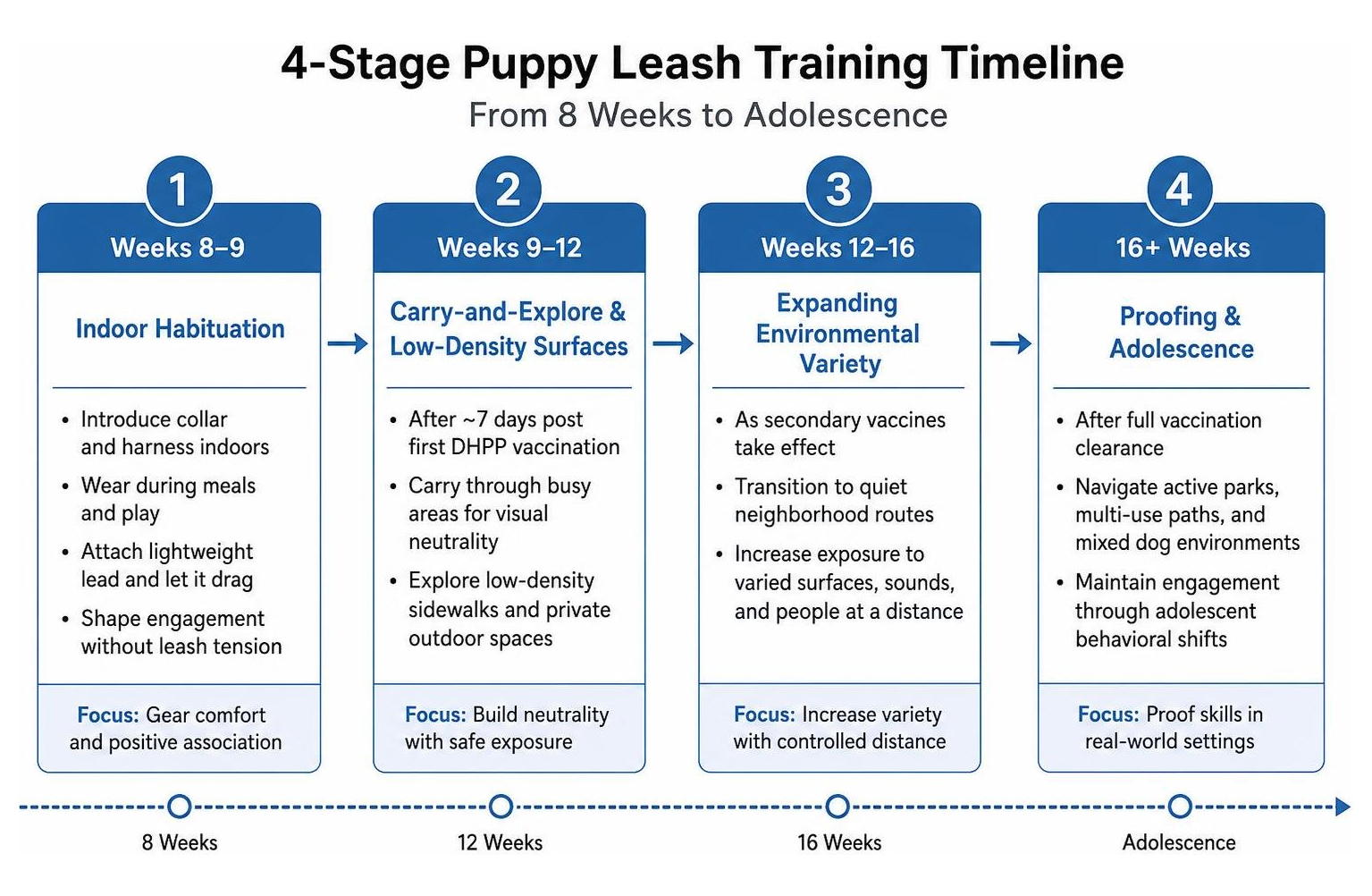
- Stage 1 (Weeks 8–9: Indoor Habituation): Introduce the collar and harness indoors. Let the pup wear the gear during meal times and supervised play. Attach a lightweight lead and allow it to drag across living room rugs to eliminate tactile sensitivity. Follow structured, humane loose-leash training guidelines to shape early engagement without leash tension.
- Stage 2 (Weeks 9–12: Carry-and-Explore & Low-Density Surfaces): Roughly seven days after the initial DHPP vaccination dose, introduce low-density sidewalks and private outdoor spaces. Carry your puppy through busier urban areas like Jack London Square or Emeryville retail corridors to build visual neutrality without exposing them to contaminated ground.
- Stage 3 (Weeks 12–16: Expanding Environmental Variety): As secondary vaccines take effect, transition to quiet neighborhood routes in Burlingame, San Mateo, or Redwood City. Increase exposure to varied surfaces, sounds, and controlled distances from passing pedestrians.
- Stage 4 (16+ Weeks: Proofing & Adolescence): Following full vaccination clearance, navigate active parks, multi-use paths, and mixed dog environments. Focus on maintaining engagement through adolescent behavioral shifts.
Step-by-Step Indoor Mechanics for Early Success
Before stepping onto busy Bay Area sidewalks, refine your handling mechanics in an environment with zero distractions. Puppies learn position through consistent reinforcement zones. If you deliver treats randomly in front of your body, your puppy will naturally forge ahead to intercept the food source.
By applying proven puppy obedience training tips 2026, you can turn your living room or hallway into a clear learning laboratory. Keep these micro-sessions short, ideally three to five minutes, two to three times daily, aligning with your puppy's natural awake-and-potty cycles.
Step-by-Step Foundations: How to Leash Train a Puppy in Low-Distraction Spaces
Indoor leash training relies on establishing an explicit value zone directly beside your hip:
- Charge the Reinforcement Zone: Stand stationary in a quiet room with your puppy wearing their harness and leash. Hold the leash loop loosely in the hand opposite your dog. With a treat pouch on your dog's side, lure the puppy into alignment with your pant seam. Deliver three to five treats consecutively right at your hip line.
- Take One Step and Mark: Step forward on your outside foot. The moment your puppy moves alongside you without placing tension on the leash, say your clear verbal marker word (such as "yes") or click, and deliver a treat directly at your seam.
- Build Two-to-Three Step Progressions: Gradually take two, three, and four steps before marking and treating. Maintain a relaxed "J" loop in the leash. If your puppy rushes ahead, stop calmly. Do not jerk the leash; simply wait for the puppy to turn back toward you, mark the orientation, and reward them when they return to your side.
- Incorporate Release Cues: End each micro-session with an explicit release word (such as "free" or "break") and toss a piece of kibble away from your hip. This teaches the puppy the distinction between focused walking beside you and casual free time.
Establishing Engagement Markers and Pressure-Release Mechanics
Dogs possess an innate opposition reflex, an instinct to lean or pull against steady physical tension applied to their body. To counteract this natural response, teach your puppy that yielding to leash pressure brings immediate release and reward:
- Gentle Collar & Harness Desensitization: Stand beside your puppy. Place very gentle, sub-threshold lateral pressure on the collar or harness ring. The millisecond the puppy shifts their weight toward the pressure rather than fighting it, release the tension, mark with "yes," and deliver a high-value reward.
- Automatic Lookback at Leash End: When your puppy drifts to the physical end of the lead, hold your hand steady against your torso without pulling back. The moment the puppy feels the boundary, stops, and turns their head back toward you, immediately mark and reward. This conditions the feeling of leash tension to serve as a cue to check in with the handler.
Troubleshooting Walking Roadblocks and Environmental Triggers
Urban environments across San Francisco, Daly City, and Berkeley present continuous sensory stimuli, including passing skateboards, delivery trucks, outdoor diners, and reactive neighborhood dogs. When a puppy encounters high-arousal triggers, their nervous system can quickly become overwhelmed.
Carefully understanding puppy body language allows you to recognize subtle indicators of stress, such as lip licking, pinned ears, sudden sniffing displacement, or stiffening, before behavioral escalations occur.
Resolving Freezing, Balking, and Leash Biting
Young puppies often freeze or refuse to move on leash. This behavior is rarely stubbornness; it typically indicates sensory overload, fear of unfamiliar outdoor sounds, or resistance to collar pressure.
- Handling Freezing and Balking: Never drag a balking puppy forward. Dragging triggers panic and intensifies resistance. Instead, turn sideways to reduce physical pressure, crouch down, and use an enthusiastic vocal cue or a tossed treat two feet ahead to encourage voluntary forward movement. If your pup remains frozen on a busy sidewalk, pick them up calmly, carry them to a quieter location, and reset.
- Addressing Leash Biting and Tugging: Leash biting often arises from overarousal or teething discomfort. If your puppy grabs the leash in their mouth and thrashes, avoid playing tug-of-war, which rewards the behavior. Hold the leash completely stationary against your leg to eliminate play value. Present a high-value treat at their nose, cue a calm "drop," and exchange the leash for a durable rubber toy or chew to carry on the walk.
Managing Reactivity: How to Leash Train a Puppy Around Neighborhood Distractions
Managing environmental triggers requires intentional distance and counter-conditioning. Proactive steps for preventing leash reactivity keep your puppy beneath their emotional threshold:
- Establish Buffer Zones: When you spot an approaching dog or cyclist on narrow sidewalks in South San Francisco or Palo Alto, step into a driveway or cross the street to create a 20-to-30-foot buffer zone.
- Implement Counter-Conditioning: The instant your puppy notices a novel trigger at a distance, mark and feed several pea-sized pieces of high-value food (such as freeze-dried liver or cooked chicken). Keep the stream of treats going until the trigger passes completely out of view.
- Use Directional U-Turns: If a high-arousal distraction appears suddenly around a blind corner, calmly announce "let's go," pivot 180 degrees, and walk briskly in the opposite direction, rewarding your puppy as they follow your lead.
Structuring Daily Walks: Polite Leash Manners vs. Decompression Breaks
A common mistake new dog owners make is expecting a young puppy to walk in an unbroken, formal heel for thirty continuous minutes. This expectation is developmentally inappropriate and mentally exhausting for a growing dog. Successful walking routines incorporate clear foundations for effective dog training by dividing walks into structured partnership work and exploratory decompression breaks.

Differentiating Loose-Leash Manners from Formal Heeling
Understand the distinct operational criteria between casual loose-leash walking and formal obedience heeling:
- Formal Heeling: A precise obedience exercise where the dog remains aligned at the handler's left knee, maintaining continuous upward eye contact and matching every stride. This requires substantial mental stamina and should be practiced in short bursts of 30 to 90 seconds.
- Polite Loose-Leash Manners: Everyday walking where the puppy has the freedom to explore, sniff, and change sides as long as they maintain a loose leash arc and respond to handler check-ins.
Incorporating Sniff Walks and Enrichment in Urban Settings
Olfactory exploration dramatically lowers canine heart rates and satisfies critical cognitive needs. Allowing your puppy dedicated "sniff breaks" during neighborhood walks significantly reduces pulling during the structured portions of your outing.
For deeper decompression, visit open coastal green spaces like Mussel Rock Park in Daly City, or quiet park areas in San Bruno, Belmont, or Foster City. Attach a 10-to-15-foot long line to your puppy's back-clip harness in low-density open spaces, allowing them to follow scent trails and explore natural terrain at their own pace.
Frequently Asked Questions About Puppy Leash Training
When is it safe to take an unvaccinated puppy on outdoor sidewalk walks?
Indoor habituation should begin the day your puppy comes home at eight weeks old. Public sidewalk walks on paved surfaces can typically begin roughly seven days after your puppy's first DHPP vaccination dose (around 9 weeks of age), provided you stick to clean, low-density residential streets.
Avoid high-risk environments such as dog parks, shared apartment pet relief zones, and pet store floors until full immunity is achieved following the final 16-week vaccination series. During the early weeks, carry your puppy in a sling or your arms through busy public spaces to facilitate vital socialization safely.
How long does it typically take to leash train a puppy reliably?
Basic loose-leash foundation skills indoors and on quiet sidewalks generally take two to four weeks of consistent, daily practice. However, establishing full loose-leash reliability across high-distraction outdoor environments is an ongoing developmental process that typically takes six to twelve months.
Expect temporary behavioral regression during the adolescent period (between 6 and 10 months of age), during which maintaining consistent boundaries and clear reinforcement zones is essential.
What is the most effective way to stop pulling without physical corrections?
The most reliable approach is total behavioral consistency: ensure pulling never rewards the dog with forward progress. The moment you feel tension on the leash, execute the "be a tree" technique by coming to a complete stop, or calmly reverse direction with a 180-degree turn.
Wait for your puppy to release the tension, turn back, or re-engage with you. The instant the leash forms a relaxed loop, mark and proceed forward. Combine this with heavy reinforcement directly at your pant seam so staying near your side becomes the most rewarding choice.
Building a Lifelong Walking Partnership

Mastering loose-leash walking is about opening a two-way line of communication between you and your dog. By choosing safe equipment, respecting your puppy's developmental stages, and clearly defining the boundary between structured walking and olfactory exploration, you lay the foundation for calm, enjoyable outings across the Bay Area.
Every walk is an opportunity to strengthen engagement and mutual trust. If you need personalized guidance navigating urban distractions, adolescent boundary testing, or early foundation work, explore our personalized dog training services. Our team at Grimm & Co. Dog Training is here to support you with tailored private sessions, group classes, and community-driven training throughout Daly City, San Francisco, and the wider Peninsula.