
How to Use Conditioned Emotional Response to Calm Your Reactive Pup
Your Dog Isn't Misbehaving. Your Dog Is Scared.

Conditioned emotional response dog reactivity is not a disobedience problem. It is a nervous system problem, and that distinction changes everything about how you address it.
Here is the short version:
- What it is: A conditioned emotional response (CER) is an automatic, involuntary reaction a dog has learned to associate with a specific trigger, like another dog, a stranger, or a loud sound. It is not a choice. It is wired in.
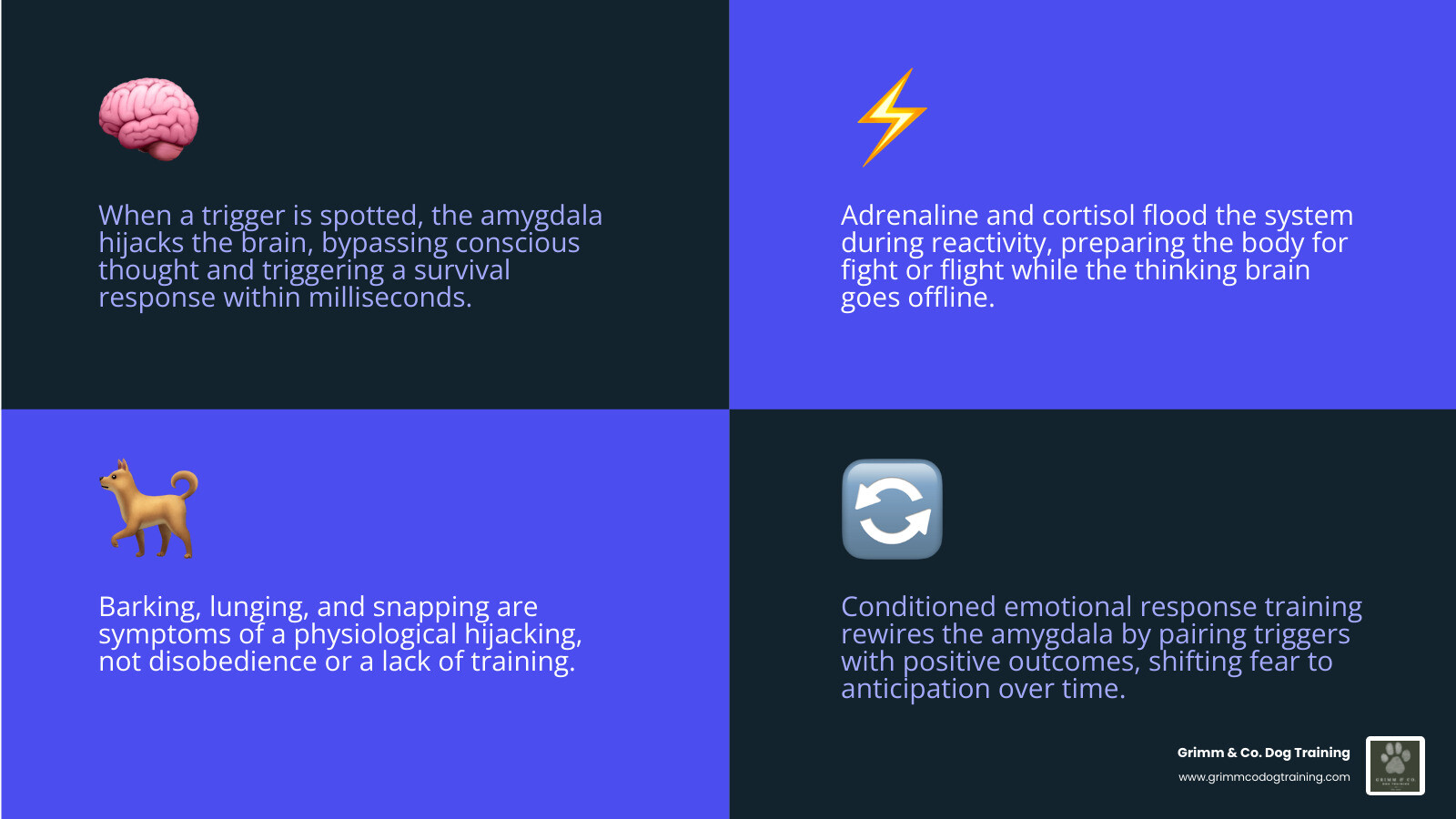
- Why it drives reactivity: When a dog has a negative CER to a trigger, the autonomic nervous system takes over. Adrenaline floods the body, the thinking brain goes offline, and the dog operates entirely on instinct. Barking, lunging, and snapping are symptoms of that state, not the cause.
- Why obedience training alone fails: You cannot teach a dog to "sit" its way out of a panic response. The emotional state has to change first.
- How CER training works: By repeatedly pairing a trigger with something genuinely great, at the right distance and intensity, you gradually rewire the automatic response from fear to anticipation. The dog stops seeing the trigger as a threat and starts seeing it as a predictor of good things.
- What the research shows: Studies on counterconditioning report strong reductions in aggressive behavior toward visitors and other dogs, in some cases approaching elimination. The science is limited but directionally clear: change the emotional response, and the behavior follows.
This matters especially in a place like the South Bay, where a walk through Daly City or downtown San Jose means navigating high foot traffic, unpredictable off-leash dogs, cyclists, and a dozen other stimuli that can tip a reactive dog over the edge before you've made it half a block. The environment is not forgiving, and a dog operating from fear in that context is both miserable and genuinely difficult to manage.
Many reactive dogs missed the critical socialization window before 12 weeks of age, when positive exposure to other dogs and novel stimuli shapes the nervous system's baseline response. That window closes, but the nervous system remains plastic. With the right approach, real change is possible.
I'm Bailey Milne-Davies, and my direct experience with conditioned emotional response dog reactivity started with my own dog, Grimm, whose frustration and reactivity toward other dogs set me on a path from dog owner to professional trainer. That personal foundation, combined with formal coursework and a scientific background, informs how we approach every reactive dog at Grimm and Co. Dog Training. What follows is a detailed, science-grounded guide to understanding and addressing reactivity from the inside out.
Why Physiology Trumps Obedience in Conditioned Emotional Response Dog Reactivity
When your dog catches sight of an unfamiliar dog on a narrow sidewalk in Redwood City, you are not witnessing a moral failing or a sudden lapse in obedience. You are witnessing a physiological hijacking. The autonomic nervous system operates on a primitive level that bypasses conscious decision making. For a reactive dog, the sight of a trigger triggers an immediate shift into a survival state, commonly known as the fight or flight response.
During this shift, the amygdala, which is the emotional center of the brain, takes complete control. It sends immediate distress signals throughout the body, causing adrenaline and cortisol to flood the system. This hormonal surge increases the heart rate, sharpens visual focus on the threat, and prepares the muscles for immediate action. Simultaneously, the frontal cortex, which is the cognitive, thinking part of the brain responsible for learning and processing commands, goes entirely offline.
This brain state explains why shouting commands at a highly aroused dog is completely useless. When your dog is over threshold, they are physiologically incapable of processing the word sit or heel. Furthermore, yelling or pulling on the leash is often perceived by your dog as joint reactivity. They assume you are also barking at the threat, which only validates and escalates their panic. To truly address Dog Reactivity, we must stop treating the outward behavior as a choice and start addressing the underlying physiological crisis.
How a Conditioned Emotional Response Dog Reactivity Protocol Rewires the Amygdala
To change the behavior, we must change the underlying emotion, and that is where classical conditioning comes into play. While operant conditioning focuses on voluntary behaviors and their consequences, classical conditioning deals with involuntary, automatic emotional responses. We are not teaching the dog to perform a task for a reward. Instead, we are changing what the trigger means to the dog on a cellular level.
Think of how human conditioning works. If you hear emergency sirens while driving, your heart rate rises and you automatically touch the brakes before you even consciously process the sound. Conversely, if you hear the music of an ice cream truck, you might feel a sudden wave of childhood nostalgia and happiness. A soldier with post traumatic stress disorder experiences a severe physiological reaction to fireworks because their brain has paired loud booms with mortal danger. In dog training, we want to shift your dog from a state of panic to the happy anticipation of an ice cream truck when they see another dog.
This is achieved through a systematic protocol often called the bar opens bar closes technique. When the trigger appears in the environment, the bar opens, meaning high value treats and enthusiastic praise begin to rain down in rapid succession. The moment the trigger disappears from view, the bar closes, meaning all food and attention stop immediately. Over hundreds of repetitions, this strict pairing rewrites the neural pathways in the amygdala. You can read more about the mechanics of this pairing in this guide on Creating a Positive Conditioned Emotional Response (CER) To Unfamiliar Dogs .
Threshold Management Is the Whole Game
The foundation of any successful behavior modification plan is threshold management. The threshold is the invisible boundary where your dog can perceive a trigger but remains relaxed enough to process information and eat food. If your dog is too close to the trigger, they cross this line, and the learning brain shuts down. Finding and respecting this distance is the only way to make progress.
To identify your dog's threshold, you must become an expert in their subtle body language. A relaxed dog will have soft eyes, a loose posture, and will take treats gently. One of the earliest physiological indicators that a dog is approaching their threshold is a pinchy mouth, where they take treats with a hard, snatching motion. This indicates that the sympathetic nervous system is starting to take over, and you need to immediately increase the distance between your dog and the trigger.
When you maintain a safe distance, your dog's parasympathetic nervous system remains active. Eating is a primary physiological sign of this state, as a dog in true fight or flight mode cannot digest food or swallow easily. By working systematically at this distance, you can find more details on preparing your dog for training in the PrepCare Content - Care for Reactive Dogs resources. Progress is not linear, and understanding that Your Dog's Reactivity Isn't Getting Worse just because they had a bad day is crucial for keeping your own frustration in check.
The Cortisol Reset and the Respite Period
If your dog has a severe reactive episode, their body is flooded with cortisol and adrenaline. This hormonal spike does not disappear when the trigger walks away. In fact, it can take up to several weeks for cortisol to fully dissipate from a dog's brain and body. During this recovery period, your dog will be highly sensitive to stimuli, reaching their reactivity threshold much faster than usual, a phenomenon known as trigger stacking.
To break this cycle, we must implement a strict respite period of one to two weeks. During this time, you must actively protect your dog from encountering any triggers. This means pausing your usual neighborhood walks in busy areas like Los Gatos or Daly City. Instead, focus on indoor enrichment, food puzzles, and backyard games to keep your dog mentally stimulated without raising their stress levels.
Allowing the nervous system to return to a baseline of safety is essential before starting any active training. If you skip this step, you are trying to build a foundation on shifting sand. You can explore what this recovery process looks like in our detailed discussion on Living with a Reactive Dog.
What the Science Tells Us About Counterconditioning Efficacy
While counter conditioning is widely recommended by modern behaviorists, it is valuable to look at what scientific literature actually says about its application. A comprehensive systematic review published in 2024 highlighted that despite its popularity, there are only 14 high quality studies evaluating counter conditioning in companion dogs. This limited body of research reveals some important nuances that every dedicated owner should understand.
One major limitation of current studies is the lack of physiological measures. Most research relies entirely on observable behavior, such as barking volume or body posture, rather than tracking internal markers like heart rate or cortisol levels. This means we must remain critical of behavioral compliance. A dog that is lying quietly on a mat when a visitor enters may look cured, but without physiological data, we cannot guarantee that their internal stress levels have actually decreased.
To help clarify the options available to owners, it is helpful to compare the two primary conditioning frameworks:
| Feature | Classical Counter Conditioning | Operant Counter Conditioning |
|---|---|---|
| Primary Goal | Change the internal emotional association | Reinforce a specific alternative behavior |
| Dog's Action | Passive observer, no behavior required | Active participant, must perform a cue |
| Timing | Food delivery is contingent only on the trigger | Food delivery is contingent on the behavior |
| Best Used For | Initial stages of fear and severe panic | Frustrated greeters and mild reactivity |
You can dive deeper into these scientific distinctions by reviewing Counterconditioning in dogs: what the science tells us. .
Efficacy Across Aggression Noise Fears and Separation Distress
The scientific literature shows that the success of counter conditioning varies wildly depending on the specific type of behavior issue being addressed. In studies focusing on aggression toward visitors and other dogs, the results are remarkably strong. All reviewed papers reported significant reductions in aggressive behavior, with some dogs achieving near total elimination of the behavior during the training and generalization phases.
Similarly, in shelter and kennel environments, classical counter conditioning has proven highly effective. One study demonstrated that simply pairing the approach of an unfamiliar person with the immediate delivery of food, regardless of the dog's behavior, significantly reduced maximum kennel barking volume over a ten day intervention. This simple stimulus association is incredibly powerful for environmental stress.
However, the science shows that counter conditioning is largely ineffective for separation anxiety. In separation cases, the longest duration any dog reached alone without showing panic was just five minutes, even after weeks of expert support. This is because separation distress is defined by the loss of safety and the absence of the owner, meaning there is no discrete, positive trigger to pair with a reward. For separation issues, broader welfare improvements and systematic desensitization to departure cues are far more effective than simple food pairing.
Step by Step Desensitization in the South Bay
Living in a dense urban or suburban environment like San Francisco or Daly City means you cannot avoid triggers forever. You must actively set up controlled training sessions to build your dog's confidence. Trying to train during your stressful daily commute or a busy weekend walk is a recipe for failure.
A highly effective way to start is by using your parked car as a safe barrier. Park at the far end of a busy pet store parking lot in San Jose or Redwood City, well away from the entrance. Sit in the back with your dog, keeping the windows slightly cracked. This setup allows your dog to observe other dogs walking by at a distance of 50 feet or more, while the physical boundary of the car provides a sense of security.
If you are working outside, use a helper dog walked by a friend at a controlled distance of 40 to 60 feet. Ensure you have high value treats that your dog rarely gets, such as freeze dried meats, roasted chicken, or squeeze tubes of wet food. Before you begin, practice emergency maneuvers in a quiet park during non peak hours. You can read about our personal experiences with these setups in Lessons from Grimm: Living with a Reactive Dog.
Implementing a Conditioned Emotional Response Dog Reactivity Plan in the Real World
Once you have established your controlled environment, you can begin the active conditioning process. The timing of your treat delivery must be precise. The very second your dog notices the trigger dog at a distance, you must immediately begin feeding high value treats in rapid succession. Do not wait for your dog to growl or bark, and do not ask them to sit. The food is paired with the sight of the dog, not a behavior.
Continue feeding continuously for the entire duration that the trigger dog is visible, aiming for a window of 30 to 60 seconds. The moment the trigger dog walks out of view or behind a barrier, you must immediately stop feeding and ignore your dog. This teaches the dog a clear contingency: other dogs make delicious food appear, and the departure of other dogs makes the food disappear.
After several successful sessions, you will witness a beautiful transition from classical conditioning to operant conditioning. Instead of staring tensely at the other dog, your pup will see the trigger and immediately whip their head back to look at you in happy anticipation of their treat. This is the voluntary check in, a major milestone where the brain has successfully rewired the trigger from a threat to a predictor of safety.
Training Incompatible Behaviors for Active Management
Once your dog has a positive emotional foundation, you can introduce operant behaviors to help manage them in tight spaces. We use Differential Reinforcement of Incompatible behaviors (DRI), which means teaching your dog a behavior that is physically impossible to perform while lunging or barking.
For example, you cannot lunge at another dog if you are actively playing the find it game, where you search the grass for scattered treats. You cannot bark if you are holding a sustained watch cue, keeping eye contact with your handler. These behaviors should be practiced in low distraction environments until they are fluent before you attempt to use them around triggers.
For safety and physical control during these transitions, we strongly recommend using a high quality front clip or double clip harness rather than a standard collar. This equipment allows you to redirect your dog's body without putting pressure on their sensitive neck. You can learn more about how we integrate these tools into our overall Training Approach to ensure safety and comfort for both ends of the leash.
Frequently Asked Questions About Canine Reactivity
Addressing reactivity can feel overwhelming, and it is natural to have questions about your dog's progress and behavior.
How do I know if my dog is a frustrated greeter or truly fearful?
A frustrated greeter is a dog that actually wants to play with other dogs but reacts out of intense barrier frustration because the leash prevents them from doing so. These dogs often have a history of successful, friendly off leash play in dog parks or daycare. Their body language on leash is typically characterized by high, flagger tails, forward postures, and whining. Fearful dogs, on the other hand, show signs of genuine distress, such as tucked tails, lip licking, ears pinned back, and a desire to move away from the trigger when given the opportunity.
What should I do if a trigger suddenly surprises us around a corner?
In a dense environment like the Bay Area, sudden encounters are inevitable. If a trigger surprises you, do not freeze or try to force your dog to sit. Instead, happily call your dog's name and execute a rapid emergency U turn or run backwards to quickly create distance. Reward your dog heavily as you move away. Your primary goal in a threshold breach is safety and distance, not training.
When is it time to bring in a professional behaviorist?
If your dog has a history of biting people or other dogs, or if you feel consistently anxious and overwhelmed during walks, it is time to seek professional help. Managing severe reactivity safely requires experienced eyes to read subtle behavioral changes. A qualified trainer can help you design a customized plan, and in some cases, a consultation with a veterinary behaviorist can provide medical support to lower your dog's baseline anxiety so they can finally learn. You can explore how to find the right support on our page for Dog Behaviorists.
Partnering for Long Term Success in the South Bay
Rehabilitating a reactive dog is a journey that requires patience, consistency, and a deep understanding of canine physiology. There are no quick fixes or magic tools that can instantly cure fear. However, by committing to systematic desensitization and building a positive conditioned emotional response, you can help your dog navigate the world with confidence and peace of mind.
At Grimm and Co. Dog Training, we specialize in relationship focused training for owners in Daly City, San Francisco, and the surrounding South Bay communities. We understand the unique challenges of raising a dog in a bustling urban environment, and we are here to help you build a stronger, more cooperative partnership with your canine companion. If you are ready to take the next step in your dog's training journey, please visit our Dog Training Services page to learn more about our private lessons and community programs.